
AI Commerce is moving quickly from an emerging idea to a practical commerce concern.
Consumers can now describe what they need in natural language, refine their requirements conversationally, compare products, and in some environments move closer to a transaction without following the traditional search-to-website path.
That creates an obvious question for retailers and commerce organizations:
Are our products, data, content, systems and operating processes prepared for this new discovery environment?
An AI Commerce Readiness Assessment is designed to answer that question with evidence rather than assumptions.
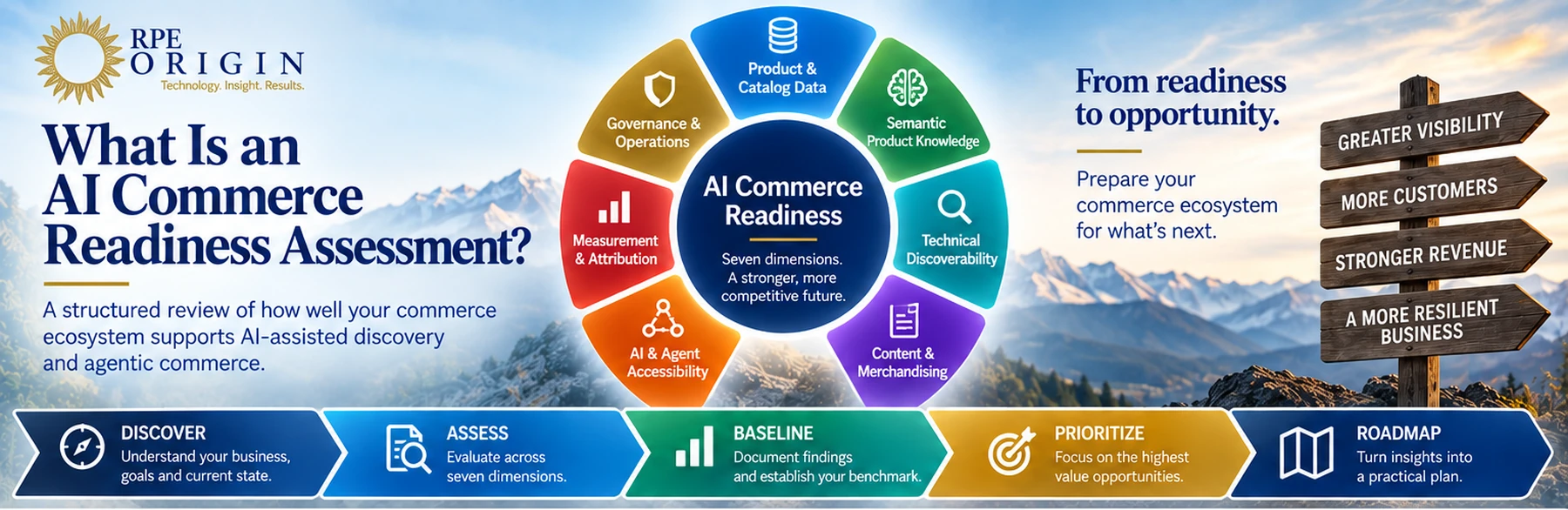
RPE Origin’s AI Commerce Readiness Assessment is a structured review of how effectively a commerce ecosystem supports AI-assisted product discovery, comparison, recommendation and emerging agentic commerce. It establishes a current-state baseline, identifies material gaps, and turns those findings into a prioritized roadmap.
Why Perform an AI Commerce Readiness Assessment?
Most organizations do not begin from zero. They already have an ecommerce platform, product feeds, structured data, analytics, content, merchandising processes and operational systems.
The difficulty is that those capabilities were usually designed for websites, search engines, marketplaces, paid media and internal operations—not specifically for AI systems that need to interpret products, customer intent, constraints and commerce actions together.
That means the most important readiness gaps are often distributed across several teams and systems.
A product may be easy to find but poorly described. A feed may be complete but semantically weak. Pricing may be accurate on the website but stale in another source. The site may have excellent content but no clear measurement of AI-assisted discovery. APIs may exist, but ownership and governance may be unclear.
The assessment creates a single view across those disconnected areas.
What the Assessment Evaluates
RPE Origin evaluates readiness across seven connected dimensions:
1. Product & Catalog Data
Whether product identity, variants, attributes, pricing, inventory and feed data are complete, accurate, consistent and current.
2. Semantic Product Knowledge
Whether machines can understand use cases, suitability, compatibility, audience, differentiators and other context beyond basic specifications.
3. Technical Discoverability
Whether important commerce information can be reliably crawled, indexed, interpreted and represented through structured data and accessible content.
4. Content & Merchandising
Whether product content answers real purchase questions, supports comparison and communicates meaningful differences between products.
5. AI & Agent Accessibility
Whether commerce data and capabilities can be exposed safely through feeds, APIs and emerging agentic-commerce integration patterns.
6. Measurement & Attribution
Whether the organization can observe AI-driven discovery, referral activity, product visibility and changes in performance over time.
7. Governance & Operational Readiness
Whether ownership, source-of-truth rules, change control, escalation and ongoing monitoring are defined.
What Evidence Does the Assessment Examine?
The assessment is evidence-based. It does not rely on a questionnaire alone or on whether teams believe a capability is mature.
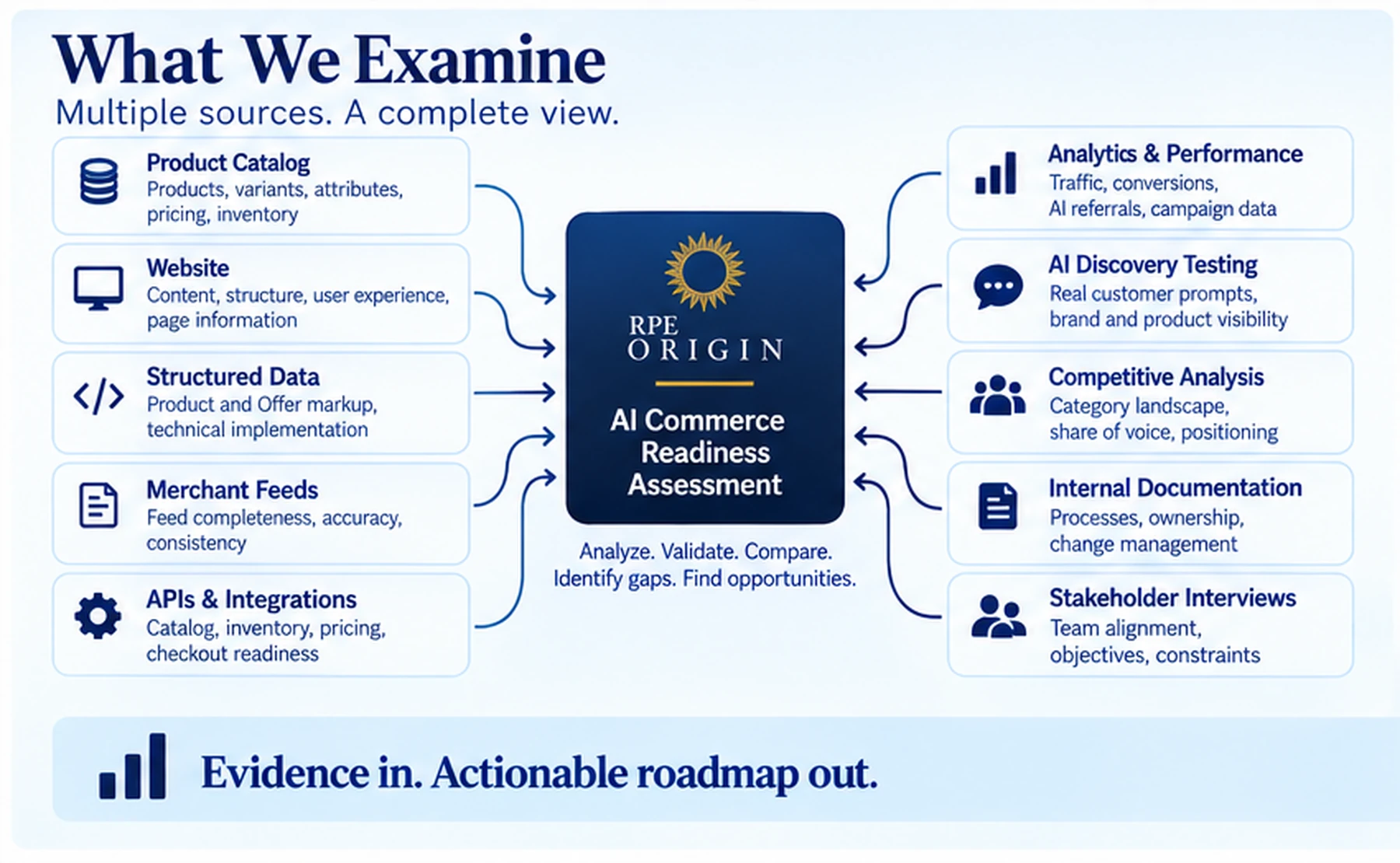
Depending on the commerce environment, evidence can include:
- Product catalog exports and product information management data
- Product pages, category pages, buying guides and supporting content
- Product and Offer structured data
- Merchant and marketplace feeds
- Pricing, inventory and fulfillment signals
- APIs and commerce integrations
- Analytics, conversion and product-performance reporting
- AI-assisted discovery tests using realistic shopper prompts
- Competitive product-discovery observations
- Internal documentation, process definitions and ownership models
- Stakeholder interviews with commerce, marketing, merchandising, engineering, analytics and governance teams
Why Current Evidence Matters
Readiness should be measured from what exists today—not from what is planned.
If a team says product data is governed, the assessment should be able to find documented ownership, standards and consistent output.
If the organization says AI discovery can be measured, there should be identifiable reporting, test scenarios or visibility data.
If the commerce platform is described as agent-ready, the assessment should be able to identify the APIs, data access, controls and integration patterns that support that conclusion.
This is what turns the exercise from strategy discussion into a usable baseline.
How the Assessment Works
Discover
Understand the business model, priority categories, major systems, strategic goals and current concerns.
Assess
Evaluate evidence across the seven readiness dimensions and test representative commerce scenarios.
Baseline
Document current-state maturity, material findings and supporting evidence.
Prioritize
Separate urgent accuracy risks from near-term improvements and longer-term strategic capabilities.
Roadmap
Translate the findings into a practical sequence of remediation and capability-building work.
What the Client Receives
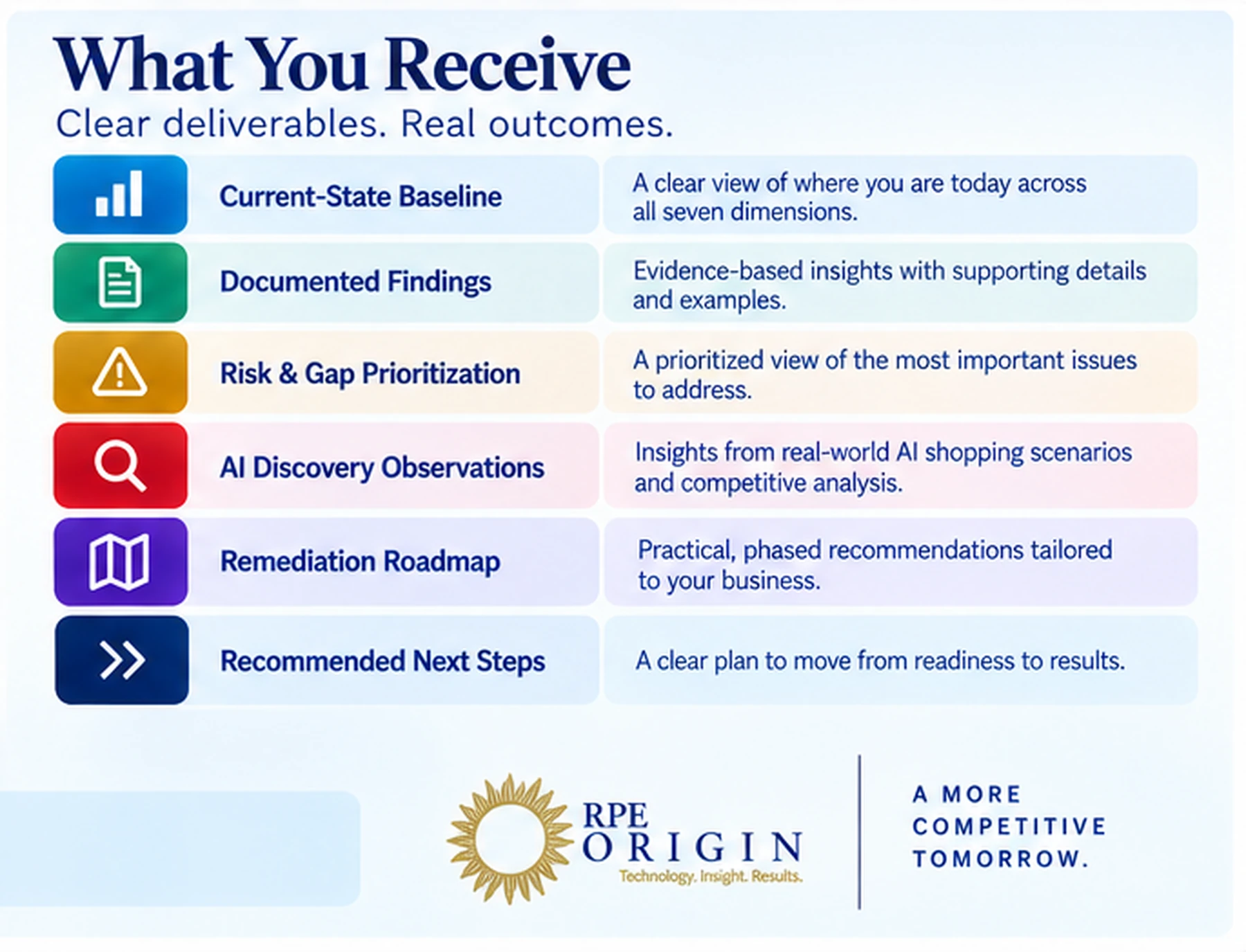
The assessment should produce something more useful than a score. RPE Origin’s objective is to provide a documented baseline and a practical roadmap.
Current-State Readiness Baseline
A clear view of current maturity across the seven readiness dimensions.
Documented Findings
Evidence-based observations describing what is working, where inconsistency exists and what limits readiness.
Risk & Gap Prioritization
A prioritized view of the issues most likely to affect accuracy, visibility, customer experience or future AI-commerce participation.
AI Discovery Observations
Findings from representative AI-shopping scenarios, including visibility, product representation, competitor context and recurring information gaps.
Remediation Roadmap
Practical recommendations sequenced by urgency, value, effort and dependency.
Recommended Next Steps
A clear plan for what the organization should correct now, strengthen next and monitor over time.
How Findings Are Prioritized
Not every gap deserves the same urgency. A useful assessment distinguishes between immediate accuracy risks, near-term readiness improvements and strategic capabilities.
Correct Now
- conflicting prices
- incorrect availability
- broken structured data
- identity or variant inconsistencies
- high-impact missing product facts
Strengthen Next
- attribute coverage
- comparison content
- semantic use cases
- AI discovery testing
- measurement improvements
- governance gaps
Build Strategically
- product knowledge architecture
- PIM modernization
- commerce APIs
- agentic-commerce integration
- advanced measurement and monitoring
What an AI Commerce Readiness Assessment Is Not
- It is not a generic AI strategy workshop.
- It is not a chatbot implementation.
- It is not simply an SEO audit.
- It is not a product-feed audit in isolation.
- It is not a pass/fail certification.
- It is not a promise that a particular AI platform will recommend a product.
The assessment evaluates the commerce foundations that influence whether products can be accurately discovered, understood, compared and represented as AI-mediated commerce evolves.
Who Should Consider an Assessment?
- Retailers with significant ecommerce revenue
- Manufacturers selling directly to consumers
- Multi-brand commerce organizations
- Organizations with large or complex product catalogs
- Commerce teams preparing for AI-assisted product discovery
- Organizations considering agentic-commerce or AI-shopping integrations
- Retailers with inconsistent product data across feeds, marketplaces and websites
- Teams that cannot yet measure how their products appear in AI-driven shopping experiences
When Is the Right Time?
An assessment is most valuable before an organization commits to a large AI-commerce implementation, when product-data issues are becoming visible, before a major commerce transformation, or when leadership needs a factual baseline for investment decisions.
It can also be used as a recurring checkpoint. AI Commerce readiness is not static: products change, data changes, platforms change and new agent capabilities appear.
Why This Matters Now
OpenAI’s current shopping experience allows users to refine needs conversationally, compare products side-by-side and receive current product information; OpenAI also uses merchant product feeds through the Agentic Commerce Protocol to improve product discovery. OpenAI product-discovery documentation This reinforces the importance of complete, current product information.
Google’s current Merchant Center AI performance reporting is available for eligible accounts and exposes conversational-shopping visibility, product attributes, shopper intent and share-of-voice information. Google AI performance insights Google is also rolling out the Universal Commerce Protocol to support programmatic commerce interactions across discovery and checkout for participating merchants. Google UCP overview
The practical implication is that commerce systems increasingly need to serve both people and intelligent intermediaries.
How Article 6 Fits the AI Commerce Series
- Article 1: Why AI Commerce matters and why seasonal readiness matters.
- Article 2: Why product data must become machine-understandable product knowledge.
- Article 3: How product discovery is moving from search results toward AI recommendations.
- Article 4: The seven dimensions that define AI Commerce readiness.
- Article 5: The practical pre-peak-season readiness checklist.
- Article 6: What RPE Origin’s professional readiness assessment actually evaluates, how it works and what the client receives.
From Questions to a Roadmap
The value of an AI Commerce Readiness Assessment is not that it tells an organization that AI is important.
The value is that it answers a more useful set of questions:
- Where are we ready today?
- Where are we relying on assumptions?
- Which gaps could affect accuracy, discovery or customer experience?
- Which improvements can be made quickly?
- Which capabilities require deeper investment?
- What should we monitor as AI Commerce evolves?
Those answers create a baseline from which the organization can act.
Request an AI Commerce Readiness Assessment
RPE Origin provides AI Commerce Readiness Assessments for retailers and commerce organizations preparing for AI-assisted product discovery and agentic commerce.
The assessment evaluates product data, product knowledge, technical discoverability, content, AI and agent accessibility, measurement, and governance. It establishes a current-state baseline, documents material gaps, and produces a prioritized roadmap for improvement.
Prepare Your Commerce Ecosystem for AI
AI-assisted product discovery is changing how consumers find, evaluate and choose products. Preparing for that shift requires more than adding AI—it requires ensuring your product data, content, technical infrastructure and measurement capabilities can support how AI systems understand and recommend what you sell.
An AI Commerce Readiness Assessment from RPE Origin establishes where you stand today, identifies the gaps that matter most and provides a prioritized roadmap for building toward AI-ready commerce.
Recent Comments