
A commerce organization can have excellent product data. It can maintain accurate identifiers, current pricing, well-modeled variants, strong inventory controls and a reliable product feed. It can also have rich semantic product knowledge: compatibility rules, use cases, buyer guidance, meaningful differentiators and carefully governed product relationships.
And still have a discoverability problem.
The issue may not be the quality of the information. The issue may be whether the systems that need that information can reliably reach it, retrieve the right version, interpret it correctly and reconcile it with the other sources describing the same product.
That is the purpose of the third dimension in RPE Origin’s AI Commerce Readiness Assessment: Technical Discoverability.
This dimension evaluates whether important commerce information can be reliably crawled, indexed, interpreted and represented through structured data and accessible content. It is where product truth meets technical delivery.
The question is no longer simply: Do we have the right information?
It becomes: Can an external system reliably find, access and understand the version of that information we intend it to use?
Good Information That Cannot Be Accessed Has Limited Value
Organizations often approach discoverability as a content problem. If a product is not being surfaced effectively, the instinct may be to add more copy, expand descriptions, create FAQs, strengthen category content or add another feed field.
Sometimes that is appropriate. But content quality is only one layer of discoverability.
A page can contain excellent product information and still be difficult for an automated system to use because crawler access is restricted, a security layer returns a challenge page, key content appears only after client-side execution, canonical signals conflict, structured data is incomplete, variant URLs are ambiguous, product images are inaccessible or the visible page disagrees with the feed.
Those conditions are easy to miss because the customer-facing experience can appear normal. A merchandising manager opens the page in a browser, sees the product, verifies the price and concludes that the information is available. A crawler may receive something materially different.
Technical Discoverability asks whether the architecture surrounding the content allows that content to participate reliably in discovery. Adding more words to the page does not solve a 403 response, a blocked image host or a structured-data implementation that exposes stale availability.
Technical Discoverability Is a Delivery Chain
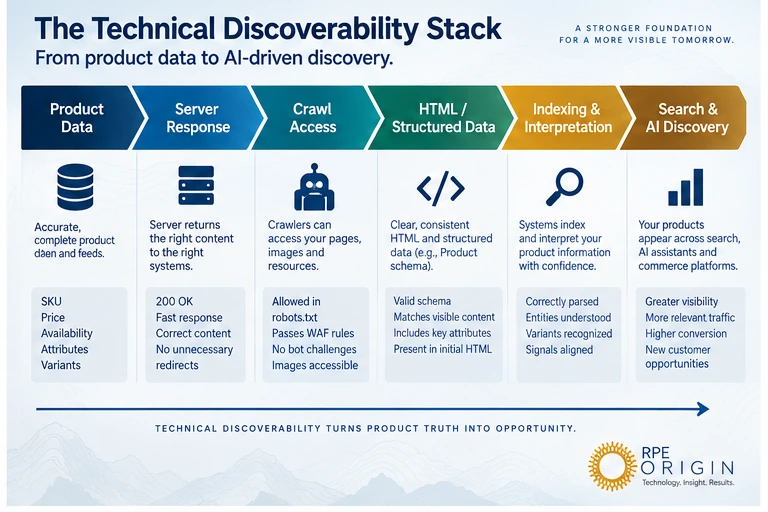
Technical discoverability is best understood as a chain rather than a single configuration setting.
The chain begins with reliable product data. The server must then return a successful response with the intended content. Legitimate crawlers need to be able to reach the page and related resources. The resulting HTML and structured data must expose the facts the organization intends to publish. Search and AI systems then need enough consistent evidence to interpret the product and connect it to discovery experiences.
A weakness at any stage can reduce the value of everything that came before it.
A perfectly maintained PIM does not help an external system if the landing page is inaccessible. A technically crawlable page does not help if price and availability are inserted late or inconsistently. Valid schema does not help if the visible page shows a different product variant. A clean product feed can still be undermined by a landing page that sends contradictory signals.
This is why RPE Origin evaluates Technical Discoverability as an end-to-end capability rather than a checklist of isolated SEO settings.
Crawlability Is the First Gate
Before a system can interpret a page, it generally needs to reach it.
Modern commerce environments frequently place several technical layers between an automated crawler and the product information it is trying to access. Those layers can include robots.txt directives, web application firewalls, CDN rules, bot-management systems, rate limits, login requirements, geo restrictions, JavaScript challenges and other security controls.
Each of those controls may exist for a legitimate reason. Retailers have to manage malicious bots, credential attacks, scraping, fraud and infrastructure abuse. The readiness question is not whether security controls should be removed. It is whether those controls distinguish appropriately between unwanted automation and legitimate discovery systems.
OpenAI’s current publisher guidance states that public websites can appear in ChatGPT search and recommends allowing OAI-SearchBot if publishers want their content to be discoverable, surfaced, cited and linked in ChatGPT search. OpenAI separately notes that firewalls, CDNs and bot-protection rules can block access even when robots.txt itself is permissive.
Google makes the same operational point in Merchant Center guidance. Google routinely crawls product landing pages and images, and states that products can be disapproved when the required crawlers cannot retrieve those resources.
The principle is simple: a product page may be perfectly useful to a human visitor and functionally unavailable to a machine.
robots.txt Is Only One Part of the Problem
When crawler access is discussed, robots.txt receives a great deal of attention. It matters, but it is only one control surface.
A site can explicitly allow a crawler in robots.txt and still return a 403 response through a WAF, a 429 response because of rate limiting, a CAPTCHA, a login screen, an empty application shell or a geo-specific error page. The configuration can look correct while the actual retrieval still fails.
That is particularly relevant for commerce teams that have hardened sites against credential abuse, card testing, aggressive scraping or automated attacks. Security teams may be applying sensible controls, but discovery systems can be affected as an unintended consequence.
A readiness assessment therefore needs to look at behavior, not merely configuration. What does the crawler actually receive? Does the URL return a successful response? Does the response contain meaningful product content? Can the product image be retrieved? Does the site require a cookie, session state or browser interaction before product facts become available?
The goal is not to make the storefront permissive. The goal is to preserve intended machine-facing access while maintaining appropriate security controls.
Structured Data Makes Product Meaning More Explicit
Crawler access answers whether a system can reach the page. Structured data helps make important facts on that page more explicit.
Google describes structured data as a standardized way to classify page content and provide machine-readable information about a product. For merchant experiences, Product and Offer markup can represent facts such as product identity, price, availability, shipping and returns.
That machine-readable representation is valuable because it reduces ambiguity. A price that appears in several visual locations on a page can be represented explicitly as an offer price. Availability can be represented as a defined value rather than inferred from a colored badge. Product identity can be tied to identifiers instead of extracted only from prose.
But structured data does not replace the visible product page. It should reinforce the same product truth.
Google’s Merchant Center requirements explicitly state that structured data must match the values shown to users. If the visible page says one thing and the structured representation says another, the organization has not improved machine understanding. It has introduced an additional conflicting source.
Structured Data Is Not a Checkbox
It is easy to reduce structured data to a binary implementation question: Do we have Product schema?
That is too shallow for an AI Commerce Readiness Assessment.
A more useful review asks whether the markup is complete enough to describe the important commerce facts, whether it matches the visible page, whether it represents the correct variant, whether price and availability are current, whether identifiers line up with the product feed and whether the markup is actually present when the crawler receives the page.
Consistency across templates also matters. A retailer can have excellent Product markup on a flagship category and weak or incomplete markup on older product templates, regional sites or special product types.
Validation should therefore be part of the operating process, not a one-time launch task. Google recommends tools such as Rich Results Test and URL Inspection to validate product markup and understand how Google sees deployed pages.
The readiness standard is not merely that schema exists. It is that structured product information is dependable.
Rendering Can Change What Machines See
Modern ecommerce sites frequently rely on JavaScript. That is not inherently a discoverability problem. The risk comes from assuming that every automated system experiences the page exactly as a shopper’s browser does.
A customer’s browser may load the initial HTML, execute JavaScript, call several APIs, determine the selected variant, inject availability, render product reviews, update the price and add structured data. By the time the person sees the page, it looks complete.
An automated system may observe a different stage of that process or apply different rendering capabilities. If critical commerce facts exist only after substantial client-side execution, the machine-facing representation can become less predictable.
Google’s current Merchant Center documentation illustrates the issue directly. For certain product-data matching workflows, Google requires structured data to be present in the HTML returned by the web server rather than generated after the page has loaded. Google Search guidance also warns that dynamically generated Product markup can make shopping crawls less frequent and less reliable, especially for fast-changing values such as price and availability.
This is not an argument against JavaScript. It is an argument for understanding which product facts exist at each stage of page delivery.
The correct diagnostic question is not: Does the page work in Chrome?
It is: What does the consuming system actually receive?
The Customer Experience and the Crawler Experience Can Diverge
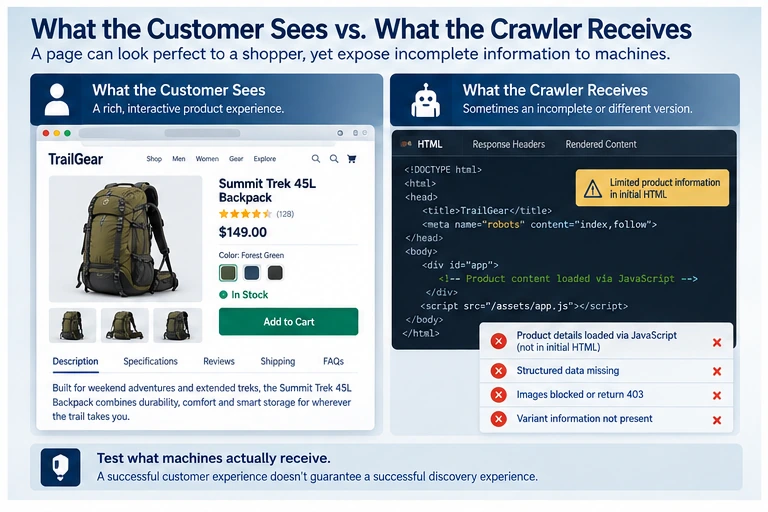
A visually correct page can hide a technically incomplete machine experience.
A shopper may see the product name, images, price, availability, color selector, reviews and an Add to Cart button. The initial response received by an automated system might contain only a document shell, a title and JavaScript references. Important product details may arrive only after additional calls, or a security rule may prevent those calls entirely.
The reverse can also happen. Structured data may contain stale or malformed values even while the visible page is correct.
That is why the assessment compares what customers see with what machines receive. It does not assume that one proves the other.
Testing those two perspectives side by side often reveals issues that are invisible in ordinary merchandising QA.
Technical Discoverability Includes Product Images
Commerce information is not limited to text and structured fields. Product imagery is also part of the machine-facing product representation.
Image URLs need to remain reachable, stable and associated with the correct products and variants. An image host can have different security controls from the primary storefront, which means a product page may be crawlable while the associated imagery returns an error.
Google’s merchant-listing guidance states that product image URLs must be crawlable and indexable. OpenAI’s current crawler guidance likewise tells product-feed participants to allow OAI-SearchBot to reach product image URLs and specifically notes that firewall, CDN or bot-protection rules returning a 403 can block processing.
This creates several possible failure modes: an image CDN rejects unfamiliar crawlers, signed URLs expire, old product image paths remain in feeds, the wrong variant image is exposed or a third-party asset host uses a different access policy.
A Technical Discoverability review therefore follows the product beyond the HTML document. The image layer is part of the evidence.
Canonicalization Matters When Products Have Multiple URLs
Commerce platforms frequently generate multiple URLs that appear to describe the same or closely related product.
A product can be reachable through category paths, search parameters, campaign links, tracking parameters, variant-specific URLs, language or regional URLs and alternate navigation structures.
That flexibility is useful for users and marketing systems, but it can create ambiguity for machine interpretation if the organization does not clearly signal which URLs represent distinct products or variants and which are alternate routes to the same resource.
Canonicalization helps establish the preferred representation, but commerce requires nuance. Some variants deserve unique URLs because price, availability, imagery or purchasable state differs. Other URL variations are simply tracking or navigation artifacts.
Google’s merchant-listing guidance supports product pages that represent multiple variants and also supports distinct variant URLs. Merchant Center separately provides canonical-link guidance for associating feed records with stable search-index URLs.
The readiness question is not whether every variant should or should not be canonicalized to a parent. It is whether URL behavior accurately reflects the product model and gives external systems a coherent identity signal.
Product Feeds and Product Pages Need to Agree
Technical Discoverability does not exist independently from Product & Catalog Data. The two dimensions meet at the landing page.
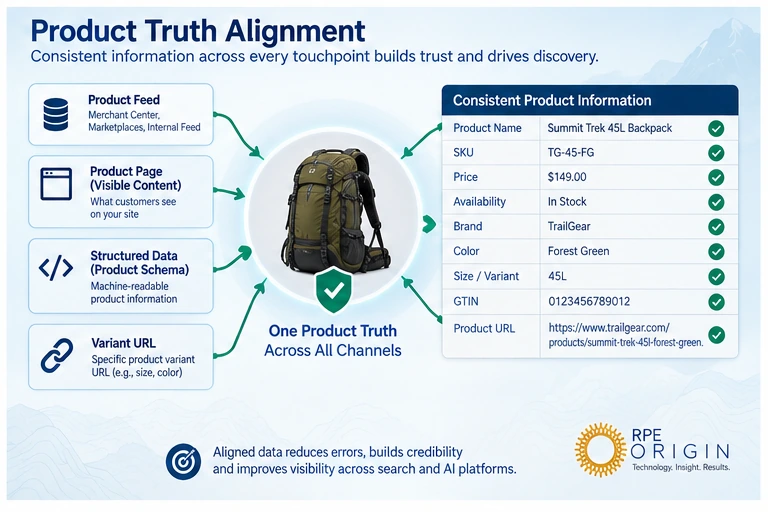
A product feed may tell a platform that a product costs $149, is in stock, uses a particular GTIN and maps to a specific landing-page URL. The landing page and its structured data should reinforce those same facts.
Google explicitly compares submitted product information with landing-page content. It also uses structured data to help understand and, in some workflows, automatically update certain values such as price and availability when mismatches occur.
Those capabilities are useful, but repeated mismatches should not be treated as routine housekeeping. They are evidence that the organization’s source systems, transformation processes or update cadences may be out of alignment.
From a readiness perspective, the question is not only whether a mismatch can be patched. It is why two machine-readable sources disagree in the first place.
Strong Technical Discoverability therefore includes product-truth alignment across the feed, visible product page, structured data and variant URL.
Redirects and Landing-Page Behavior Can Create Friction
A product URL can technically resolve and still provide a poor or ambiguous machine-facing experience.
Redirect chains add latency and create more opportunities for failure. Geo redirects can send a crawler to an unintended market. Session logic can alter the selected product state. A discontinued product may redirect to a broad category rather than explain that the item is unavailable or identify a replacement.
Google’s landing-page guidance recommends using as few redirects as possible, noting that redirects increase load time and can interfere with retrieval. Google’s current product-page troubleshooting guidance also treats redirect loops, unreachable robots.txt files, network failures and server errors as causes of crawl failure.
The issue is not that redirects are inherently bad. Redirects are a normal part of web architecture.
The readiness question is whether the redirect preserves product identity and leads external systems predictably to the intended commerce evidence.
Discoverability Should Be Tested, Not Assumed
A recurring problem in technical reviews is that organizations evaluate configuration instead of observable behavior.
The robots.txt file looks correct. The schema plugin is enabled. The sitemap exists. The CDN rule appears to allow the expected traffic. Product pages are visible in the CMS.
Those facts are useful, but none of them proves that an external system receives the intended result.
A Technical Discoverability assessment should test representative URLs and verify the actual response. That may include fetching pages, checking status codes, reviewing headers, inspecting server-returned HTML, validating structured data, checking canonical tags and indexability directives, retrieving product images, comparing feeds with landing pages and evaluating variant behavior.
Google recommends URL Inspection and Rich Results Test for exactly this type of validation: understanding not merely what the implementation intends to publish, but what Google can actually retrieve and interpret.
This reflects a broader RPE Origin principle: Score the evidence, not the ambition.
If the architecture diagram says the page is available but the crawler receives a 403 response, the 403 is the evidence.
Common Technical-Discoverability Failure Patterns
A useful assessment should identify specific failure modes rather than conclude that the organization has generic ‘SEO problems.’
Typical findings can include product pages blocked by robots directives, legitimate crawlers blocked by WAF or CDN rules, product images returning 403 responses, structured data missing on specific templates, schema values that disagree with visible content, price or availability that exists only after client-side rendering, conflicting canonicals, variant URLs mapped to the wrong product, product pages missing from sitemaps, excessive redirect chains, bot challenges, stale structured data or feed URLs that resolve to the wrong item.
These failures have different owners and different remediation paths.
A schema defect may belong to ecommerce development. A WAF problem may require security and infrastructure. Feed-to-page inconsistencies may involve merchandising, integrations and data governance. Variant URL behavior may require ecommerce architecture and SEO working together.
That cross-functional nature is precisely why Technical Discoverability belongs inside a broader readiness assessment rather than being treated as a narrow optimization task.
What Evidence Does the Assessment Examine?
A Technical Discoverability review can draw evidence from several layers of the commerce stack.
That evidence may include robots.txt, XML sitemaps, HTTP status codes, response headers, canonical tags, indexability directives, structured data, product-page HTML, variant URLs, feed landing-page mappings, redirects, image URLs, CDN behavior, WAF and bot-management behavior, JavaScript rendering patterns, Search Console evidence, Merchant Center diagnostics and structured-data validation results.
Representative products should be selected deliberately. A simple, always-in-stock product provides a useful control, but complex products often expose the real weaknesses.
A product with multiple variants, a promotional price, inventory changes, several images and category-specific attributes can reveal whether the technical architecture remains coherent as the product state becomes more complicated.
The purpose is not to crawl the entire site merely to produce a long list of warnings. The purpose is to determine whether the architecture reliably exposes the commerce evidence required for discovery and whether the observed failures are isolated exceptions or symptoms of a broader operating pattern.
Technical Discoverability Is About Reliability
There is a temptation to define discoverability as visibility: Can the product be found?
That is only part of the question.
A stronger readiness standard asks whether the product can be retrieved consistently, interpreted correctly and reconciled with the other authoritative sources that describe it.
That changes the scope. A page that is occasionally crawlable is weaker than one that is reliably accessible. Structured data that is valid on one template and broken on another is not a stable capability. A feed that points to a landing page with conflicting availability has not created dependable product truth.
Technical Discoverability is therefore less about isolated technical features and more about the reliability of the entire machine-facing commerce experience.
Accessible Does Not Automatically Mean Useful
The first three readiness dimensions now form a deliberate progression.
Product & Catalog Data establishes factual product truth.
Semantic Product Knowledge adds use cases, suitability, relationships and meaning.
Technical Discoverability determines whether those facts and that knowledge can be reached and interpreted by the systems expected to use them.
Together they support the broader RPE Origin progression: Available → Understandable → Recommendable.
But successful retrieval is not the finish line.
A system may crawl a product page successfully, identify the correct product, understand the price and availability and even infer some intended use. The next question is whether the content actually answers the practical purchase questions needed to compare alternatives and make a decision.
That leads to the fourth AI Commerce readiness dimension: Content & Merchandising.
The next question becomes: Once the product has been found and understood, does the content actually help someone choose it?
Can AI and Search Systems Reliably Reach Your Product Information?
Strong product data and product knowledge only create value when the systems that depend on them can reliably access and interpret them. Crawler restrictions, structured-data gaps, rendering behavior, conflicting URLs and infrastructure controls can all weaken discoverability without being obvious to the customer-facing team. An AI Commerce Readiness Assessment can help identify where technical barriers exist and which issues are most important to address.
Recent Comments