
A complete product catalog can tell a system a great deal. It can identify the product, distinguish its variants, provide a price, indicate availability and describe technical characteristics. Those facts establish a reliable foundation, and without them the rest of the commerce experience becomes much harder to trust.
But product specifications do not always explain the decision a customer is trying to make. A shopper may not ask, “Which drills have an 18V motor and a half-inch chuck?” They may ask, “Which drill should I buy for occasional home projects if I have never owned one before?”
Those are very different questions. The first can be answered largely through attributes. The second requires context: intended use, skill level, likely tradeoffs, compatibility, alternatives and an explanation of why one product may fit better than another.
That layer of meaning is what RPE Origin refers to as Semantic Product Knowledge. It is the second dimension of AI Commerce readiness, and it builds directly on the product truth established in the Product & Catalog Data dimension.
The objective is not to make product data more verbose. It is to make important product meaning explicit, reusable and defensible enough that people and machines can connect products to real customer needs.
Product Data and Product Knowledge Are Not the Same Thing
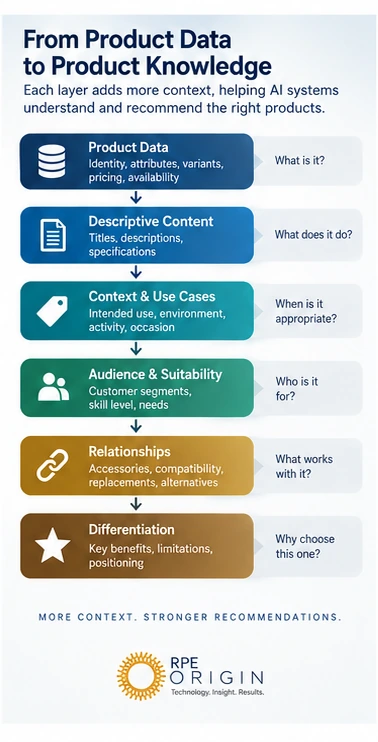
Product data establishes factual product truth. It answers questions such as what the product is, which SKU identifies it, what it costs, what size or material it is, whether it is available and which variants exist. Those facts are foundational because every higher-level interpretation depends on them being correct.
Product knowledge goes further. It explains who the product is for, what problem it solves, under what conditions it performs well, which other products it works with, where its limitations matter and why a buyer might choose it over another option. In other words, product knowledge connects facts to context.
Product Data → Product Knowledge
That transition is especially important in AI-assisted discovery because conversational requests often express needs rather than product terminology. A shopper may describe a situation, a budget, an environment, a compatibility constraint and a preference all at once. The system then has to translate those signals into product relevance.
A catalog can be complete in the traditional sense and still leave those questions unanswered. That is why semantic readiness cannot be evaluated simply by counting fields or measuring description length. The assessment must determine whether the available information carries enough meaning to support real purchase decisions.
AI-Assisted Shopping Creates More Context-Rich Questions
Traditional ecommerce search often begins with a short phrase: waterproof hiking shoes, beginner golf clubs, carry-on luggage or cordless drill. Those queries contain useful intent, but they leave much of the interpretation to the shopper. The customer opens pages, compares details and decides which products appear appropriate.
Conversational shopping can move more of that interpretation upstream. A shopper might ask for hiking shoes for wet trails, explain that they have wide feet, usually hike three to five miles and want support without the weight of a backpacking boot. That single request introduces terrain, weather, fit, usage pattern, distance and a preference about weight.
The system is no longer matching a category alone. It is evaluating suitability across multiple dimensions.
Google’s current Merchant Center guidance reflects this shift toward richer product context. Its product_detail attribute supports structured technical and descriptive information such as activity, occasion, sport, finish, theme and other product characteristics, and Google states that this information can support discovery across AI-driven surfaces such as AI Mode. Product_highlight provides a complementary mechanism for short, customer-facing benefits that answer common consumer questions.
The broader point is not that every merchant must populate every platform-specific field. It is that modern discovery increasingly benefits from product information that explains both characteristics and meaning.
Semantic Knowledge Explains Suitability
Suitability is one of the clearest examples of the difference between data and knowledge. Two products can look very similar in a specification table and still serve very different customers.
A tool designed for occasional household projects may share voltage, dimensions and many features with a model intended for frequent professional use. A suitcase can meet the same airline dimensions as another while being optimized for very different travel patterns. A monitor can share resolution and screen size with a competitor while being substantially better suited for color-critical design work.
A knowledgeable salesperson naturally translates specifications into practical guidance. They explain whether a product is appropriate for beginners, frequent users, a particular environment or a particular type of task. They may also explain when the product is not a good fit.
In many organizations, that knowledge already exists. It may be embedded in category copy, sales training, support documentation, merchandising rules or the experience of product managers. The readiness question is whether the knowledge is represented consistently enough to be discovered and reused.
This matters because suitability claims can carry real consequences. Statements such as “appropriate for outdoor use,” “designed for children,” or “recommended for commercial operation” should be supported by evidence and governed rather than casually inferred. Semantic readiness therefore combines richer product meaning with stronger discipline around how that meaning is established.
Compatibility Is Product Knowledge, Not Just a Specification
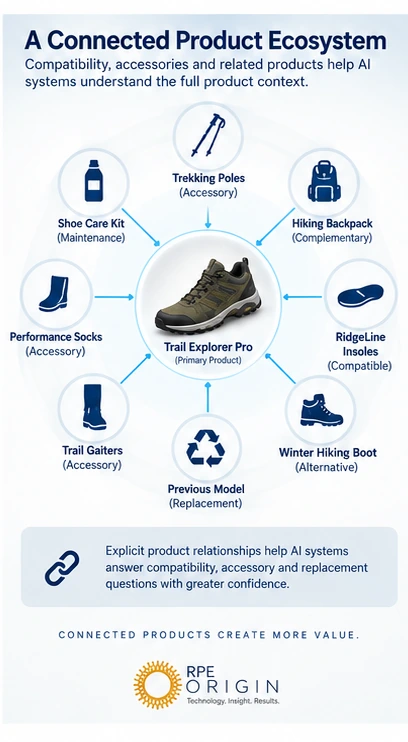
Compatibility is another area where conventional catalogs frequently stop short of what shoppers actually need. A record may contain a technical platform name or model number, but the customer usually asks a relationship question: “Will this work with the product I already own?”
That pattern appears everywhere—batteries and tools, filters and appliances, ink and printers, cases and phones, lenses and cameras, replacement parts and equipment, software and operating systems, modular furniture and accessories.
The important information is not only the attribute on the primary product. It is the explicit relationship between products.
Google’s related_product attribute is a concrete example. Google says the attribute is primarily intended for conversational experiences such as AI Mode and can identify accessories, spare parts, substitutes and other related products. That makes the underlying principle particularly clear: product relationships are becoming first-class discovery information.
An AI Commerce readiness assessment therefore looks for more than a compatibility statement on a page. It examines whether the organization has a repeatable way to represent compatibility, required parts, replacements and alternatives, and whether those relationships stay current as catalogs change.
When that knowledge lives only in a PDF, a call-center lookup table or the memory of an experienced employee, it may be valuable internally but weak as machine-accessible product knowledge.
Audience Matters
Products are often designed for identifiable audiences even when the catalog does not formally represent those audiences. A running shoe may be positioned for beginners, high-mileage runners, trail runners or customers seeking additional stability. A software package may be intended for small businesses, developers, marketers or regulated enterprises. Luggage may be designed around business travel, weekend trips, families or frequent flyers.
Those distinctions matter because shoppers often describe themselves before they describe a product. “I am a beginner.” “I travel every week.” “I need this for a small apartment.” “I am buying for an eight-year-old.”
If audience knowledge is present only as lifestyle language, campaign creative or internal merchandising intuition, an external system may have difficulty using it consistently. Semantic product knowledge makes those audience relationships clearer and connects them to the product facts that support the claim.
The key is specificity. Broad labels such as “for everyone” add little value. Useful audience knowledge identifies the needs, constraints or usage patterns that make the product appropriate. That turns a merchandising concept into evidence that can participate in discovery.
Differentiation Needs to Be Explicit
Commerce organizations rarely sell only one solution to a need. They usually offer a range of products with overlapping features, price points and target customers. The challenge is explaining why those choices are meaningfully different.
Consider three coffee makers from the same brand. All three may brew coffee, use similar materials and occupy roughly the same amount of counter space. Yet a buyer may care about very different distinctions: easiest to clean, best for a small kitchen, supports both pods and ground coffee, fastest brew cycle or best for serving several people.
If those differentiators are not explicit, comparison becomes harder for both shoppers and automated systems. A product page may describe each item individually without ever stating the decision logic that separates them.
Google’s product_highlight guidance illustrates a useful distinction. Google recommends product highlights for meaningful product benefits and product_detail for technical, verifiable data. That separation mirrors a practical knowledge model: specifications explain characteristics; semantic knowledge explains significance.
A readiness assessment therefore looks for the rationale behind adjacent products. Can the organization explain why Product A exists alongside Product B? Are the benefits, limitations and intended situations represented consistently? Can those distinctions be supported by evidence rather than generic marketing language?
Product Knowledge Often Exists—Just Not in the Catalog
Many organizations already possess more product knowledge than their primary catalog reveals. It may live in buying guides, FAQs, installation manuals, comparison charts, customer-service scripts, support tickets, training materials, reviews, merchandising rules and the experience of product teams.
That is encouraging because semantic readiness is not always a content-creation problem. Sometimes it is a knowledge-recovery and knowledge-organization problem.
A customer-service team may answer the same compatibility question every day. A product manager may know precisely which model is appropriate for a beginner. A merchandising team may have a well-understood replacement path when an older item is discontinued. Those answers are valuable assets.
The difficulty is fragmentation. If the answer exists only in one support document or the experience of one team, it cannot reliably participate across search, onsite merchandising, marketplace syndication, conversational AI and other discovery surfaces.
The assessment therefore asks two related questions: Does the organization know the answer? And is that answer represented as governed, accessible evidence?
The second question is what turns organizational knowledge into reusable product knowledge.
What Semantic-Knowledge Gaps Look Like in Practice
A useful assessment should identify specific knowledge failures rather than concluding that product content is simply “thin.” That diagnosis is too broad to support remediation.
A stronger finding might show that intended use is clear for one product family but absent from another. It might identify compatibility rules buried in installation PDFs, audience information implied through imagery but never stated explicitly, or meaningful differences between adjacent models that cannot be reconstructed from the product records.
Other findings may include limitations documented only in support content, inconsistent category terminology, accessory relationships that stop at the primary catalog, replacement-product logic maintained manually, or internal merchandising rules that never reach customer-facing content.
Each of those gaps affects a different type of shopper question, and each has a different remediation path. A compatibility gap may require relationship data. A differentiation gap may require comparison content. An audience gap may require structured attributes plus clearer copy. A governance gap may require ownership and approval rules before any content is changed.
Score the evidence, not the ambition.
That principle matters here because semantic product knowledge can easily become subjective. The objective is not to generate as many claims as possible. It is to document the product context that can be supported, governed and maintained.
What Evidence Does the Assessment Examine?
For Semantic Product Knowledge, the evidence set expands beyond the core product feed. An assessment may review structured attributes, descriptions, category pages, buying guides, FAQs, comparison content, manuals, compatibility documentation, support material, merchandising rules, related-product data, replacement logic and representative customer questions.
The assessment then connects those artifacts rather than treating each one in isolation. A compatibility statement on a support page may be accurate, but does the same relationship exist in the product data? A buying guide may explain which model fits a beginner, but is that suitability reflected anywhere else? A replacement rule may be clear internally, but is it exposed to the channels customers use?
Representative scenarios are especially useful. Rather than asking only whether product knowledge exists, the assessment can ask whether the available evidence is sufficient to answer real commerce questions: Which stroller works with this car seat? Which monitor is best for color-critical design? Which filter fits this refrigerator model? Which drill makes sense for an occasional home user?
These are knowledge tests. They reveal whether the organization has enough explicit evidence to connect factual product truth to customer context.
The goal is not to prove that every possible question can be answered. It is to establish where knowledge is strong, where it is fragmented, and which gaps materially limit discovery or recommendation quality.
The Gap Between Content and Knowledge
One of the easiest mistakes to make is assuming that more copy automatically produces better product knowledge. It does not.
A thousand-word product description can still fail to answer the questions a customer actually asks. Generic statements such as “designed for modern living” or “delivers exceptional performance” may sound polished, but they provide little evidence about use, audience, compatibility or differentiation.
Useful semantic content is more concrete. It states that a compact appliance is designed for small kitchens, that a removable reservoir can be filled without moving the unit, that a product requires a particular accessory, or that a material is suitable for a defined environment.
The difference is information density, not word count.
That distinction is important for AI Commerce because models are capable of interpreting prose, but they cannot reliably recover facts that were never expressed. More language does not compensate for missing product truth.
The better editorial question is therefore: Does this content introduce facts, relationships or constraints that help another system understand when the product is relevant?
Semantic Knowledge Should Be Structured Where Possible
Not every piece of product meaning belongs in a database field. Some explanations are naturally better suited to prose, comparison content, FAQs or buyer guidance. The goal is not to force every nuance into a rigid schema.
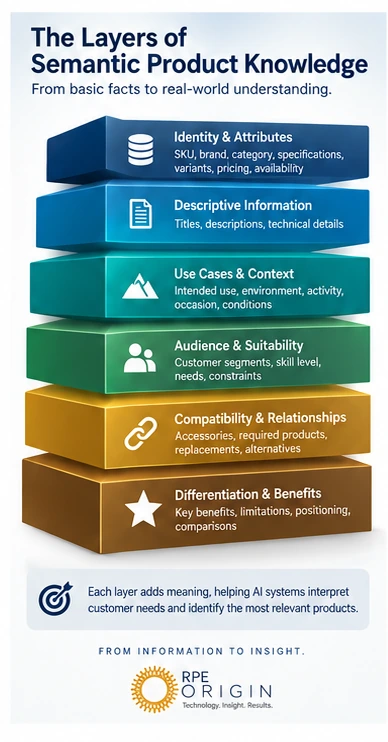
But important, repeatable relationships should be structured where practical. Intended use, audience, activity, compatibility, required accessories, replacements, product relationships, limitations and meaningful benefits can often be represented more consistently when they are modeled explicitly.
Google’s current Merchant Center specification includes product_detail, product_highlight, question_and_answer and related_product attributes that illustrate this direction. OpenAI’s Agentic Commerce product-feed specification likewise relies on structured catalog data to help ChatGPT index products, understand core attributes and surface accurate product information.
Those platform schemas will continue to evolve. The more durable objective is to create an internal knowledge model that can support multiple channels rather than encoding product meaning separately for each destination.
That approach reduces duplication, makes governance clearer and allows the same trusted knowledge to support ecommerce search, merchandising, customer service, marketplace content and future AI integrations.
The Knowledge Model Has to Be Governed
As organizations enrich semantic product knowledge, governance becomes more important rather than less. A SKU and a price are usually straightforward facts. Claims about suitability, audience, compatibility or recommended use can carry more ambiguity and more risk.
Who decides that a product is “best for beginners”? What evidence supports an outdoor-use claim? Who owns a compatibility relationship when one product is revised? What happens when a new model replaces an older one? Which teams approve limitations or warnings?
Without clear answers, semantic enrichment can create a new inconsistency problem. Different teams may publish different interpretations, automated content-generation systems may amplify unsupported claims, and downstream channels may repeat outdated relationships.
Reliable AI recommendations start with governed product truth.
Governance therefore includes provenance, ownership, validation, approved terminology, update processes and a way to resolve conflicts. The organization should be able to explain not only what a semantic claim says, but where it came from and how it will be maintained.
This becomes especially important as product knowledge is reused across more channels. A single inaccurate relationship can otherwise propagate quickly.
Product Knowledge Improves More Than AI Discovery
The value of semantic product knowledge extends well beyond AI-assisted shopping. Better context can improve onsite search, faceted navigation, merchandising, comparison tools, recommendation systems, personalization, customer service, marketplace content, sales enablement and product-content generation.
That broader value matters when prioritizing remediation. An organization does not have to justify every improvement solely on the basis of future AI traffic. A clearer compatibility model can reduce support burden today. Better audience and suitability data can improve merchandising now. Stronger differentiation can help product pages and comparison experiences immediately.
AI Commerce adds urgency because external systems increasingly participate in interpretation and recommendation, but the underlying work strengthens the commerce information architecture as a whole.
This is why Semantic Product Knowledge should be treated as a reusable capability rather than a one-time AI optimization project.
From Understanding Products to Making Them Discoverable
Product & Catalog Data establishes factual product truth. Semantic Product Knowledge adds meaning around use, audience, suitability, compatibility and differentiation.
Together, they move an organization farther along the readiness progression:
Available → Understandable → Recommendable
But even excellent product knowledge has limited value if the systems that need it cannot reliably find, crawl, render or interpret it. A retailer may have strong compatibility information, excellent buyer guidance and well-governed product relationships while still placing that information behind technical barriers or representing it inconsistently across URLs and structured data.
That leads to the third AI Commerce readiness dimension: Technical Discoverability.
The next question is no longer simply, “Do we have the right product knowledge?” It is, “Can the systems that need it reliably find and interpret it?”
Does Your Product Knowledge Explain Why a Product Is the Right Fit?
Specifications tell part of the story. If use cases, suitability, compatibility, audience and product differences are unclear or scattered across systems, AI-assisted discovery may have difficulty connecting the right product to the right customer need. An AI Commerce Readiness Assessment can help identify where product knowledge is strong, where important context is missing and which gaps should be addressed first.
Recent Comments