
Improving AI Commerce readiness creates an obvious follow-up question: How will you know whether the work is making a difference?
A retailer may improve product data, enrich semantic product knowledge, remove technical barriers, strengthen merchandising and expose new AI-facing capabilities. Those changes may all be valuable, but without a measurement model the organization can still struggle to answer basic questions.
Are products appearing more often in AI-assisted shopping experiences? Which products are being surfaced? What kinds of customer needs are associated with those appearances? Are AI systems sending measurable traffic? What happens after that traffic arrives? Are those interactions contributing to revenue? Which improvements appear to correlate with stronger visibility?
That is the purpose of the sixth dimension in RPE Origin’s AI Commerce Readiness Assessment: Measurement & Attribution.
This dimension evaluates whether the organization can observe AI-driven discovery, referral activity, product visibility and changes in performance over time.
The central question is not simply: Can we attribute every sale to AI?
A more useful question is: Do we have enough evidence to understand how AI-assisted discovery is influencing the commerce journey?
AI Commerce Creates a New Measurement Layer
Traditional digital commerce has spent years building measurement around relatively familiar channels: paid search, organic search, email, social, affiliates, display, marketplaces and direct traffic.
Those channels typically provide some combination of impressions, clicks, sessions, conversions and revenue. The definitions are not always perfect, but the measurement models are mature enough that most organizations have established reporting conventions.
AI-assisted discovery introduces a less uniform environment.
A shopper may spend several minutes interacting with an AI system before ever reaching the merchant’s site. The AI experience may surface products, summarize features, compare alternatives, answer objections, narrow the consideration set, recommend a retailer or participate in checkout.
Some of those interactions occur entirely outside the merchant’s analytics stack.
That means AI Commerce measurement cannot rely on website analytics alone. The organization needs to combine platform-level visibility signals with referral, onsite engagement and transaction data where those signals are available.
Visibility Comes Before Traffic
One of the most important distinctions in AI Commerce measurement is between being surfaced and receiving a click.
A product can appear in an AI-generated comparison or recommendation without generating site traffic. That appearance still matters because the product participated in the shopper’s consideration set.
Traditional web analytics cannot see that event unless the platform exposes it.
Google’s current Merchant Center AI performance insights provide an example of this emerging visibility layer. Google says the report shows how brands and products are discovered across conversational shopping experiences in AI Mode and AI Overviews. Current metrics include share of voice, frequency and the number of products showing for top terms, attributes and search intents.
The report also groups conversational activity into stages such as discovery, evaluation and ready to buy, giving merchants a way to see how visibility changes across different parts of the shopping journey.
That is a materially different measurement model from normal referral reporting. It begins with the question: Was the product represented?
Referral Traffic Is Measurable—When the Platform Exposes It
Some AI-assisted discovery does result in a website visit, and that traffic should be identifiable where the platform provides a usable source signal.
OpenAI currently states that ChatGPT search referral URLs automatically include the UTM parameter utm_source=chatgpt.com. That gives publishers and merchants a practical way to isolate at least some inbound ChatGPT search traffic in analytics platforms such as Google Analytics.
Once that source is preserved, the merchant can examine the same downstream behaviors it would for other acquisition sources: landing pages, product views, engagement, add-to-cart activity, checkout starts, transactions and revenue.
But this creates another important distinction.
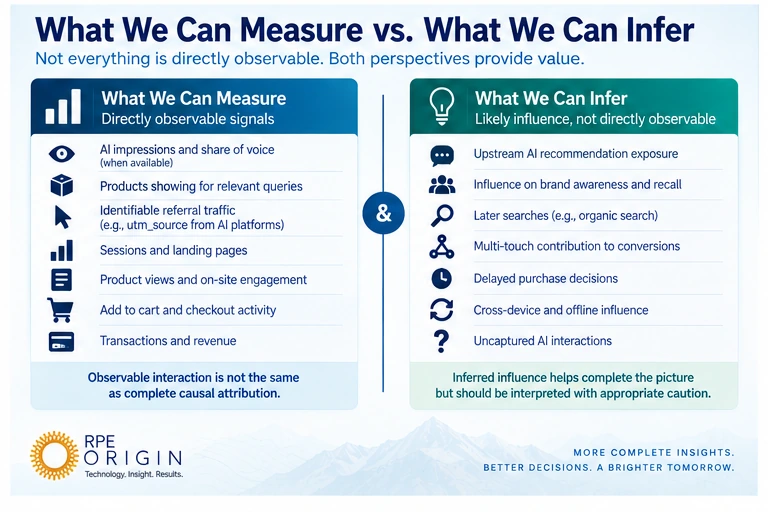
Referral measurement captures interactions that generate an observable referral. It does not capture every AI interaction that may have influenced a decision.
Attribution Will Be Incomplete
Consider a shopper who asks an AI assistant for product recommendations, compares several options, remembers a brand name, searches for that brand later, visits the merchant through organic search and purchases two days afterward.
The AI interaction may have materially influenced the decision.
Traditional attribution may credit organic search.
Neither result is necessarily wrong. They are measuring different observable portions of the journey.
This is why AI Commerce measurement needs to distinguish between observable interaction and complete causal attribution.
The first can often be measured directly. The second may remain partially unobservable.
That does not make measurement useless. It simply means the organization should resist the temptation to turn incomplete evidence into false precision.
Last-Click Attribution Is Not Enough
Last-click attribution has always had limitations. AI-assisted discovery makes those limitations more visible because the AI interaction may occur well before the final visit or transaction.
If an AI assistant participates in the research and comparison process but another channel produces the last click, a last-click model may assign no value to AI at all.
That does not mean conversion metrics should be abandoned. It means they should be interpreted alongside earlier signals.
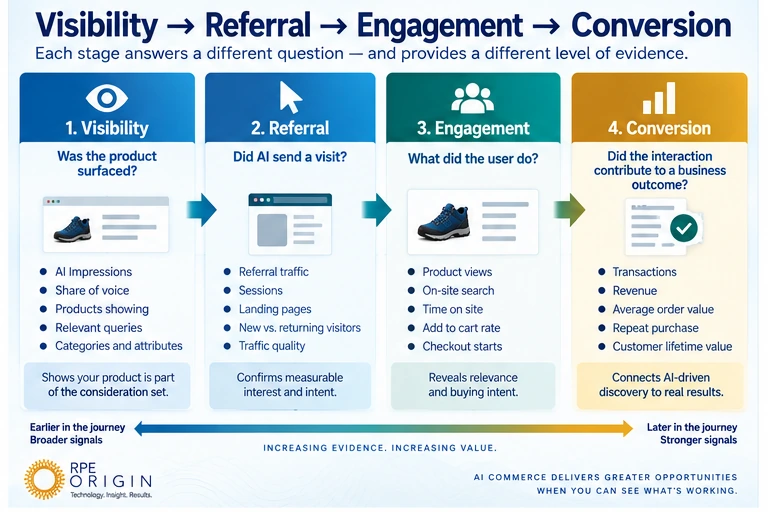
A more useful model evaluates several stages: Visibility → Referral → Engagement → Conversion.
Each stage answers a different question.
Visibility asks whether the product entered the consideration set. Referral asks whether the AI interaction produced a measurable visit. Engagement asks what the shopper did after arriving. Conversion asks whether the journey produced a business outcome.
Together, those signals provide a more useful picture than a single attribution number.
Visibility Measures Whether the Product Enters Consideration
Visibility metrics help answer whether products are being represented in AI-assisted discovery at all.
Depending on the platform, useful signals may include AI impressions, share of voice, products showing, query frequency, product-category visibility, popular attributes and search intents.
Google’s current AI performance insights expose several of these signals. Its share-of-voice metric compares a merchant’s AI impressions with impressions across the merchant and its defined competitor set for related queries. The report also includes frequency and products-showing metrics, along with top terms, popular attributes and top search intents.
These are not conversion metrics. They are evidence about product representation.
That evidence is valuable because a product cannot earn downstream referral or conversion activity if it is rarely or never entering the AI-assisted consideration set.
Referral Measures Whether Discovery Produces Traffic
Referral measurement asks a narrower question: Did the AI interaction produce a visit we can identify?
For ChatGPT search, the current utm_source=chatgpt.com parameter gives organizations a practical source signal.
Other AI platforms may expose different referral identifiers, reporting surfaces or no usable referral signal at all.
The durable capability is therefore not a dashboard hard-coded to one referrer name. It is a process for identifying known AI-origin traffic, preserving source information, classifying it consistently and updating the classification model as new platforms or referral patterns emerge.
If those visits are allowed to fall into generic referral or direct traffic, the downstream analysis becomes much less useful.
Engagement Shows What Happens After the Referral
A referral by itself says very little about traffic quality.
A shopper may arrive on a product page and leave immediately. Another may view several products, use onsite search, compare options, add an item to cart and return later to purchase.
Those behaviors help distinguish visibility from meaningful interest.
A readiness assessment should therefore examine whether AI-origin traffic can be analyzed through the same engagement framework used for other acquisition sources.
Useful measures may include product views, category exploration, onsite search usage, time on site, add-to-cart rate, checkout starts and returning-user behavior.
The question is not only: How many AI sessions did we receive?
It is: What did those visitors do once they arrived?
Conversion Still Matters
Ultimately, commerce organizations need to understand business outcomes.
Where observable, AI-referred traffic should be connected to familiar metrics such as transactions, revenue, average order value, repeat purchase, customer lifetime value and assisted conversion.
But those metrics need careful interpretation.
Early AI-assisted traffic may be small. Sample sizes may be unstable. Referral patterns may change quickly. Some AI experiences may keep more of the shopping journey inside the external platform rather than on the merchant’s site.
The right objective is not to overstate precision.
It is to establish a baseline, monitor directional change and understand whether AI-assisted discovery is beginning to contribute meaningful commercial activity.
Measurement Should Start Before Optimization
Organizations often begin measuring after they make changes.
That makes it difficult to determine whether performance actually improved.
An AI Commerce Readiness Assessment should establish the current state before remediation begins. That baseline may include current AI referral volume, known landing pages, platform visibility, product categories appearing, engagement rates, transaction activity and known reporting gaps.
Once product data, content, discoverability or access improvements are implemented, the same measures can be reviewed again.
That creates a defensible before-and-after comparison.
Without a baseline, improvement can easily become anecdotal. With a baseline, the organization can distinguish a real directional change from a general impression that performance ‘seems better.’
Measurement Can Reveal Readiness Gaps
Measurement is not only an outcome function. It is also a diagnostic tool.
Google’s current AI performance insights make that especially clear because the report can show popular product terms, attributes and search intents associated with conversational shopping activity.
Suppose shoppers frequently look for waterproof hiking shoes for wide feet, but the retailer’s product data does not consistently represent width. The measurement signal points directly back to a product-data gap.
Or suppose a product category has strong AI visibility but weak engagement after referral. That pattern may indicate a landing-page mismatch, weak content, unclear merchandising, stale pricing or limited inventory.
Measurement can therefore feed remediation rather than simply report on it.
In a mature readiness program, analytics should help determine what gets improved next.
Platform Metrics Need Clear Definitions
Another readiness issue is metric governance.
A metric called AI impressions on one platform may not mean exactly the same thing as a visibility event somewhere else. A share-of-voice metric may depend on a platform-defined competitor set. A referral may capture only a subset of AI-assisted journeys.
Organizations should document each metric’s source, definition, scope, update cadence and known limitations.
Google, for example, currently defines AI share of voice using AI impressions for the merchant relative to impressions across the merchant and its defined competitor set for related queries. Its AI performance report currently focuses on organic AI traffic rather than paid Ads traffic, and its historical data is updated daily with a short lag.
Those details matter because a metric without a definition is easy to misuse.
Measurement readiness therefore includes not only collecting signals, but also governing what those signals actually mean.
Reporting Will Continue to Change
AI Commerce reporting is evolving quickly.
Google introduced AI performance insights in 2026 and has continued changing Merchant Center performance reporting more broadly. In August 2026, Google announced reporting-definition changes designed to improve consistency across Merchant Center, Google Ads and YouTube.
That evolution should be expected.
Organizations should avoid hard-coding the measurement strategy around today’s exact interface or metric layout.
The durable capability is the ability to ingest new signals, classify them, preserve historical context, document definition changes and update reporting logic without losing continuity.
The platform interface will change. The measurement discipline needs to survive the change.
AI Measurement Should Connect to Product-Level Data
Aggregate AI traffic is useful. Product-level measurement is much more actionable.
If an organization can determine which products are being surfaced, which products receive AI-origin traffic, which categories are underrepresented, which attributes correlate with visibility and which products convert after AI referrals, the measurement function can directly inform remediation.
This matters because AI Commerce readiness is rarely uniform across an entire catalog.
One category may have rich attributes, strong content and excellent availability. Another may be technically discoverable but lack useful comparison information. A third may have strong product pages but unstable identifiers.
An organization-level average can hide those differences.
Product-level analysis makes it possible to connect performance signals back to specific readiness gaps.
The Data Model Needs Stable Product Identity
This is another reason Product & Catalog Data sits at the beginning of the readiness framework.
Measurement becomes much harder when product identity is inconsistent across systems.
If one system uses a SKU, another uses an internal product ID, Merchant Center uses a different identifier and analytics captures only URL paths, reconciling product performance becomes unnecessarily difficult.
Stable identifiers make it possible to connect the measurement chain: product feed → AI visibility → referral → onsite behavior → transaction.
Without that continuity, the organization may have all of the individual data points and still be unable to assemble a reliable product-level view.
Attribution Should Be Used for Decisions, Not False Precision
There is a natural temptation to reduce the measurement problem to a single number: AI generated a specific amount of revenue.
Sometimes that statement will be defensible.
Sometimes it will not.
A stronger measurement discipline is comfortable describing different levels of evidence separately. Direct ChatGPT referrals may have generated a known number of sessions and transactions. Merchant Center may report a change in AI share of voice for a category. Product visibility may improve after attribute remediation. Assisted-conversion analysis may suggest additional influence. Some upstream interactions may remain unobservable.
That is not a weakness in the analysis. It is a more accurate representation of what the evidence can support.
The objective is not mathematical certainty. It is better decision evidence.
What Measurement & Attribution Gaps Look Like in Practice
A readiness assessment may identify gaps such as ChatGPT referrals being grouped into generic referral traffic, AI-related source parameters not being preserved, no AI-specific reporting, product identifiers that cannot be reconciled between analytics and feeds, Merchant Center AI insights that are not reviewed or a complete absence of baseline measurement before remediation begins.
Other findings may include site-level reporting that hides category differences, AI-origin traffic that cannot be connected to product-level engagement, attribution that relies exclusively on last click, undocumented metric definitions, platform reporting changes that are not tracked or performance data that never feeds back into product-data and content remediation.
Those findings are actionable.
Some require analytics configuration. Some require data engineering. Some require BI work. Some require identifier cleanup or reporting governance.
Measurement readiness is therefore as much an operating discipline as it is an analytics implementation.
What Evidence Does the Assessment Examine?
For Measurement & Attribution, the evidence may include GA4 acquisition reports, referral-source classifications, campaign parameters, landing-page reports, product-level ecommerce events, Merchant Center analytics, AI performance insights, Search Console, product identifiers, transaction data, attribution settings, BI reports, reporting documentation and historical baselines.
The assessment can then test whether a practical measurement chain exists.
Can ChatGPT referral sessions be isolated? Can those sessions be tied to specific product views? Can platform visibility be compared across time periods? Can products identified in Merchant Center be reconciled with ecommerce analytics? Can readiness measures be compared before and after remediation?
If the answer is no, the organization may still possess useful data. It does not yet have a reliable measurement framework.
The purpose of the assessment is to identify where the chain breaks and what has to be connected to make the evidence usable.
Measurement Is About Learning, Not Just Reporting
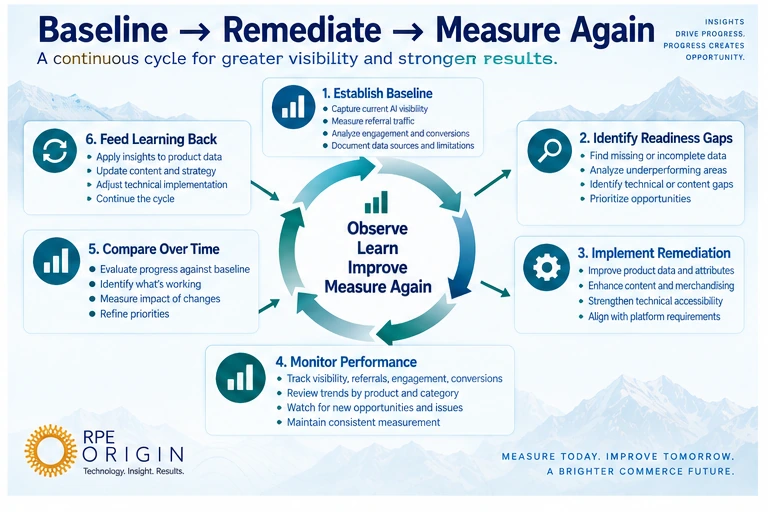
The strongest measurement programs create a feedback loop rather than a static dashboard.
Observe → Learn → Improve → Measure Again.
That loop matters because AI Commerce readiness is not static. Customer language changes. Platform capabilities change. Product assortments change. New attributes become important. Different categories gain or lose visibility.
Measurement helps the organization respond to those changes based on evidence rather than assumption.
A visibility gap can trigger product-data remediation. Weak engagement can trigger content review. Strong referral traffic with low availability can trigger inventory analysis. A changing query pattern can influence category strategy.
Measurement becomes most valuable when it informs what the organization does next.
From Measurement to Governance
At this point, the readiness framework includes six dimensions.
Product & Catalog Data establishes product truth.
Semantic Product Knowledge adds meaning.
Technical Discoverability makes that information reachable.
Content & Merchandising supports product choice.
AI & Agent Accessibility enables controlled interaction.
Measurement & Attribution shows what is happening.
One final question remains: Who owns the system once all of these capabilities are in motion?
Who monitors quality? Who resolves conflicts? Who approves changes? Who responds when AI-facing information is wrong? Who maintains the baseline and determines what gets fixed next?
That leads to the seventh readiness dimension: Governance & Operational Readiness.
Can You Measure Whether AI Commerce Readiness Is Improving?
AI-assisted discovery creates new signals across visibility, referrals, engagement and transactions. If those signals are fragmented, inconsistently defined or disconnected from product-level data, it becomes difficult to know which improvements are working. An AI Commerce Readiness Assessment can help establish a measurement baseline, identify reporting gaps and define the signals needed to monitor progress over time.
Recent Comments