
A product can be technically discoverable and still be difficult to recommend.
The page may be crawlable. The structured data may be valid. The price may be current. Product attributes may be complete. The organization may even have strong semantic product knowledge around compatibility, intended use, audience and product relationships.
But when a shopper asks, “Which of these products should I choose?” the answer depends on something more.
It depends on whether the commerce experience explains the decision.
That is the purpose of the fourth dimension in RPE Origin’s AI Commerce Readiness Assessment: Content & Merchandising.
This dimension evaluates whether product content answers real purchase questions, supports comparison and communicates meaningful differences between products. It also examines whether the merchandising system gives shoppers—and the systems assisting them—enough context to understand alternatives, tradeoffs and fit.
The underlying question is: Once a product has been found and understood, does the available content provide enough evidence to help someone choose it?
Product Content Has to Support a Decision, Not Just Describe an Item
Traditional ecommerce content has often been organized around the product detail page. A title identifies the item. A description provides an overview. Specifications list attributes. Images show the product. Reviews provide social proof. That model remains important, but it does not always explain the decision a shopper is trying to make.
AI-assisted discovery places more emphasis on decision context. A shopper may ask which model is best for a small apartment, whether the premium version is worth the price difference, which option is easiest for a beginner, what works with something they already own, or what tradeoffs exist between two similar products.
Those questions are not answered by identity alone. They require the commerce experience to explain why product differences matter.
That is where merchandising becomes part of AI Commerce readiness. Merchandising is not just presentation or placement. It is the discipline of organizing product information so that a buyer can understand relevance, compare alternatives and make a confident decision.
Specifications Are Necessary, but They Rarely Tell the Whole Story
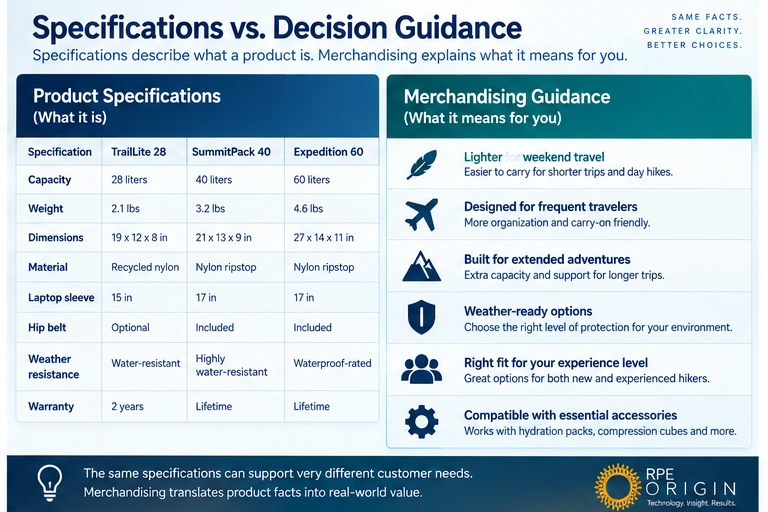
Product specifications are essential because they establish facts that can be compared objectively: dimensions, capacity, materials, weight, performance, compatibility, included accessories, warranty and technical characteristics.
But customers do not always know how to translate those specifications into practical consequences.
Consider two carry-on bags. One weighs 6.2 pounds and the other weighs 7.8 pounds. The factual difference is obvious. The decision significance is not.
A frequent business traveler may care because the lighter bag leaves more room under an airline weight limit. Another shopper may prefer the heavier bag because it includes a reinforced frame, additional organization or more protective construction. The specification creates the evidence; the merchandising content explains what that evidence means.
The same pattern appears in electronics, tools, appliances, furniture, apparel and nearly every other category. A processor speed, material thickness, battery capacity or fabric construction may be meaningful to an expert while remaining abstract to a typical buyer.
Good content closes that gap. It translates technical facts into decision context without replacing or distorting the facts underneath.
Product Highlights Should Answer Real Customer Questions
Current Google Merchant Center guidance reflects this distinction directly. Google’s product_highlight attribute is intended for short, easily consumed product benefits that answer common consumer questions or emphasize important attributes. Google recommends using product highlights for selling benefits while reserving product_detail for technical, verifiable information.
Google also states that product highlights can help shoppers discover product information across AI-driven surfaces such as AI Mode in Search. That matters because it reinforces a broader principle: machine-facing commerce information is moving beyond raw specifications toward concise representations of why a product matters to a customer.
A specification might say “Battery life: 12 hours.” A useful product highlight might explain that the device can run through a typical workday without recharging. The second statement does not replace the factual specification. It gives the shopper practical context.
For AI Commerce readiness, the important question is whether the organization consistently translates product facts into customer-relevant benefits without exaggerating, inventing or obscuring the underlying evidence.
Good Merchandising Makes Differences Explicit
Many catalogs contain multiple products that appear nearly identical unless someone already understands the assortment.
A manufacturer may offer base, standard, premium and professional versions of the same core product. A retailer may stock several brands within a narrow price range. A category may contain dozens of items with overlapping features and nearly identical product descriptions.
Internal teams often understand those differences because they work with the assortment every day. They know which model is the entry point, which version adds meaningful capability and which product is intended for heavier use.
The customer does not automatically know that. Neither does an external AI system unless the differences are represented clearly.
Useful merchandising content makes distinctions explicit: best for occasional use, better for large spaces, designed for portability, includes features sold separately on another model, supports a broader compatibility range, or provides a material durability advantage.
Without that context, an AI system may be able to list differences but still lack enough evidence to explain why one product is more appropriate for a particular need.
Comparison Content Is Increasingly Important
Comparison has always been part of ecommerce, but AI-assisted shopping makes it more central because conversational systems can be asked to compare multiple products in a single interaction.
A shopper may present three products and ask which is best for a particular use case. At that point, the system needs more than a collection of specification rows. It needs enough context to understand the practical implications of those differences.
A good comparison table should therefore do more than repeat dimensions, materials and feature counts. It should make product roles understandable. One model may be the best fit for occasional household use, another for frequent use with more power and a third for professional workloads.
That kind of content helps translate assortment structure into customer choices.
It also creates a useful discipline internally. If a merchandising team cannot explain why two adjacent products exist or which customer each one serves, that ambiguity often appears in the digital experience as well.
A readiness assessment therefore evaluates whether comparison logic exists, whether it is supported by real product evidence and whether the explanation is consistent across product pages, guides and other channels.
Merchandising Is More Than the Product Detail Page
The product detail page is important, but it is only one part of the merchandising system.
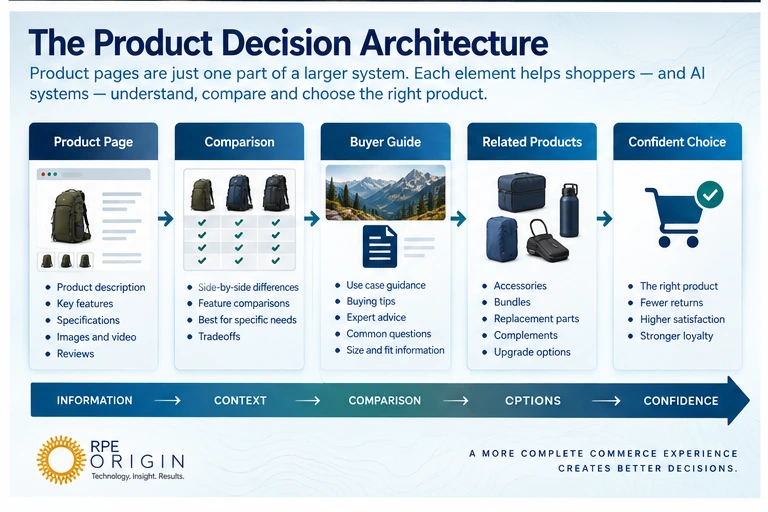
Customer decisions may be shaped by category pages, filters, comparison tables, buying guides, related-product modules, bundles, FAQs, accessories, replacement suggestions, cross-sells, upsells and “good / better / best” groupings.
Together, these elements express the retailer’s understanding of the assortment. They tell customers which products belong together, how products differ, what alternatives exist, what additional items may be required and which product fits a particular use case.
This is why merchandising should be evaluated as a decision architecture rather than a single page template. A shopper may begin on a category page, refine through filters, compare several products, read a buyer guide, open two detail pages and finally add an accessory.
An AI assistant can traverse a similar evidence landscape. The clearer the relationships and decision cues are across that landscape, the stronger the basis for product understanding and recommendation.
Rich Product Pages Create More Decision Context
Google currently recommends richer product-detail experiences that go beyond a basic title and description. Its Merchant Center guidance for rich product description pages recommends structured, well-formatted descriptions, high-resolution imagery, product highlights, product details and additional media where appropriate.
The goal is not to make every product page extremely long.
Length is not the same as usefulness.
A rich page is one that reduces meaningful uncertainty. It helps a customer understand what the product does, who it is for, how it differs, what it works with, what is included, what limitations matter and what alternatives may be appropriate.
For a simple commodity item, that may require very little copy. For a complex technical product, it may require detailed specifications, comparison content, installation guidance, compatibility information and supporting documents.
The readiness question is therefore not “How much content do we have?” It is “Does the content match the complexity of the purchase decision?”
The Best Content Answers the Questions Before the Shopper Has to Ask
A useful merchandising exercise is to examine the questions customers already ask.
What do they ask support? What do they ask sales? What do they type into onsite search? What appears repeatedly in reviews? Which misunderstandings generate returns? Where do shoppers hesitate or abandon?
Those questions frequently reveal gaps that are invisible in the product-data model.
Customers may repeatedly ask whether a charger is included, whether a bag fits under an airline seat, whether an item can be used outdoors, what the difference is between two models, whether a product works with an older generation, whether assembly is required or whether a product is appropriate for beginners.
If those questions recur, the problem may not be customer attention. The commerce experience may simply not make the answer obvious.
For AI Commerce readiness, repeated questions are useful evidence. They can show which pieces of customer intent are not yet well supported by the product content.
Merchandising Logic Should Be Explainable
Retailers frequently use merchandising logic that is clear internally but invisible externally.
A merchandiser may know which product is the entry-level option, which model replaces a discontinued item, which accessories are usually purchased together, which version is best for expert users or which configuration is best suited to a particular environment.
Some of that knowledge may drive site placement or recommendations without being documented anywhere that another system can use.
That creates a gap between operational knowledge and published product knowledge.
If an AI system is expected to explain why a product is appropriate, the underlying customer-relevant merchandising logic should be supported by explicit evidence. That does not mean exposing confidential margin rules or internal business priorities. It means making the reasoning that matters to a buyer clear enough to be reused.
Explainable merchandising is therefore both a content and governance issue.
Poor Content Can Make Strong Products Look Undifferentiated
One of the most common merchandising problems is sameness.
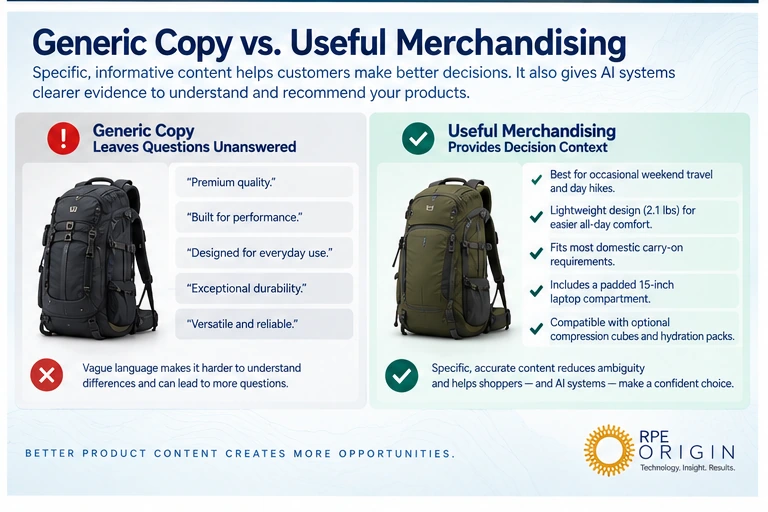
Several products in the same category may use nearly identical language: premium quality, built for performance, designed for everyday use, exceptional reliability, versatile and durable.
Those phrases sound positive, but they create very little decision evidence. If every product is described as premium, versatile and high-performing, none of those claims explains why one product is a better fit than another.
Stronger content makes the audience and use case explicit. Instead of “Designed for everyday performance,” the content might say that a compact drill is intended for homeowners handling furniture assembly, shelving and occasional household projects.
That statement is more useful because it gives the shopper context and gives an AI system something concrete to reason with.
The difference is not simply stylistic. Generic copy increases ambiguity. Specific merchandising reduces it.
Content Quality Is Not the Same as Content Length
Longer content does not automatically produce better AI Commerce readiness.
A thousand-word description can still fail to answer the questions that determine a purchase. Short content can be highly useful when it is specific, well-structured and connected to actual customer needs.
The better standard is whether the content reduces ambiguity.
That may involve a clearer title, more complete specifications, structured highlights, buyer guidance, compatibility statements, comparison content, stronger imagery or a concise FAQ. The appropriate format depends on the uncertainty that needs to be resolved.
This is why Content & Merchandising should be evaluated as an information-quality problem rather than a word-count exercise.
The Content Needs to Agree With the Product Truth
Content enrichment can create risk when it becomes disconnected from governed product data.
A marketer may update the product description. A merchandising team may create a comparison chart. A support team may add an FAQ. A feed may contain another version of the same information. A marketplace listing may retain older language.
If those sources diverge, more content can actually create more ambiguity.
For example, the product page may say an accessory is included, the comparison table may describe it as optional, the FAQ may refer to an earlier generation where it was included, and the feed may not mention it at all.
That is not a content-volume problem. It is a product-truth and governance problem.
The content layer should reinforce the same underlying facts established through Product & Catalog Data and Semantic Product Knowledge. Enrichment is valuable only when it stays synchronized with the source of truth.
AI Commerce Content Should Be Factual, Not Algorithmic
There is a temptation to treat AI Commerce content as another optimization exercise: What phrases should we add so AI recommends us? Which keywords should we repeat? What structure will make an AI rank this product first?
That framing is risky because it encourages teams to write for an imagined algorithm instead of improving the information itself.
Google’s current Merchant Center guidance explicitly tells merchants not to submit SEO keywords inside product_highlight or product_detail fields. Instead, Google emphasizes relevant product benefits for highlights and factual, verifiable specifications for product details.
OpenAI’s current Agentic Commerce product-feed specification likewise calls for concise titles and factual product descriptions in structured product feeds.
The stronger objective is not to manipulate a recommendation system. It is to make the product easier to understand accurately.
That principle is more durable because it improves the evidence regardless of which search, shopping or AI platform ultimately consumes it.
Merchandising Can Turn Product Data Into a Useful Choice Architecture
Product data describes the assortment. Merchandising organizes that assortment into choices.
That distinction becomes increasingly important as AI systems help shoppers narrow large catalogs.
A well-merchandised environment gives the system evidence about alternatives, tiers, complementary products, replacements, bundles, tradeoffs, intended audiences and category roles.
That structure effectively becomes part of the decision architecture. The system can do more than identify products. It can help explain how the assortment fits together.
This is where strong merchandising starts to resemble a knowledge model. Relationships that were once expressed only through page placement or merchandising intuition become explicit enough to support both human and machine decision-making.
What Content & Merchandising Gaps Look Like in Practice
A useful assessment should identify specific content and merchandising gaps rather than conclude that the organization simply needs “better content.”
Common findings may include product descriptions that repeat generic marketing language, important customer questions left unanswered, unclear differences between adjacent products, missing compatibility guidance, category pages that do not explain the assortment, filters that do not reflect real decision criteria, comparison pages that repeat specifications without interpretation, accessories that are poorly linked, replacement products that are undocumented or benefits that are stated without factual support.
Other findings may involve terminology that changes from one channel to another, FAQ content that is disconnected from product records, obsolete merchandising language after a product change or buyer guides that no longer match the current assortment.
Those findings point to different remediation paths. Some require content rewriting. Some require product-data enrichment. Some require taxonomy or navigation changes. Some require merchandising-system changes. Some require better governance.
The goal is specificity. Specific evidence produces specific work.
What Evidence Does the Assessment Examine?
For Content & Merchandising, the evidence set extends across the customer decision experience.
An assessment may review product detail pages, descriptions, product highlights, specifications, comparison tables, category pages, faceted navigation, buying guides, FAQs, related-product logic, bundles, accessories, replacement relationships, onsite search behavior, customer-service questions, reviews and documented merchandising rules.
Representative shopping scenarios can then be used to test whether the content supports a decision.
For example: Which laptop is best for a student who needs portability but also runs design software? Which stroller is appropriate for a newborn and compatible with this car seat? Which of these grills is easiest to maintain? What is the meaningful difference between the standard and premium version?
These are not merely content audits. They are decision-support tests.
The assessment asks whether a reasonable answer can be constructed from governed, accessible evidence and whether the answer is consistent with the retailer’s actual assortment logic.
The purpose is not to reward sites for producing more copy. It is to determine whether the content makes choices clearer.
From Understandable to Recommendable
The first four readiness dimensions now form a more complete progression.
Product & Catalog Data establishes factual product truth.
Semantic Product Knowledge explains context, suitability and relationships.
Technical Discoverability makes that information reachable.
Content & Merchandising translates those facts and relationships into useful decision support.
This is where Understandable begins to become Recommendable.
But one more question remains. Even if an AI system can find the content and understand the product, can it interact safely and usefully with the commerce environment itself? Can it access the right feeds, retrieve current commercial information, call APIs under appropriate controls or participate in emerging agent-mediated workflows?
That leads to the fifth readiness dimension: AI & Agent Accessibility.
Does Your Product Content Help Customers—and AI—Make a Confident Choice?
Strong product content should do more than describe what you sell. It should explain meaningful differences, answer real purchase questions and make the logic behind product recommendations easier to understand. An AI Commerce Readiness Assessment can help identify where content and merchandising support confident discovery—and where gaps may be limiting product understanding.
Recent Comments