
An assessment can identify what is wrong. A baseline can explain where the organization stands. Prioritization can determine what matters most.
But none of those steps creates improvement by itself.
Improvement begins when priorities are translated into work.
That is the purpose of Roadmap, the final stage in the RPE Origin AI Commerce Readiness Assessment: Discover → Assess → Baseline → Prioritize → Roadmap.
The roadmap turns findings into a practical sequence of remediation and capability-building work.
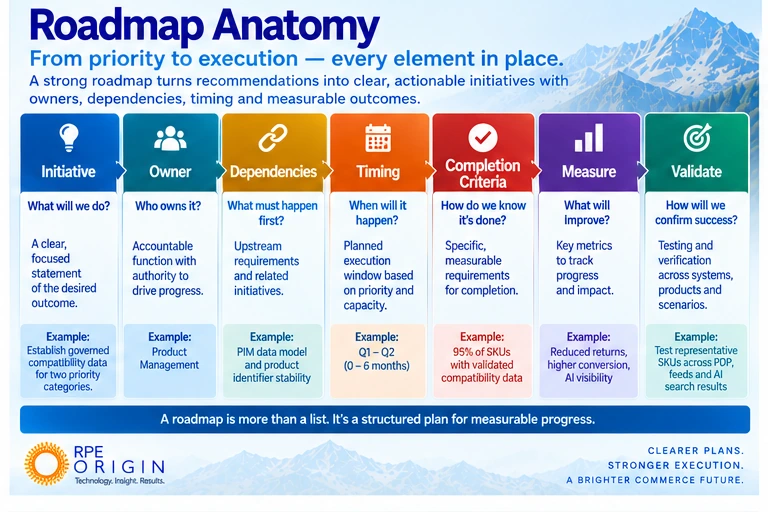
It answers: What should happen next, in what order, who should own it, and how will we know when it is complete?
A Roadmap Is More Than a List of Recommendations
A weak assessment often ends with broad recommendations such as improve product data, add structured data, enhance product content, strengthen governance or improve measurement.
Those statements may be directionally correct. They are not yet actionable.
A roadmap should convert each recommendation into work the organization can execute.
Instead of “improve compatibility information,” a stronger roadmap item might define the scope: establish authoritative compatibility relationships for two priority categories, add them to the product-data model, expose them through product pages and feeds, validate representative scenarios, and then expand the pattern to additional categories.
That recommendation now includes scope, systems, sequence, validation and expansion criteria.
That is the difference between advice and a roadmap.
The Roadmap Starts With the Priority Model
The Roadmap phase should not reopen the prioritization discussion from scratch.
It begins with the output of Prioritize: immediate risks, foundational dependencies, near-term opportunities, strategic capabilities, deferred items, likely owners and major sequencing constraints.
The roadmap converts those categories into executable work.
That continuity matters. If the priority model says product identity is foundational, the roadmap should not suddenly schedule advanced agentic checkout first simply because it is more visible or innovative.
The execution plan should preserve the reasoning already established during the assessment.
Sequence the Work Around Dependencies
The most important roadmap question is often not what is highest priority. It is what has to happen before something else can succeed.
Consider a sequence such as stabilizing product identifiers, repairing feed mappings, enriching missing attributes, building semantic product relationships, strengthening comparison content and then establishing product-level measurement.
All of those initiatives may be worthwhile, but they do not need to begin simultaneously.
If measurement depends on consistent product identity, identity work has to come first. If content enrichment depends on a stable taxonomy, taxonomy work should precede large-scale content production. If agentic commerce depends on reliable inventory and scoped APIs, those foundations should be established before transactional capabilities are exposed.
Good roadmaps make those dependencies explicit so teams do not invest in downstream capabilities whose prerequisites remain unstable.
Roadmaps Need Workstreams
A long list of individual findings quickly becomes difficult to manage.
Grouping related work into workstreams creates a more usable execution model.
Typical AI Commerce workstreams may include Product Data, Product Knowledge, Technical Discoverability, Content & Merchandising, AI & Agent Accessibility, Measurement, and Governance.
The seven readiness dimensions provide a useful starting structure, but the workstreams should be organized around execution rather than forced into identical buckets.
One workstream may contain several dimensions if the same initiative needs coordinated action across data, content, systems and governance.
The roadmap should make the work easier to operate, not merely mirror the assessment report.
One Initiative May Span Several Dimensions
Roadmap design should avoid creating artificial silos.
An initiative such as establishing governed compatibility data may involve Product & Catalog Data, Semantic Product Knowledge, Content & Merchandising and Governance & Operational Readiness.
Likewise, improving AI referral measurement may depend on product identity, analytics engineering and governance in addition to Measurement & Attribution.
The seven dimensions explain the readiness problem.
The workstream explains how the organization will solve it.
That distinction keeps execution focused on business outcomes rather than on preserving assessment categories.
Define the Outcome Before the Task
One of the strongest roadmap practices is defining the desired outcome before listing implementation tasks.
A weak roadmap item might say “update feed mappings.”
A stronger outcome is: ensure required product attributes are represented consistently in the source catalog, product detail page, structured data and merchant feed for the two priority categories.
The supporting tasks can then include identifying missing mappings, changing transformation logic, validating sample products and monitoring exceptions.
The outcome defines success. The tasks describe how to get there.
This makes the roadmap easier to govern because completion can be evaluated against a result rather than against activity.
Each Initiative Needs an Owner
A roadmap without ownership is a wish list.
Each initiative should identify an accountable function such as Product Data Operations, Merchandising, Ecommerce Engineering, Platform Engineering, Analytics, Security or Governance.
The roadmap does not always need to name an individual immediately, but it should identify the function accountable for making progress.
Cross-functional initiatives can also identify supporting teams.
For example, compatibility-data remediation may be accountable to Product Management with support from the PIM team, Merchandising and Ecommerce Engineering.
That creates enough operational clarity to begin execution and expose capacity or decision bottlenecks.
Ownership Should Follow Authority
Assigning work to a team does not help if that team cannot change the underlying system or process.
The roadmap should align accountability with actual authority.
If Product Marketing cannot modify feed transformations, it should not own feed remediation. If Analytics cannot change product identifiers, it should not own identity reconciliation.
Ownership should sit where the organization can make the relevant decision or control the required implementation.
This avoids roadmap items becoming blocked because the named owner is responsible in theory but powerless in practice.
Roadmaps Need Time Horizons
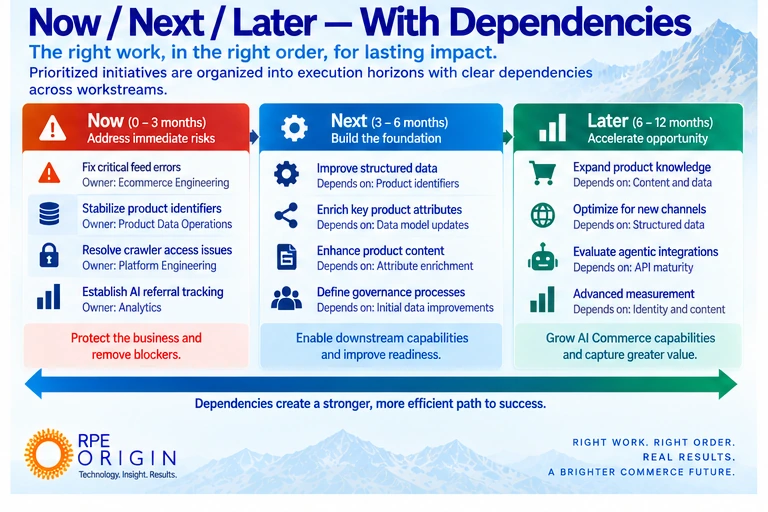
Prioritize established broad sequencing concepts such as Now, Next, Later and Monitor.
Roadmap should make those horizons concrete.
Now, often the first zero to three months, should focus on immediate customer or operational risk, critical inconsistencies, blocked discovery, urgent measurement blind spots and governance failures.
Next, often three to six months, should strengthen foundations such as product identity, attribute coverage, structured data, content quality, ownership and process.
Later, often six to twelve months, can accelerate higher-order product knowledge, advanced measurement, new channels and agentic integrations once prerequisites are stable.
Monitor tracks lower-impact findings, emerging platform standards and capabilities dependent on future conditions.
The exact timing should reflect the organization, but the roadmap should create a clear execution horizon.
Roadmaps Need Realistic Capacity
An organization may identify twenty worthwhile initiatives and have capacity to execute four.
The roadmap has to acknowledge that reality.
If every initiative is marked high priority and assigned to the next quarter, the roadmap is not executable.
Execution planning should consider engineering capacity, merchandising capacity, data-team capacity, vendor availability, budget, release windows, seasonal freezes and competing strategic projects.
This is where the constraints identified during Discover become important again.
The assessment process closes the loop by using early context to shape a realistic final plan.
Existing Projects Should Be Integrated, Not Ignored
The assessment may identify remediation that overlaps with projects already underway, such as PIM replacement, ecommerce replatforming, analytics migration, API modernization or content redesign.
The roadmap should incorporate those initiatives rather than pretend the organization is starting from a blank slate.
If a planned PIM migration will resolve a product-data weakness, the roadmap may recommend incorporating the requirement into that project instead of building a separate permanent solution.
If the migration is twelve months away but the current weakness creates immediate customer risk, an interim control may still be appropriate.
The roadmap should distinguish among solve now, incorporate into an existing initiative and defer until a planned platform change.
That helps prevent duplicated investment.
Every Roadmap Item Should Have Completion Criteria
One of the easiest ways for roadmap work to stall is leaving “done” undefined.
Consider the initiative “improve product attributes.” There is no clear point at which the organization can say the work is complete.
A stronger initiative might define completion as an approved required-attribute model, implemented PIM fields, ninety-five percent population across priority SKUs, validated feed mappings, successful testing of representative products and documented exceptions.
Now the organization can evaluate whether the outcome was achieved.
Completion criteria turn broad improvement goals into governed deliverables.
Measurement Should Be Built Into the Roadmap
The roadmap should also define how improvement will be measured.
A feed-remediation initiative may track mismatch rate, feed failures and attribute completeness. A discoverability initiative may track crawler errors, structured-data validation and product coverage. A measurement initiative may track identifiable AI referral sessions, product-level visibility and downstream conversion behavior.
This reinforces the broader lifecycle: Assess → Baseline → Prioritize → Remediate → Monitor.
Remediation without measurement makes it difficult to determine whether the work actually improved readiness.
Each material initiative should therefore identify the signal that will demonstrate progress.
The Roadmap Should Include Validation
Completing an implementation task does not prove the readiness problem has been solved.
The roadmap should include explicit validation.
After fixing feed transformations, the organization may compare source and downstream values, test representative SKUs, validate the feed, confirm product-page consistency and monitor for recurrence.
After changing crawler rules, it may test representative pages, verify response codes, confirm HTML and images are accessible and monitor crawler errors.
After improving measurement, it may verify source classification, product-event reconciliation and dashboard logic.
Every material remediation should have a corresponding verification step.
Remediation Should Be Reassessed Against the Baseline
The baseline becomes the comparison point.
After remediation, the organization can ask whether product-data consistency improved, evidence confidence increased, technical failures declined, product knowledge became more complete or governance controls became clearer.
That creates measurable movement.
The assessment is no longer just a historical report. It becomes the reference point against which progress can be demonstrated.
Some Roadmap Items Are Capability-Building, Not Defect Fixes
Not every roadmap initiative fixes something that is broken.
Some create capabilities the organization does not yet have.
Examples include establishing AI referral reporting, creating governed product-knowledge relationships, introducing agent-facing access controls, implementing monitoring or defining formal AI Commerce governance.
Those items should be described differently from remediation because they represent capability-building.
That distinction helps stakeholders understand why the roadmap includes both repair work and investments intended to enable future opportunities.
Roadmap Should Preserve “Do Not Do Yet”
The safeguards established in Prioritize should carry into the roadmap.
If the priority analysis concluded that agentic checkout should not be pursued before API access controls mature, the roadmap should preserve that dependency explicitly.
For example, agentic checkout evaluation may be gated by completion of authentication, authorization, idempotency and observability initiatives.
That is stronger than placing the advanced initiative vaguely in a Later column.
Gates protect the sequencing logic established during prioritization.
Roadmap Should Identify Decision Points
Some initiatives cannot be fully planned until additional evidence or design decisions are available.
For example, after analyzing a product-data weakness, the organization may need to decide whether to extend the existing PIM, replace it or introduce a separate product-knowledge capability.
The roadmap can contain explicit decision gates.
One quarter may complete the data-model analysis and architecture decision; a later quarter can execute the approved path.
This keeps uncertainty visible instead of pretending every implementation detail is already known.
Roadmaps Should Be Living Documents
The roadmap should not become a static PDF that is reviewed once and forgotten.
AI Commerce changes too quickly, and the organization will learn more as remediation progresses.
Priorities may shift because platform capabilities change, business strategy changes, new evidence appears, remediation exposes additional dependencies or standards evolve.
The roadmap should therefore be reviewed periodically as governed operational work.
That does not mean constantly rewriting the plan. It means maintaining the connection between the roadmap, current evidence and changing business context.
Progress Should Be Visible
The organization should be able to see where roadmap initiatives stand.
A simple status model such as Not Started, Planned, In Progress, Blocked, Complete and Monitoring may be sufficient.
For more complex programs, each initiative can also track owner, target date, dependencies, completion criteria, validation status and resulting metrics.
This turns the roadmap into an execution instrument instead of a presentation artifact.
Visibility also makes cross-functional blockers easier to identify before they silently delay downstream work.
Roadmap Governance Should Survive the Assessment
RPE Origin can produce the roadmap. The organization has to operate it.
That means the roadmap itself needs ownership.
Someone should coordinate updates, monitor dependencies, escalate blockers, review progress, validate completion and maintain the connection to the readiness baseline.
That role may belong to an ecommerce leader, AI Commerce program owner, product leader or another cross-functional owner.
The title matters less than the accountability.
Without ongoing ownership, even a well-designed roadmap can become a static deliverable.
What a Strong Roadmap Produces
By the end of the Roadmap phase, the organization should have sequenced initiatives, defined workstreams, accountable owners, major dependencies, execution horizons, completion criteria, validation requirements, measurement expectations, decision gates, deferred initiatives and monitoring requirements.
That is the practical output of the assessment.
It translates evidence and priority into a structure the organization can operate.
The formal RPE Origin assessment outputs include a current-state readiness baseline, documented findings, risk and gap prioritization, AI discovery observations, a remediation roadmap and recommended next steps.
The roadmap is where those outputs converge into action.
Evidence In. Actionable Roadmap Out.
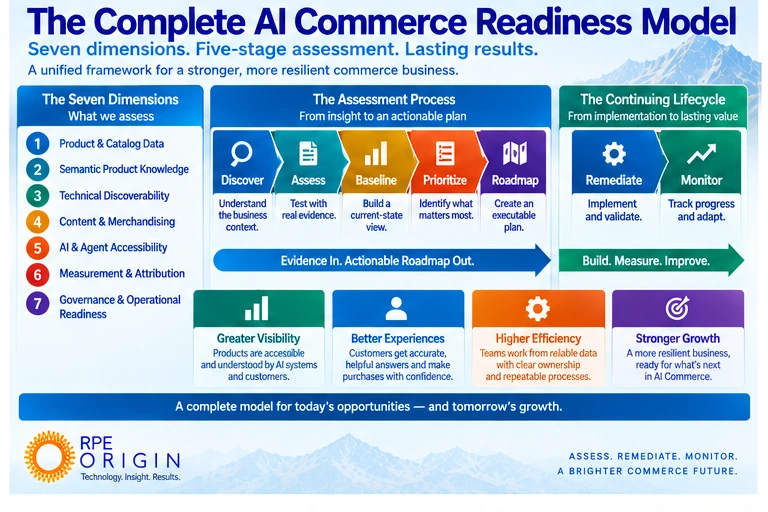
The twelve articles in this series form a complete model.
The first seven explain what the assessment evaluates: Product & Catalog Data, Semantic Product Knowledge, Technical Discoverability, Content & Merchandising, AI & Agent Accessibility, Measurement & Attribution, and Governance & Operational Readiness.
The final five explain how the assessment works: Discover, Assess, Baseline, Prioritize and Roadmap.
The process starts with context. It moves through evidence. It establishes the current state. It determines what matters most. And it ends with a practical plan.
Execution then continues through remediation and monitoring.
That is the operating principle behind the assessment: Evidence in. Actionable roadmap out.
Do You Have a Practical Plan for Turning AI Commerce Readiness Into Action?
Readiness findings create value only when they lead to executable work. A strong roadmap should define what needs to happen, what comes first, who owns each initiative, which dependencies must be resolved and how improvement will be validated over time. An AI Commerce Readiness Assessment can turn current-state evidence and prioritized findings into a practical roadmap for remediation and capability-building.
Recent Comments