
A readiness assessment can identify dozens of legitimate findings. That does not mean an organization should try to fix all of them at once.
Some issues create immediate customer, revenue or compliance risk. Some are foundational problems that affect several other capabilities. Some are useful improvements but not urgent. Some require large investments or depend on other work being completed first. Others may be technically interesting but have limited strategic value.
That is why Prioritize is a distinct phase in the RPE Origin process: Discover → Assess → Baseline → Prioritize → Roadmap.
The previous phases establish context, verify the evidence and describe the current state. Prioritize turns that body of work into a decision framework.
The central question becomes: Of everything we found, what matters most now?
Prioritization Is Not the Same as Severity
Technical assessments often classify findings as critical, high, medium or low. That can be useful because it expresses the seriousness of the defect itself.
But severity alone is not enough to determine what should be done first.
Consider two findings. One is a technically significant structured-data inconsistency affecting a low-volume product category. The second is a smaller compatibility-data issue affecting the retailer’s highest-revenue category and contributing to frequent customer questions and returns.
The first may appear more severe from a technical perspective. The second may create greater business impact.
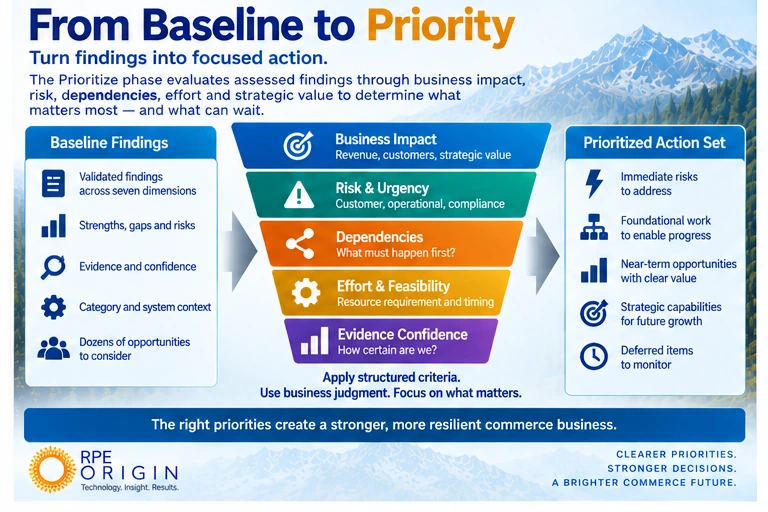
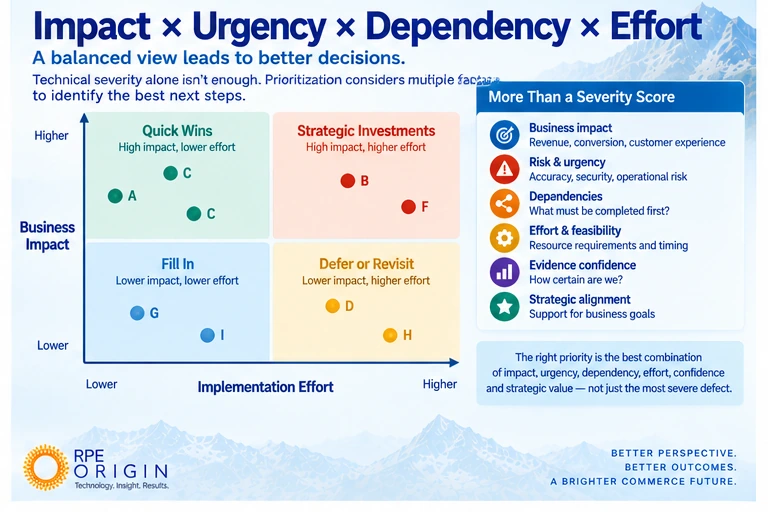
A useful prioritization model therefore considers more than severity. It evaluates business impact, customer or operational risk, dependencies, implementation effort, evidence confidence and strategic alignment together.
The right question is not which defect looks worst. It is which issue creates the strongest combination of risk, opportunity and dependency for this organization.
Business Impact Has to Matter
A readiness roadmap should reflect business consequences rather than technical neatness.
Impact may involve revenue, conversion, returns, product visibility, customer trust, operational cost, support volume, strategic categories, partner requirements or seasonal demand.
A problem affecting a flagship category should generally receive more attention than the same problem in a rarely purchased category. Likewise, a defect repeated across thousands of products may warrant more attention than one affecting a small number of low-value SKUs.
This is where the business context established during Discover becomes essential.
Prioritization should reconnect technical findings to the products, customers and strategic objectives that made the assessment worth performing in the first place.
Customer Risk Should Be Separated From Opportunity
Some findings represent missed opportunity. Others represent active risk.
Those should not be treated as though they are interchangeable.
Risk-oriented findings can include materially incorrect pricing, stale availability, misleading compatibility information, blocked transaction flows, overly broad API permissions, unsupported product claims or controls that expose the organization to security or compliance issues.
Opportunity-oriented findings can include missing product highlights, weak comparison content, incomplete semantic relationships, limited AI referral reporting or underdeveloped merchandising guidance.
Both categories matter, but active accuracy, security or customer-harm risk will often deserve attention before optimization work.
A practical prioritization model should explicitly distinguish between protecting the business and improving the opportunity.
Foundational Problems Often Deserve Higher Priority
Some readiness findings affect several dimensions at once.
Unstable product identifiers, for example, can weaken feeds, variant relationships, structured data, analytics, API reconciliation and attribution. Weak source-of-truth governance can introduce inconsistency into content, product knowledge, technical outputs and measurement.
Those are foundational issues.
Fixing downstream symptoms one at a time can create temporary improvement while leaving the underlying problem untouched.
The Prioritize phase should therefore ask whether a finding is primarily a symptom or a root capability gap.
Foundational problems often deserve additional priority because correcting them creates leverage across multiple downstream capabilities.
Business Impact Has to Matter
A readiness roadmap should reflect business consequences rather than technical neatness.
Impact may involve revenue, conversion, returns, product visibility, customer trust, operational cost, support volume, strategic categories, partner requirements or seasonal demand.
A problem affecting a flagship category should generally receive more attention than the same problem in a rarely purchased category. Likewise, a defect repeated across thousands of products may warrant more attention than one affecting a small number of low-value SKUs.
This is where the business context established during Discover becomes essential.
Prioritization should reconnect technical findings to the products, customers and strategic objectives that made the assessment worth performing in the first place.
Customer Risk Should Be Separated From Opportunity
Some findings represent missed opportunity. Others represent active risk.
Those should not be treated as though they are interchangeable.
Risk-oriented findings can include materially incorrect pricing, stale availability, misleading compatibility information, blocked transaction flows, overly broad API permissions, unsupported product claims or controls that expose the organization to security or compliance issues.
Opportunity-oriented findings can include missing product highlights, weak comparison content, incomplete semantic relationships, limited AI referral reporting or underdeveloped merchandising guidance.
Both categories matter, but active accuracy, security or customer-harm risk will often deserve attention before optimization work.
A practical prioritization model should explicitly distinguish between protecting the business and improving the opportunity.
Foundational Problems Often Deserve Higher Priority
Some readiness findings affect several dimensions at once.
Unstable product identifiers, for example, can weaken feeds, variant relationships, structured data, analytics, API reconciliation and attribution. Weak source-of-truth governance can introduce inconsistency into content, product knowledge, technical outputs and measurement.
Those are foundational issues.
Fixing downstream symptoms one at a time can create temporary improvement while leaving the underlying problem untouched.
The Prioritize phase should therefore ask whether a finding is primarily a symptom or a root capability gap.
Foundational problems often deserve additional priority because correcting them creates leverage across multiple downstream capabilities.
Dependencies Change the Order of Work
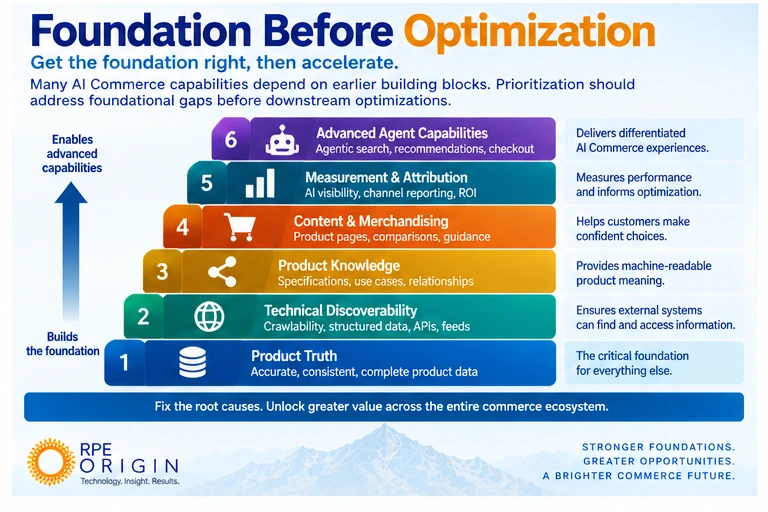
Even when two improvements are equally valuable, one may need to happen first.
A retailer may want to improve AI product visibility, but it may first need to stabilize product identifiers, correct feed mappings and improve structured product attributes. Only then does investing heavily in semantic enrichment or advanced merchandising produce a reliable foundation.
The same principle applies to agentic commerce. An organization may want AI-assisted checkout, but if APIs are undocumented, permissions are too broad, inventory is not sufficiently current or cart operations depend on browser state, then the advanced capability is not the first project.
The prerequisite work is.
Prioritization should therefore expose dependency order rather than presenting findings as an independent list of desirable improvements.
Effort Matters—But It Should Not Dominate
Implementation effort belongs in the prioritization model because organizations operate with finite time, budget and engineering capacity.
An issue that takes two hours to correct may be worth addressing immediately. A replatforming dependency may require a multi-quarter plan.
But effort should not become the only deciding factor.
If organizations prioritize only easy work, they can spend months completing low-value tasks while foundational risk remains untouched.
A stronger approach balances impact, urgency, dependency, effort, evidence confidence and strategic value.
That produces a portfolio of work that includes quick wins without allowing quick wins to become the strategy.
Confidence Should Affect Priority
Evidence confidence should influence the next action.
A high-impact finding supported by strong evidence may justify immediate remediation. A potentially serious issue supported only by limited evidence may deserve additional validation first.
That creates an important distinction.
High impact plus high confidence often produces an action priority.
High impact plus low confidence may produce an investigation priority.
Sometimes the most important next step is not fixing the problem. It is reducing uncertainty enough to know whether the problem exists at the scale or severity suspected.
That prevents the organization from committing significant resources to findings that have not been verified sufficiently.
Quick Wins Are Useful—But They Are Not the Strategy
Every roadmap benefits from some quick wins.
Correcting a broken feed field, exposing an existing attribute, fixing an analytics classification, changing a crawler rule or improving a comparison table may produce visible progress with relatively little effort.
Quick wins can also help establish momentum and demonstrate that the assessment is producing practical value.
But they should not crowd out deeper work.
A roadmap made entirely of easy tasks can create the appearance of progress without improving the underlying readiness architecture.
The priority set should therefore include tactical wins alongside foundational remediation and longer-term capability development.
Some Work Should Be Deferred Deliberately
Not every valid finding belongs in the immediate roadmap.
A lower-value issue may be deferred because the affected category is being retired, a replatforming project will replace the system, another dependency must be completed first, the platform capability is not yet mature enough to justify implementation, business value is limited or implementation cost is disproportionate.
Deferral is not a failure to act.
It can be a disciplined decision that preserves resources for higher-value work.
The important requirement is to make the decision visible so the finding is not silently forgotten.
Deferred items should have a rationale and, where appropriate, a condition or date for reconsideration.
Prioritization Should Protect Against Technology Novelty
AI Commerce is evolving quickly, which makes novelty a real prioritization risk.
Agentic checkout, new integration protocols, new AI shopping surfaces and emerging measurement capabilities can attract attention precisely because they are new.
They may be strategically important. They may also be premature.
If an organization still has inconsistent product identity, stale feeds, weak ownership and incomplete product knowledge, adding an advanced agentic integration can increase complexity before the underlying commerce foundation is ready.
Prioritization should therefore favor business readiness and prerequisite capability over novelty.
The newest feature is not automatically the next best investment.
Strategic Alignment Matters
Some findings rise in priority because they directly support business strategy.
If the organization is expanding internationally, regional product data, localization and market-specific availability may deserve more weight. If the company is entering a major marketplace, feed quality may become more urgent. If leadership wants to pursue agentic commerce, API maturity, identity consistency and access controls become more strategically relevant.
If the business is focused on reducing returns, compatibility information, sizing, product guidance and decision-support content may deserve additional weight.
Prioritization should connect readiness improvements to actual strategic direction.
That alignment makes the eventual roadmap easier to explain, fund and govern.
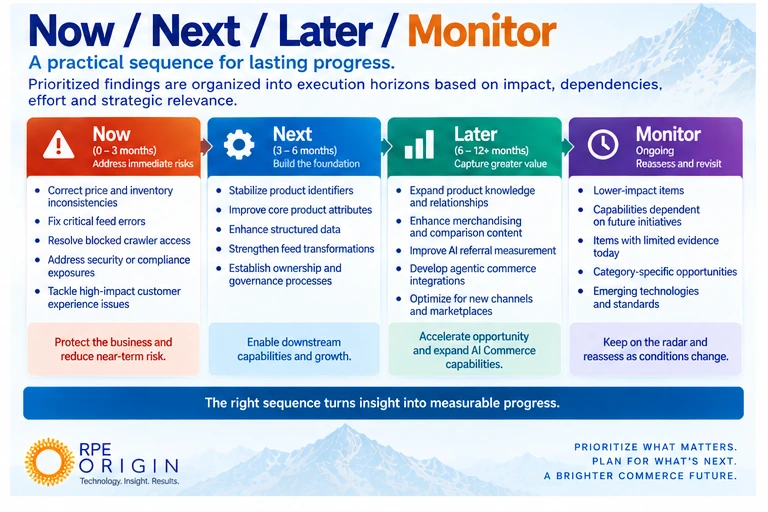
Priorities Should Be Organized Into Tiers
A practical priority model is often easier to use when findings are grouped into execution tiers instead of being presented as one long ranked list.
Immediate Risk includes issues that can create material inaccuracy, customer harm, security exposure, compliance risk or major operational disruption.
Near-Term Foundation includes capabilities that should be strengthened because other improvements depend on them.
Near-Term Opportunity includes improvements with meaningful business value and manageable effort.
Strategic Capability includes longer-term investments that prepare the organization for future AI Commerce opportunities.
Monitor or Defer includes valid findings that do not currently justify active investment or depend on conditions that have not yet been met.
This structure makes the difference between urgency, foundation, opportunity and future capability much clearer than a simple 1-to-73 ranking.
Prioritization Should Be Transparent
Stakeholders should be able to understand why one item sits above another.
That means the criteria should be visible.
A finding may receive high priority because it affects a priority category, the evidence is strong, customer or revenue risk is material, several downstream capabilities depend on it and the remediation is feasible.
Another finding may be deferred because business impact is limited, evidence is incomplete, a platform migration will supersede it or the implementation cost is disproportionate to the benefit.
Transparent criteria reduce the appearance that the priority list is simply consultant preference.
They also make it easier for the organization to update the priorities later if circumstances change.
The Priority Model Should Not Pretend to Be Mathematical Certainty
Organizations sometimes create formulas such as Priority = Impact × Urgency × Confidence ÷ Effort.
These models can be helpful because they force teams to evaluate consistent criteria.
They can also create false precision.
A score of 8.7 versus 8.4 does not prove that one project objectively belongs first. The underlying inputs still require judgment, and the model cannot capture every business dependency or timing constraint.
Prioritization works best when quantitative scoring supports professional interpretation instead of replacing it.
The goal is decision discipline, not artificial mathematical certainty.
Cross-Dimension Issues Need Special Attention
A finding that affects several dimensions deserves special consideration because its remediation may unlock multiple benefits.
Weak product-identity governance, for example, can affect Product & Catalog Data, Semantic Product Knowledge, Technical Discoverability, AI & Agent Accessibility and Measurement & Attribution.
That does not automatically make product identity the highest-priority item.
But the breadth of dependency should be visible.
Cross-dimensional effects help the organization recognize where one investment can remove several downstream constraints and where repeated local fixes would be inefficient.
Sequence Matters as Much as Rank
A priority list answers what is most important. A sequence answers what has to happen first.
Those are not the same question.
An organization might rank measurement as strategically important but still need to reconcile product identifiers before product-level attribution becomes reliable. It may want advanced merchandising but first need to stabilize the taxonomy and attribute model. It may want agentic commerce but first need clean API boundaries and authentication.
Prioritization should therefore begin revealing execution order before the formal Roadmap phase.
Dependencies turn a flat list into a logical sequence.
Priority Should Reflect Implementation Windows
Timing matters as well.
Retailers may have holiday code freezes, seasonal inventory peaks, major product launches, replatforming windows, budget cycles or regulatory deadlines.
A high-priority change may need to wait for the right implementation window. That does not reduce its importance.
It changes how the roadmap should schedule the work.
The Prioritize phase should therefore consider both importance and practical timing so the final plan reflects how the organization can actually execute.
Owners Should Be Visible Before the Roadmap Is Built
A finding with no plausible owner is difficult to execute.
Prioritization should therefore identify the likely accountable function even before individual assignments are finalized.
Product-data work may belong to product operations. Merchandising issues may sit with content or ecommerce. Technical discoverability may require ecommerce engineering and security. Measurement may belong to analytics. Agent-access controls may require platform engineering and governance.
Identifying the likely owner helps reveal capacity constraints and cross-functional dependencies before the roadmap is finalized.
Prioritization Should Include “Do Not Do Yet”
One of the most useful outputs of the phase can be a list of initiatives that the organization should not pursue yet.
For example, do not implement agentic checkout before API controls mature. Do not scale AI-generated product copy before product truth is governed. Do not optimize product-level AI attribution before identifiers can be reconciled. Do not rebuild comparison content before the underlying taxonomy is stable.
These are not rejections of the capabilities.
They are sequencing decisions.
A clear “do not do yet” list protects the organization from investing in advanced capabilities whose prerequisites are not ready.
What the Prioritize Phase Produces
By the end of Prioritize, the organization should have a structured view of what deserves attention and in what broad order.
That should include ranked or tiered findings, immediate risks, foundational dependencies, near-term opportunities, strategic capabilities, deferred items, evidence-confidence considerations, likely owners and major sequencing constraints.
This is not yet the detailed implementation plan.
It is the decision framework that makes the implementation plan possible.
Prioritize answers: What matters most?
Roadmap answers: How do we turn those priorities into an executable plan?
Do You Know Which AI Commerce Gaps Deserve Attention First?
A readiness assessment can uncover many valid opportunities, but they should not all be treated with the same urgency. Business impact, customer risk, dependencies, implementation effort and strategic value all influence what should happen next. An AI Commerce Readiness Assessment can help separate immediate risks, foundational work, near-term opportunities and longer-term capabilities into a practical order of action.
Recent Comments