
What Does “AI Commerce Ready” Actually Mean? A Practical Readiness Framework
By this point in the AI Commerce conversation, most commerce leaders understand the basic premise.
Consumers are beginning to use AI systems to discover products, compare options, refine preferences and make purchase decisions. Product data matters. Structured attributes matter. Semantic context matters. And the customer journey is starting to extend beyond traditional search results and merchant websites.
The harder question is: What does it actually mean for a retailer to be AI Commerce ready?
That question deserves a more concrete answer than “We have good product data,” “Our site is optimized for SEO,” or “We have an AI roadmap.”
AI Commerce readiness is broader. It reflects how well an organization can make its products discoverable, understandable, comparable, recommendable, transactable, measurable and governable across an increasingly distributed commerce ecosystem.
That requires more than one team and more than one technology. It requires a framework.

AI Commerce Readiness Is a System, Not a Feature
One of the easiest mistakes to make is treating AI Commerce as another implementation project: install a chatbot, connect an API, create an AI shopping assistant, launch a pilot.
Those may eventually become useful components. But none of them answer the fundamental readiness question: Can the commerce ecosystem consistently provide AI systems with the reliable information, context and operational support required to represent the business accurately?
A merchant may have excellent product feeds but weak semantic context; strong structured data but inconsistent inventory; excellent catalog governance but no visibility into AI-generated discovery; or a sophisticated commerce stack with unclear organizational ownership.
AI Commerce readiness therefore needs to be assessed as a connected operating model.
A Practical AI Commerce Readiness Framework
RPE Origin organizes the assessment around seven dimensions:
- Product & Catalog Data
- Semantic Product Knowledge
- Technical Discoverability
- Content & Merchandising
- AI & Agent Accessibility
- Measurement & Attribution
- Governance & Operational Readiness
Each dimension answers a different question. Together, they determine how effectively a commerce organization can move from simply being online to being understandable and recommendable in AI-assisted shopping experiences.
1. Product & Catalog Data
Is the underlying product information complete, accurate, consistent and current?
Readiness areas include:
- SKU and product identity consistency
- GTIN, UPC, EAN, MPN and brand coverage
- variant relationships
- pricing and inventory accuracy
- availability and shipping information
- dimensions, materials and specifications
- category-specific attributes
- images, reviews and ratings
- feed consistency
Diagnostic questions
- Are products uniquely identifiable across systems?
- Are parent and variant relationships clear?
- Are important attributes complete?
- Do product feeds agree with the website?
- Are pricing and inventory synchronized?
- Are category-specific specifications represented explicitly?
2. Semantic Product Knowledge
Can a machine understand not only what the product is, but when and why it is appropriate?
Readiness areas include:
- intended use
- audience
- environment
- compatibility
- suitability
- occasion
- performance characteristics
- differentiators
- constraints and tradeoffs
- relationships to alternatives
Diagnostic questions
- Can products be mapped to meaningful use cases?
- Are differentiators explicit?
- Is compatibility structured?
- Can the organization represent who this product is for?
- Can machines distinguish similar products using real purchase criteria?
3. Technical Discoverability
Can AI and search systems reliably access and interpret the commerce environment?
Readiness areas include:
- crawlability and indexability
- canonical URLs
- site architecture
- Product and Offer structured data
- variant markup
- XML sitemaps
- feed accessibility
- robots directives
- page performance
- rendered-content accessibility
Diagnostic questions
- Can major product pages be crawled?
- Is important content available without inaccessible dependencies?
- Is Product and Offer structured data implemented correctly?
- Are variant relationships represented accurately?
- Are feed and structured-data values aligned?
4. Content & Merchandising
Does the commerce content support the way customers actually evaluate products?
Readiness areas include:
- product descriptions
- specifications
- FAQs
- comparison content
- use-case content
- buying guides
- compatibility information
- review coverage
- category guidance
- seasonal merchandising
- alternatives and substitutes
Diagnostic questions
- Do product pages answer real purchase questions?
- Are important differences between products obvious?
- Are use cases documented?
- Can customers compare similar items easily?
- Do FAQs reflect real shopper concerns?
5. AI & Agent Accessibility
How prepared is the commerce platform to participate directly in emerging AI and agentic commerce ecosystems?
Readiness areas include:
- merchant-feed capability
- API availability
- real-time catalog access
- inventory access
- pricing access
- product availability
- cart operations
- checkout architecture
- identity and permissions
- security
Diagnostic questions
- Can commerce data be exposed programmatically?
- Are APIs available for pricing and inventory?
- Can external systems retrieve current variants?
- Can checkout be invoked through approved integration patterns?
- Are authentication and authorization models suitable for agent access?
6. Measurement & Attribution
Can the organization determine whether AI-assisted discovery is influencing commerce performance?
Readiness areas include:
- AI referral identification
- campaign attribution
- assisted conversion analysis
- product-level exposure
- AI surface visibility
- prompt/test monitoring
- competitive visibility
- conversion quality
- analytics taxonomy
- baseline reporting
Diagnostic questions
- Can AI referrals be identified?
- Can the organization measure at product level?
- Are representative prompts tracked over time?
- Can changes in product representation be monitored?
- Is there a baseline against which improvement can be measured?
7. Governance & Operational Readiness
Who owns the truth?
Readiness areas include:
- authoritative product-data ownership
- catalog quality ownership
- structured-data ownership
- AI discovery monitoring
- issue resolution
- change control
- data standards
- security and compliance review
Diagnostic questions
- Is there an authoritative source for product data?
- Who owns catalog quality?
- Who resolves inconsistencies?
- Are change-control processes defined?
- Are product-data standards documented?
- Are AI integrations reviewed for security and compliance?
Current-platform context for the framework
OpenAI: Product discovery in ChatGPT — merchant feeds and product information can support richer product discovery.
Google Merchant Center: AI-powered shopping performance reporting — AI reporting is expanding around discovery, evaluation, product terms, attributes and completeness.
Google Merchant Center: Universal Commerce Protocol — agentic commerce increasingly reaches catalog, cart and transaction capabilities.
Readiness Is Not Binary
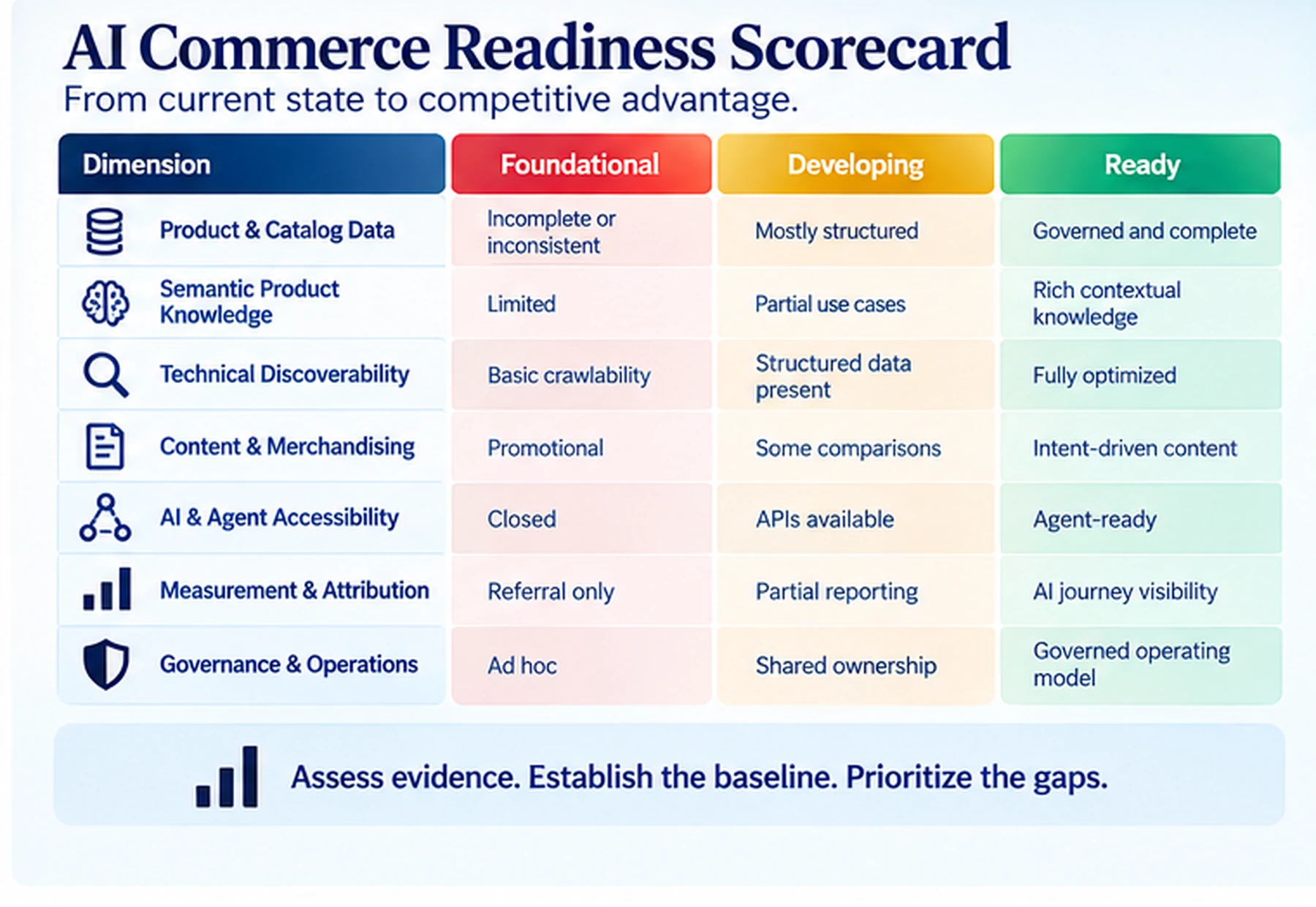
A retailer should not think of AI Commerce readiness as Ready / Not Ready. Readiness exists on a spectrum, and an organization may be strong in one dimension while still developing another.
AI Commerce Readiness Is a System, Not a Feature
One of the easiest mistakes to make is treating AI Commerce as another implementation project: install a chatbot, connect an API, create an AI shopping assistant, launch a pilot.
Those may eventually become useful components. But none of them answer the fundamental readiness question: Can the commerce ecosystem consistently provide AI systems with the reliable information, context and operational support required to represent the business accurately?
A merchant may have excellent product feeds but weak semantic context; strong structured data but inconsistent inventory; excellent catalog governance but no visibility into AI-generated discovery; or a sophisticated commerce stack with unclear organizational ownership.
AI Commerce readiness therefore needs to be assessed as a connected operating model.
A Practical AI Commerce Readiness Framework
RPE Origin organizes the assessment around seven dimensions:
- Product & Catalog Data
- Semantic Product Knowledge
- Technical Discoverability
- Content & Merchandising
- AI & Agent Accessibility
- Measurement & Attribution
- Governance & Operational Readiness
Each dimension answers a different question. Together, they determine how effectively a commerce organization can move from simply being online to being understandable and recommendable in AI-assisted shopping experiences.
1. Product & Catalog Data
Is the underlying product information complete, accurate, consistent and current?
Readiness areas include:
- SKU and product identity consistency
- GTIN, UPC, EAN, MPN and brand coverage
- variant relationships
- pricing and inventory accuracy
- availability and shipping information
- dimensions, materials and specifications
- category-specific attributes
- images, reviews and ratings
- feed consistency
Diagnostic questions
- Are products uniquely identifiable across systems?
- Are parent and variant relationships clear?
- Are important attributes complete?
- Do product feeds agree with the website?
- Are pricing and inventory synchronized?
- Are category-specific specifications represented explicitly?
2. Semantic Product Knowledge
Can a machine understand not only what the product is, but when and why it is appropriate?
Readiness areas include:
- intended use
- audience
- environment
- compatibility
- suitability
- occasion
- performance characteristics
- differentiators
- constraints and tradeoffs
- relationships to alternatives
Diagnostic questions
- Can products be mapped to meaningful use cases?
- Are differentiators explicit?
- Is compatibility structured?
- Can the organization represent who this product is for?
- Can machines distinguish similar products using real purchase criteria?
3. Technical Discoverability
Can AI and search systems reliably access and interpret the commerce environment?
Readiness areas include:
- crawlability and indexability
- canonical URLs
- site architecture
- Product and Offer structured data
- variant markup
- XML sitemaps
- feed accessibility
- robots directives
- page performance
- rendered-content accessibility
Diagnostic questions
- Can major product pages be crawled?
- Is important content available without inaccessible dependencies?
- Is Product and Offer structured data implemented correctly?
- Are variant relationships represented accurately?
- Are feed and structured-data values aligned?
4. Content & Merchandising
Does the commerce content support the way customers actually evaluate products?
Readiness areas include:
- product descriptions
- specifications
- FAQs
- comparison content
- use-case content
- buying guides
- compatibility information
- review coverage
- category guidance
- seasonal merchandising
- alternatives and substitutes
Diagnostic questions
- Do product pages answer real purchase questions?
- Are important differences between products obvious?
- Are use cases documented?
- Can customers compare similar items easily?
- Do FAQs reflect real shopper concerns?
5. AI & Agent Accessibility
How prepared is the commerce platform to participate directly in emerging AI and agentic commerce ecosystems?
Readiness areas include:
- merchant-feed capability
- API availability
- real-time catalog access
- inventory access
- pricing access
- product availability
- cart operations
- checkout architecture
- identity and permissions
- security
Diagnostic questions
- Can commerce data be exposed programmatically?
- Are APIs available for pricing and inventory?
- Can external systems retrieve current variants?
- Can checkout be invoked through approved integration patterns?
- Are authentication and authorization models suitable for agent access?
6. Measurement & Attribution
Can the organization determine whether AI-assisted discovery is influencing commerce performance?
Readiness areas include:
- AI referral identification
- campaign attribution
- assisted conversion analysis
- product-level exposure
- AI surface visibility
- prompt/test monitoring
- competitive visibility
- conversion quality
- analytics taxonomy
- baseline reporting
Diagnostic questions
- Can AI referrals be identified?
- Can the organization measure at product level?
- Are representative prompts tracked over time?
- Can changes in product representation be monitored?
- Is there a baseline against which improvement can be measured?
7. Governance & Operational Readiness
Who owns the truth?
Readiness areas include:
- authoritative product-data ownership
- catalog quality ownership
- structured-data ownership
- AI discovery monitoring
- issue resolution
- change control
- data standards
- security and compliance review
Diagnostic questions
- Is there an authoritative source for product data?
- Who owns catalog quality?
- Who resolves inconsistencies?
- Are change-control processes defined?
- Are product-data standards documented?
- Are AI integrations reviewed for security and compliance?
Current-platform context for the framework
OpenAI: Product discovery in ChatGPT — merchant feeds and product information can support richer product discovery.
Google Merchant Center: AI-powered shopping performance reporting — AI reporting is expanding around discovery, evaluation, product terms, attributes and completeness.
Google Merchant Center: Universal Commerce Protocol — agentic commerce increasingly reaches catalog, cart and transaction capabilities.
Readiness Is Not Binary
A retailer should not think of AI Commerce readiness as Ready / Not Ready. Readiness exists on a spectrum, and an organization may be strong in one dimension while still developing another.
From Readiness to Action
The first three articles in this series established the progression:
- Article 1: AI Commerce creates a new discovery layer.
- Article 2: Product data becomes product knowledge.
- Article 3: AI uses that knowledge to interpret intent, compare products and construct recommendations.
The next question is: How prepared is your commerce ecosystem to participate? That is what the readiness framework is designed to answer.
Establish Your AI Commerce Baseline
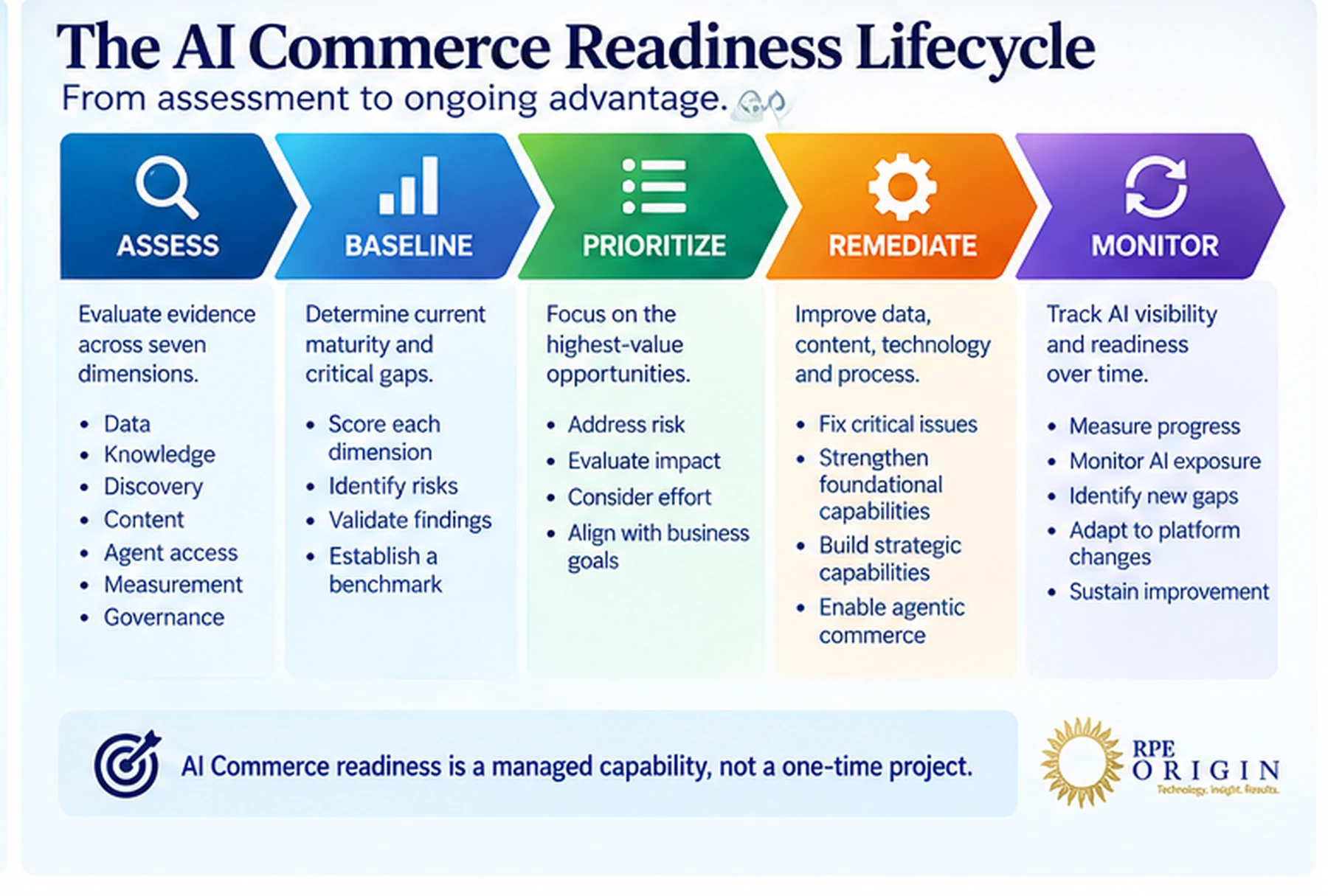
An AI Commerce Readiness Assessment from RPE Origin evaluates the seven dimensions that influence whether AI systems can accurately discover, understand, compare and recommend your products.
The assessment identifies what is working, where meaningful gaps exist, which issues create the greatest risk, which improvements offer the strongest near-term value and what capabilities should be developed next.
Recent Comments