
The Assess phase produces evidence. The Baseline phase gives that evidence structure.
By the end of assessment, RPE Origin may have dozens of observations: missing product attributes in certain categories, inconsistent variant relationships, structured data that diverges from page content, strong API controls, weak referral classification, unclear ownership, healthy feed cadence, isolated crawler failures and strong merchandising in selected categories.
Each finding matters, but a list of findings is not yet a useful current-state view.
The organization needs to understand what those findings mean collectively.
That is the purpose of Baseline, the third stage in the process: Discover → Assess → Baseline → Prioritize → Roadmap.
Baseline answers a simple question: Where does the organization stand today, based on the evidence we have?
A Baseline Is More Than a Score
There is a natural temptation to reduce readiness to one number. A summary score can be useful, but it can also obscure the shape of the underlying readiness profile.
An organization may be strong in Product & Catalog Data and weak in Measurement & Attribution. Another may have excellent Technical Discoverability but poor Governance & Operational Readiness. A third may perform well overall but have a material weakness in one strategically important product category.
Those differences matter more than the aggregate.
A strong baseline therefore shows where readiness is strong, where it is uneven, where evidence is limited and where material risk exists.
The score, if one is used, should summarize the evidence. It should never replace it.
The Baseline Should Reflect the Seven Dimensions
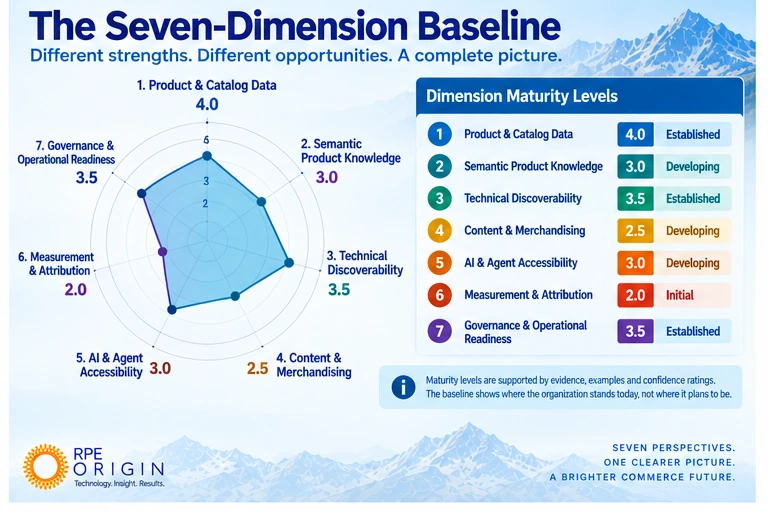
The most natural structure for the baseline is the same seven-dimension framework used during assessment.
Each dimension should have a current-state view grounded in observed evidence: strengths, material gaps, systemic patterns, known exceptions, evidence confidence, representative examples and relevant dependencies.
The objective is not to reproduce every test result.
It is to synthesize the evidence into a clear description of what is working, what is not and how confident the assessment is in that conclusion.
This preserves the integrity of the detailed findings while making the baseline usable for executives and operators.
Strengths Belong in the Baseline Too
Readiness assessments can become overly defect-focused. That is a mistake.
A baseline should document what is already working well.
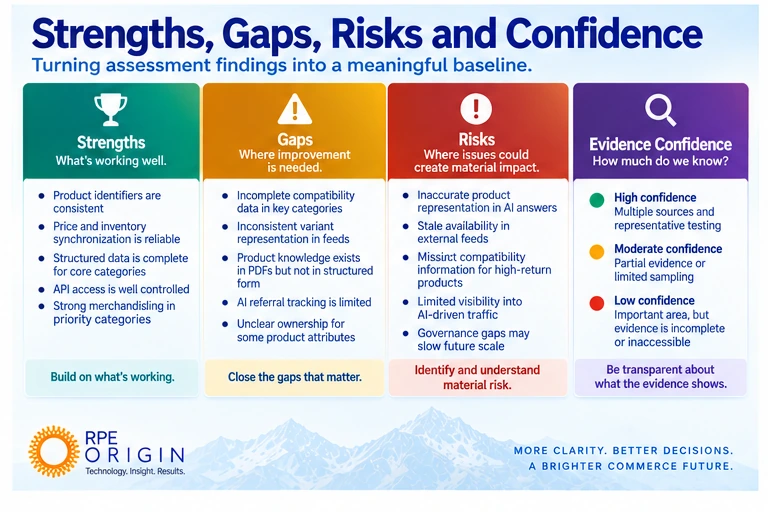
Stable product identifiers, reliable pricing synchronization, strong crawler access, complete structured data, useful product comparisons, well-scoped API permissions, identifiable AI referral traffic and clearly documented ownership are all examples of strengths that matter.
Those strengths reduce remediation effort and show which capabilities can serve as foundations for the next phase.
A good roadmap should build on what is working rather than assume everything needs to be replaced.
Gaps Need Context
A gap by itself is rarely useful enough.
The baseline should explain what is missing, where the gap appears, whether it is isolated or systemic, which products or categories are affected and how confident the assessment is.
For example, “compatibility data is incomplete” is too broad. A stronger statement might explain that compatibility information is well documented for replacement parts but inconsistently structured across accessories in two priority categories, with product pages carrying more detail than feeds or APIs.
That description gives the organization something it can reason
Patterns Matter More Than Individual Defects
The Baseline phase should elevate recurring patterns instead of treating every symptom as an independent strategic issue.
If ten mismatches all originate from the same transformation rule, the baseline should identify the transformation weakness rather than list ten separate defects.
The same logic applies elsewhere. Several missing attributes may indicate a category-model problem. Repeated crawl failures may point to a WAF policy. Weak product comparisons across a category may indicate a merchandising-governance issue. Fragmented referral data may indicate an analytics-classification gap.
Baseline is where isolated observations become broader readiness themes.
That synthesis is what makes the next prioritization step manageable.
Maturity Can Be Useful—If It Is Explained
A maturity model can help summarize current readiness across the seven dimensions.
Labels such as Initial, Developing, Established or Advanced can create a useful common language, especially for executive stakeholders.
But the label should never stand alone.
If a dimension is rated Developing, the reader should be able to see the evidence, representative examples, operating controls, known gaps and confidence level supporting that conclusion.
That prevents maturity scoring from becoming arbitrary or overly subjective.
The baseline should always make it possible to move from summary back to evidence.
Evidence Confidence Should Be Visible
Not every baseline statement deserves the same degree of confidence.
Some conclusions may be supported by repeated observations across systems and representative products. Others may depend on limited sampling. Still others may be constrained by missing access or incomplete documentation.
A mature baseline should communicate those differences.
High confidence can indicate that the finding was observed repeatedly across multiple evidence sources. Moderate confidence can indicate partial evidence or limited sampling. Low confidence can identify an important area where evidence was incomplete or inaccessible.
That distinction improves credibility and shows where follow-up investigation may be appropriate.
Missing Evidence Should Affect Confidence, Not Automatically the Score
This is subtle but important.
If the organization cannot provide API documentation, that does not automatically prove that its APIs are poor.
It does mean the assessment cannot verify the capability fully.
The baseline should therefore distinguish among readiness gap, evidence gap and unresolved question.
Those are different conditions and should not be collapsed into the same score.
This keeps the assessment fair while still making the absence of evidence visible.
The Baseline Should Show Cross-Dimension Dependencies
Readiness dimensions influence one another.
Weak Product & Catalog Data can limit Semantic Product Knowledge, Content & Merchandising and product-level Measurement & Attribution. Weak Governance can undermine feeds, content consistency, monitoring and AI-facing API controls. Weak Technical Discoverability can prevent otherwise strong content from participating in external discovery.
The baseline should identify those relationships where they materially affect the current state.
This matters because the next phase will need to distinguish foundational capability gaps from downstream symptoms.
A dependency view helps prevent the organization from fixing the surface issue while leaving the underlying cause untouched.
Baseline by Category Can Be More Useful Than Enterprise Averages
Readiness may differ substantially by product category.
A retailer may have strong product data and content in hiking, weaker semantic knowledge in electronics and inconsistent technical access for replacement parts.
An enterprise-wide average can hide those differences.
Where the evidence supports it, category-level views can show where remediation should be concentrated and where stronger practices can be replicated.
This is especially useful when the Discover phase intentionally selected priority categories with different levels of complexity.
Baseline by System Can Reveal Concentration of Risk
The same principle applies to systems.
The baseline may show that the PIM is well governed while feed transformations are fragile, ecommerce structured data is strong while analytics classification is weak, or product content is reliable while ownership of AI-facing APIs is unclear.
That reveals where operational risk is concentrated.
A useful baseline can therefore be viewed through several lenses: by dimension, by category, by system, by representative scenario and by evidence confidence.
The final report does not need every possible matrix, but it should use the views that best explain the current state.
Representative Scenarios Help Explain the Baseline
Representative customer scenarios are one of the most effective ways to make the baseline understandable to non-technical stakeholders.
Consider a scenario asking which replacement filter fits a specific refrigerator model.
The baseline might show that compatibility exists in internal data, appears on the product page, is missing from the feed, produces inconsistent AI answers and has unclear operational ownership.
That one scenario makes several readiness weaknesses tangible.
Scenarios convert technical observations into customer-facing consequences and help explain why the baseline matters.
A Baseline Should Identify Material Risks
Not every gap is equally consequential.
Baseline should not yet determine remediation order, but it should identify where meaningful risk exists.
Risk may involve inaccurate product representation, stale pricing or inventory, misleading compatibility, inaccessible product information, weak transactional controls, inability to measure AI activity or unclear ownership.
This gives the Prioritize phase the raw material it needs.
Baseline says: this is where risk exists.
Prioritize later says: this is what we should address first.
Baseline Should Separate Current State From Future State
This distinction is essential.
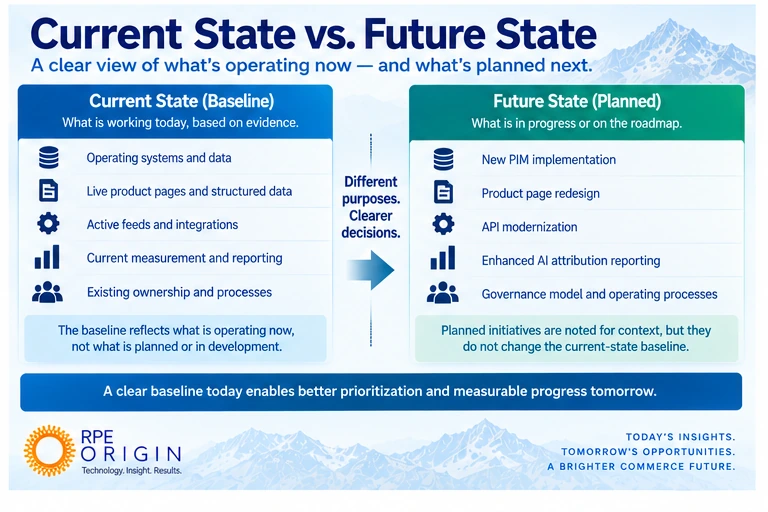
An organization may already have a new PIM project, API modernization effort, analytics implementation or content replatform underway.
Those initiatives belong in the assessment context because they may affect remediation choices and dependencies.
They should not inflate the baseline.
The baseline should describe what is operating now. Planned initiatives can be noted separately as committed remediation, planned capability, dependency or future-state initiative.
Keeping that boundary clear preserves the integrity of the current-state assessment.
The Baseline Needs a Date
Readiness changes over time.
That means the baseline should be explicitly time-bound, for example: Current-state baseline as of October 2026.
This matters because product data, system architecture, platform requirements and operating processes all change after the assessment begins.
A dated baseline makes later comparison possible and prevents a historical assessment from being mistaken for the current operating state.
The Baseline Should Be Repeatable
One of the biggest benefits of a structured baseline is that it can be measured again later.
If the organization returns in six months, it should be possible to ask whether product-data consistency improved, semantic coverage increased, crawl failures declined, AI referral measurement strengthened or governance controls became clearer.
That creates trend data.
It turns the assessment from a one-time report into a reference point for continuous improvement.
The value of the baseline therefore grows when the methodology and evidence definitions remain stable enough to support comparison over time.
Baseline Is the Bridge Between Assessment and Decision-Making
Assess answers: What does the evidence show?
Baseline answers: What does that evidence mean about the organization today?
The next step asks: Which findings matter most?
That is the purpose of Prioritize.
The baseline becomes the decision surface for comparing impact, urgency, effort, dependencies and strategic value.
Without a coherent baseline, prioritization becomes reactive. With a coherent baseline, the organization can make deliberate choices about where to act first.
Do You Have a Clear Baseline for AI Commerce Readiness?
A useful readiness assessment should do more than identify individual defects. It should show where the organization stands across product data, product knowledge, technical access, content, agent capabilities, measurement and governance. An AI Commerce Readiness Assessment can help turn validated findings into a defensible current-state baseline that supports better prioritization and future measurement.
Recent Comments