
Discovery establishes context. Assessment tests it.
By the end of the Discover phase, RPE Origin should understand the organization’s business model, priority categories, major systems, customer decision patterns, strategic goals, known concerns and representative commerce scenarios.
Those inputs define what matters. They do not determine the findings.
That happens during Assess, the second stage in the RPE Origin process: Discover → Assess → Baseline → Prioritize → Roadmap.
This is the point where stakeholder beliefs, process documentation, system configuration and real-world behavior are compared across the seven readiness dimensions.
The central question becomes: What does the evidence actually show?
Assessment Should Verify, Not Confirm
A common failure in consulting and technical assessment work is starting with a stakeholder concern and unconsciously trying to prove it.
Statements such as “our product data is strong,” “our APIs are ready,” “the site is fully crawlable,” or “we have good governance” can be valuable context because they reveal how the organization sees itself.
They are not findings.
The Assess phase should test them.
A product-data team may sincerely believe attributes are complete because the PIM contains the expected fields. The assessment may discover that those fields disappear in the merchant feed. An ecommerce team may believe structured data is healthy because Product schema appears on the page, while testing shows that important variant or availability values are inconsistent.
The objective is not to disprove stakeholders. It is to replace assumption with evidence.
Score the Evidence, Not the Ambition
This is one of the core principles of the RPE Origin methodology: Score the evidence, not the ambition.
An organization may have strong intentions. It may have a roadmap, a newly selected PIM, a product-page redesign or an API modernization initiative underway.
Those initiatives matter, but they do not describe the current operating state.
An assessment baseline has to reflect what exists today.
If a capability is planned but not operating, it should not be scored as though it already exists. If a process is documented but not followed, observed operating behavior matters more than the document. If a feed specification says a field should be populated but the actual feed is missing the value, the feed is the evidence.
This distinction keeps the assessment defensible and prevents future-state plans from inflating current-state readiness.
Assessment Happens Across Connected Evidence
The seven readiness dimensions are distinct, but they are not isolated.
A single weakness can appear across several dimensions.
Consider a compatibility problem. The assessment may find that compatibility attributes are missing from the PIM, product manuals contain relevant information that is not structured, product pages do not explain the relationship clearly, structured data does not expose it, AI-assisted test scenarios produce inconsistent answers and no team clearly owns the compatibility model.
That is not one finding repeated six times.
It is one underlying weakness with consequences across multiple readiness dimensions.
The Assess phase should therefore look for patterns across evidence rather than treating every observation as an isolated defect.
Representative Products Create a Manageable Test Set
Most assessments do not need to manually inspect every SKU.
They need to determine whether the organization’s systems and processes reliably produce good outcomes.
Representative products make that possible.
The test set may include simple products, multi-variant products, technically complex products, high-revenue items, frequently compared products, items with compatibility requirements, promotional products, low-inventory products, replacement products and recently launched items.
The purpose is not statistical sampling in the strict academic sense. It is to exercise meaningful catalog patterns.
A product that crosses several systems and business rules can reveal more about readiness than dozens of uncomplicated records.
Evidence Should Be Traced Across Systems
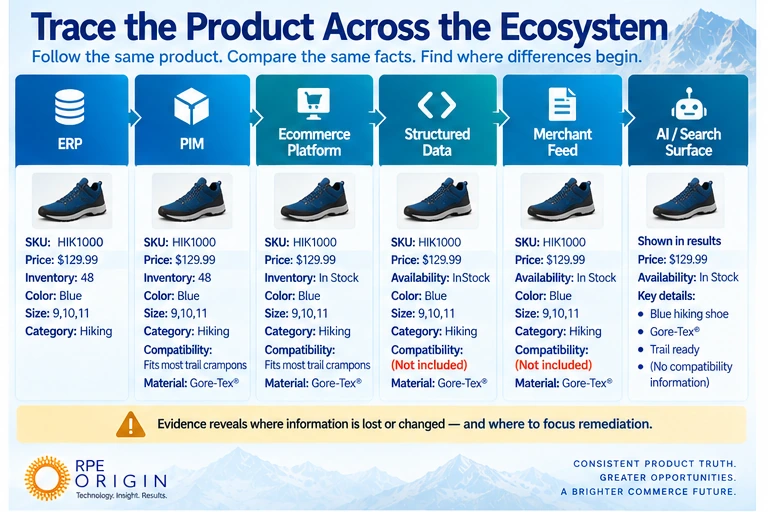
One of the strongest assessment techniques is following the same product across the commerce ecosystem.
For example: ERP → PIM → ecommerce platform → structured data → merchant feed → marketplace or AI/search surface.
At each stage, the assessment can compare identity, title, attributes, variants, price, availability, imagery, relationships and descriptions.
That creates a product-truth trace.
If information changes, disappears or conflicts, the assessment can identify where the divergence begins.
This is much more useful than concluding that the product feed is inconsistent. A stronger finding might show that the source data is correct in the PIM but a transformation step drops a compatibility attribute before publication.
That difference matters because the second finding points toward a specific remediation path.
Scenarios Test More Than Product Records
Product tracing examines information consistency. Representative commerce scenarios test whether the information actually supports a real customer need.
Consider a shopper asking for a lightweight carry-on under $200 that fits domestic overhead bins and has a padded laptop compartment.
That scenario can test product attributes, semantic suitability, product comparison, price freshness, availability, content quality, technical accessibility and AI representation at the same time.
A single scenario can therefore produce evidence across several dimensions.
The question is not simply whether a product appears in the answer.
It is whether the system has enough reliable evidence to determine why the product belongs in the answer and whether the supporting facts remain consistent across the underlying systems.
The Seven Dimensions Need Different Evidence
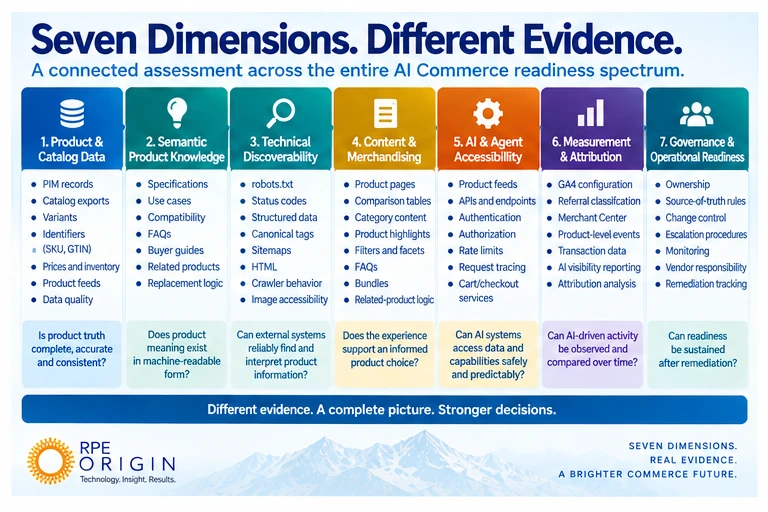
Although the assessment is integrated, each dimension requires different evidence.
Product & Catalog Data may require PIM records, catalog exports, identifiers, variants, pricing, inventory and feed diagnostics.
Semantic Product Knowledge may require specifications, use cases, compatibility rules, audience guidance, buyer guides, FAQs, related products and replacement logic.
Technical Discoverability may require robots.txt, status codes, structured data, canonical tags, HTML, sitemaps, crawler behavior, image accessibility and redirect testing.
Content & Merchandising may require product pages, comparison tables, category content, product highlights, filters, FAQs, bundles and merchandising rules.
AI & Agent Accessibility may require feeds, APIs, authentication, authorization, rate limits, environment separation, tracing and cart or checkout services.
Measurement & Attribution may require GA4, referral classifications, Merchant Center, AI reporting, product-level events, transaction data and attribution configuration.
Governance & Operational Readiness may require ownership maps, source-of-truth documentation, change control, escalation, monitoring, vendor responsibility and remediation tracking.
The assessment asks a different question in each dimension, so the evidence has to match the question.
Evidence Quality Matters
Not all evidence is equally strong.
A stakeholder statement is useful. A documented process can be stronger. A system configuration is stronger still. Observed behavior may provide the highest level of confidence.
Consider the question: Is a specific crawler allowed to access the site?
Possible evidence might include someone saying it is allowed, robots.txt appearing to allow it, a WAF configuration showing an allow rule, and an actual request successfully retrieving the intended content.
Each level adds confidence.
The assessment should distinguish among stated evidence, documented evidence, configured evidence and observed evidence rather than treating them as equivalent.
That distinction becomes particularly important when documentation and actual behavior do not agree.
Testing Should Reproduce the Customer and Machine Experience
An assessment should not rely only on backend records.
It should inspect the final representations available to customers and external systems.
A PIM record can be correct while the product page is wrong. The product page can be correct while structured data is stale. Structured data can be correct while the feed points to another variant. An API may return accurate product information while an agent-facing integration exposes an older cached value.
Testing should therefore include actual delivery surfaces where appropriate: live product pages, returned HTML, structured data, feeds, images, API responses, referral classifications and realistic AI-assisted product questions.
The goal is to evaluate what is actually available at the edge, not merely what upstream systems are intended to publish.
Assessment Should Look for Systemic Patterns
Not every defect deserves a major finding.
One malformed product record may be an isolated issue. The same problem appearing across an entire category suggests something systemic.
The Assess phase should distinguish among isolated defect, repeatable pattern and structural capability gap.
That distinction becomes critical later during prioritization.
A single broken image may require a local correction. A product-image pipeline that routinely produces inaccessible URLs may require architecture work. A missing compatibility field on one SKU may be a data-entry issue; the same field missing across every product may indicate a schema or process gap.
The symptom can look similar. The remediation can be completely different.
Exceptions Matter
Assessment frameworks become unreliable when every variation is automatically treated as a defect.
Commerce systems contain legitimate exceptions.
Some products may not require GTINs. Some categories may not need compatibility information. Some products may intentionally have distinct variant URLs. Certain items may be unavailable in specific markets by design.
The assessment should therefore ask whether an exception is intentional, documented, controlled and understandable.
An intentional exception is not the same thing as an unmanaged inconsistency.
This prevents the methodology from rewarding uniformity for its own sake.
Findings Need Evidence Trails
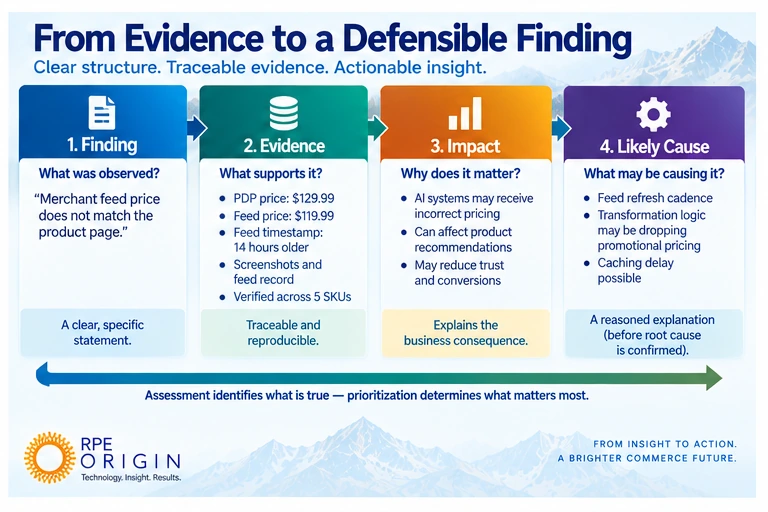
A useful finding should be traceable.
For example, the finding may state that product availability is not consistently synchronized across channels.
The supporting evidence might show that the ERP and product detail page both report In Stock while the merchant feed reports Out of Stock and has a timestamp many hours older than the source record.
The business impact may be that AI-assisted or shopping-channel experiences receive stale availability information.
The likely cause may be an insufficient feed-refresh cadence or a failed synchronization job.
That is much stronger than writing “inventory needs improvement.”
Good findings explain what happened, where it was observed, why it matters and what evidence supports the conclusion.
Evidence Should Be Reproducible
Another important quality standard is reproducibility.
If a finding depends on a transient condition, the assessment should preserve enough evidence for someone else to validate what was observed.
That may include product identifier, URL, timestamp, feed record, screenshot, API response, query result or test scenario.
This becomes especially important when product state changes quickly.
A price mismatch found on Tuesday may disappear on Wednesday after a normal update cycle. Without a preserved evidence trail, the finding can become difficult to defend or investigate.
Reproducibility also makes remediation verification easier because the organization can rerun the same test after the fix.
The Assessment Should Separate Finding From Cause
A common mistake is assuming the cause before the investigation is complete.
For example, the confirmed finding may be that a Merchant Center price does not match the product detail page.
Possible causes could include stale source data, failed feed refresh, transformation logic, promotional timing, regional pricing or caching.
The finding can be confirmed before the root cause is known.
The assessment should therefore distinguish observed finding from probable cause and confirmed root cause.
That separation prevents premature conclusions and makes it easier for technical teams to investigate without inheriting an unsupported diagnosis.
Severity Should Not Be Assigned Too Early
During Assess, the primary objective is to determine what is true.
Prioritization comes later.
A finding may look severe technically but have limited business impact. Another may look small but affect the organization’s highest-revenue category or a product family with heavy return volume.
That is why the canonical process separates Assess from Prioritize.
Assessment determines the evidence. Prioritization determines what matters most.
Keeping those steps separate reduces the temptation to let urgency influence the interpretation of the evidence itself.
Contradictory Evidence Is Useful
Sometimes systems disagree.
That is not an obstacle to the assessment. It is often the finding.
If the PIM says one thing, the feed says another and the product page says something else, the contradiction itself is evidence.
The assessment should not silently choose the source that appears most convenient.
It should identify the discrepancy, determine which source is supposed to be authoritative and document where the conflict appears.
Contradictory evidence often exposes governance weaknesses that would otherwise remain hidden.
Missing Evidence Is Also Evidence
An organization may not have documented field ownership, API specifications, feed mappings, monitoring thresholds, AI referral reporting or a formal product-knowledge model.
The absence of those artifacts does not automatically prove that the underlying capability is poor.
But it does limit confidence.
A mature assessment should distinguish between evidence of weakness and lack of evidence supporting strength.
That nuance matters because an undocumented process that happens to work today may still represent operational risk, even if the immediate output looks acceptable.
Assessment Should Avoid False Precision
Maturity scoring can create a false sense of certainty.
A score of 71 versus 74 can appear highly precise even when the underlying evidence does not justify that level of differentiation.
Scoring should therefore be used as a communication mechanism, not as a substitute for professional judgment.
The strongest output is not the score alone.
It is the evidence explaining why the score exists.
That is why the RPE Origin framework emphasizes: Evidence in. Actionable roadmap out.
The Assess Phase Produces Findings, Not Yet a Roadmap
By the end of Assess, the organization should have a documented body of evidence.
That may include validated strengths, material gaps, observed inconsistencies, systemic patterns, known exceptions, unresolved questions, likely causes and evidence confidence.
Those findings are not yet the roadmap.
They first need to be organized into a coherent current-state view.
That is the purpose of the next phase: Baseline.
Baseline answers: What does all of this evidence mean about where the organization stands today?
Are Your AI Commerce Decisions Based on Evidence or Assumptions?
A readiness assessment should verify how product data, content, technical access, integrations, measurement and governance actually perform—not simply document how they are intended to work. An AI Commerce Readiness Assessment can help turn representative products, system evidence and real customer scenarios into defensible findings across all seven readiness dimensions.
Recent Comments