
From Search Results to AI Recommendations: How Product Discovery Is Changing
For most of the last two decades, digital commerce discovery has followed a familiar pattern.
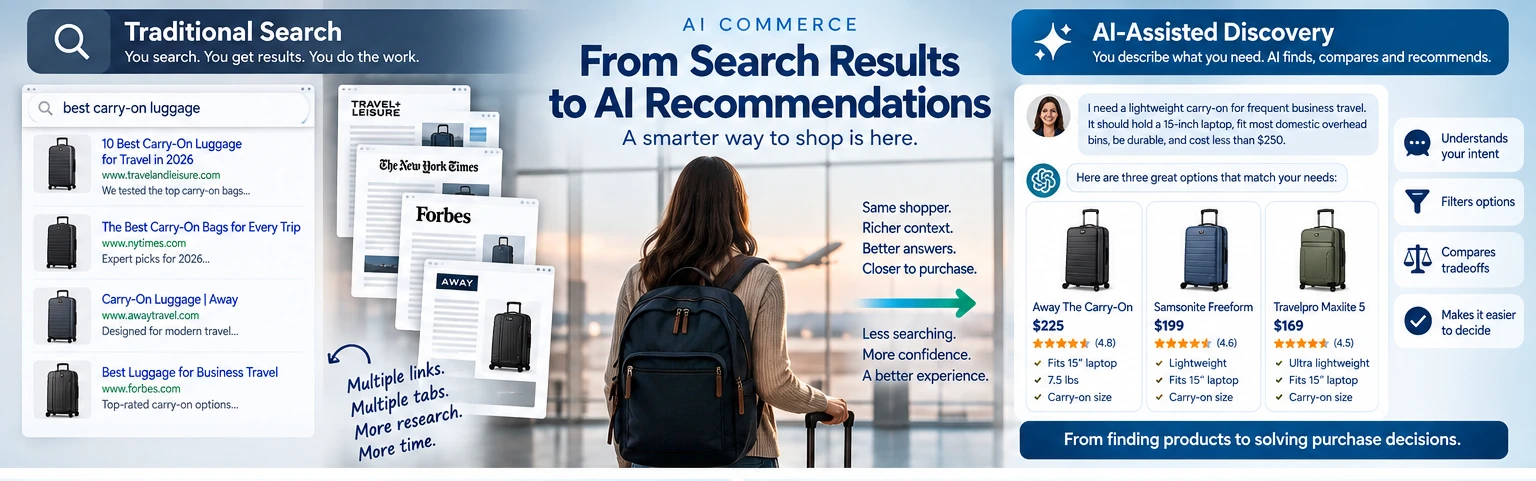
A shopper enters a query. A search engine returns results. The shopper opens several pages, compares products, reads reviews, checks specifications and decides what to buy.
The search engine helps the shopper find options. The shopper does most of the interpretation.
AI-assisted commerce changes that relationship.
Instead of starting with a short keyword phrase, a consumer can describe the problem they are trying to solve: “I need a lightweight carry-on for frequent business travel. It needs to hold a 15-inch laptop, fit most domestic overhead bins and cost less than $250.”
The AI system can then interpret the constraints, identify relevant products, compare alternatives and help narrow the decision.
That is not simply a different kind of search box. It is a different discovery model. And for brands preparing for AI Commerce, that difference matters.
Product Discovery Is Moving From Queries to Intent
Traditional search has historically depended heavily on keywords. A shopper searches for carry-on luggage, running shoes, coffee maker, gifts for golfers or laptop backpack. Those phrases contain some intent, but much of the decision-making remains implicit.
The shopper still has to determine which features matter, which products satisfy the need, which tradeoffs are acceptable, which alternatives are better and whether the product is appropriate for a particular situation.
Conversational AI allows more of that intent to be expressed directly. A consumer can say: “I need a running shoe for daily training. I have wide feet, run about 20 miles per week, prefer substantial cushioning and want to stay under $160.”
That request contains product category, use case, fit requirement, usage frequency, performance preference and budget. The AI system can work with that richer context immediately.
For brands, this means optimization can no longer stop at the question: “Which keywords describe our product?” It must increasingly include: “Which customer needs can our product confidently satisfy?”
Search Returns Results. AI Can Return a Shortlist.
Consider the difference between two experiences.
Traditional search for “best cordless vacuum” may return retailer pages, review sites, category pages, sponsored listings and manufacturer pages. The consumer then evaluates the results.
With AI-assisted discovery, the shopper can ask: “I live in a small apartment with hardwood floors and a dog. I want a cordless vacuum that is quiet, easy to store and costs less than $400.”
The AI can potentially identify several candidates and explain which meet the budget, which perform well on pet hair, which are suitable for hardwood floors, which are compact and which have relevant tradeoffs.
The system is not just retrieving products. It is helping construct the consideration set.
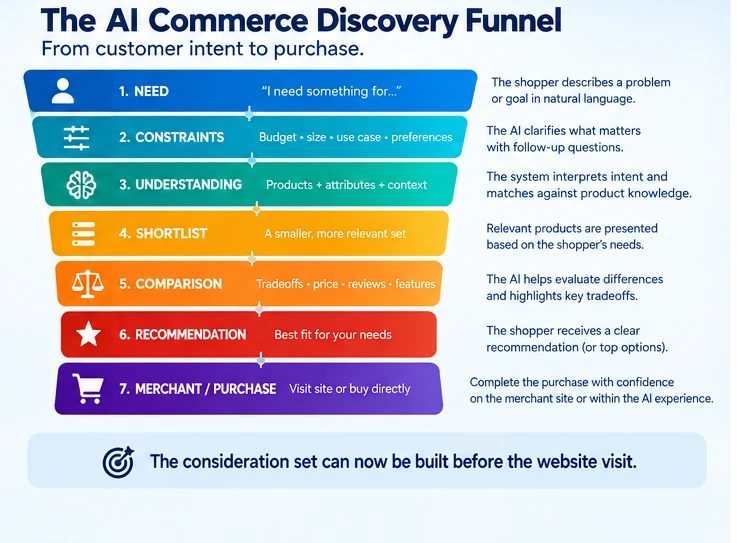
The Consideration Set May Be Built Before the Website Visit
Traditional digital-commerce strategy often assumes that the merchant website is where substantial product comparison takes place. Once on the site, merchandising, content, filters and recommendations help the consumer evaluate products.
AI-assisted shopping can move some of that work upstream. Before the customer visits the merchant, the AI may already have helped determine the relevant category, suitable product types, key evaluation criteria, competing brands, acceptable tradeoffs and a shortlist of specific products.
In some cases, the merchant website may receive a shopper who is already much closer to purchase.
The strategic implication is significant: product discovery is becoming distributed across AI systems, not concentrated entirely inside search results and merchant websites.
Being Indexed Is Not the Same as Being Understood
A product can exist online and still be poorly represented in an AI-assisted shopping experience. A search engine may be able to find the product page, but recommendation requires more.
The AI system may need to understand what the product is, which variants exist, what it costs, whether it is in stock, what features it offers, which use cases it supports, who it is appropriate for and how it differs from alternatives.
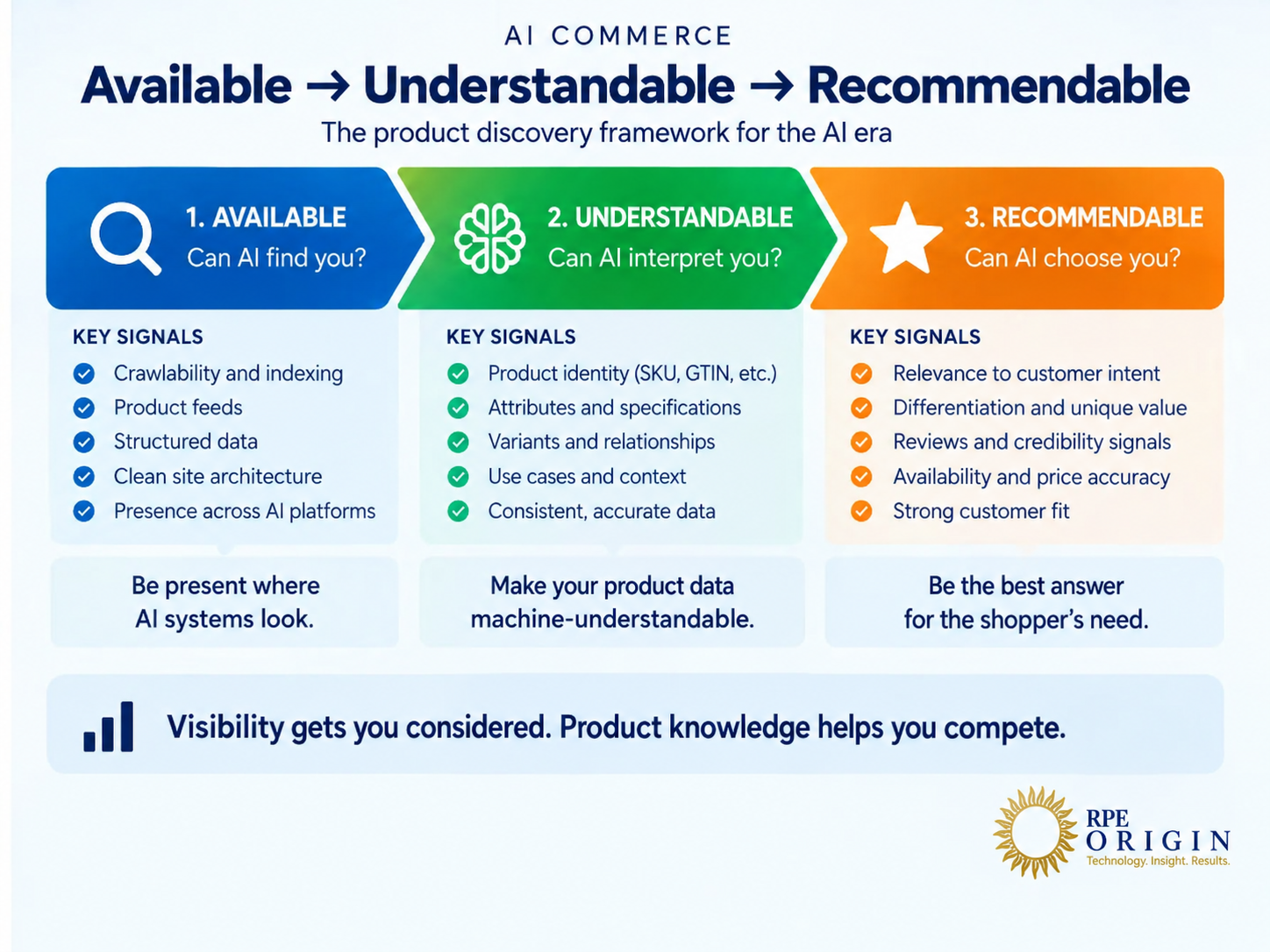
That leads back to the framework introduced in Article 1: Available → Understandable → Recommendable.
Traditional SEO has often concentrated heavily on the first stage: can the page be discovered? AI Commerce increases the importance of the next two: can the product be accurately interpreted, and can the system determine when the product is relevant to a specific need?
Recommendation Introduces a New Competitive Layer
Search ranking has always been competitive. Brands compete for organic visibility, paid placement, shopping results and marketplace position.
AI-assisted discovery adds another competitive layer: recommendation eligibility.
Imagine a shopper asks: “What are three good carry-on bags under $200 for business travelers who carry laptops?” There may be hundreds of products that technically qualify. The AI system must narrow them.
That requires enough product information to compare price, size, weight, laptop compatibility, durability, reviews, availability and intended use.
If a competitor communicates these facts clearly and your product does not, the AI may have more confidence in the competitor. This is why AI Commerce readiness is not just about visibility. It is about confidence.
AI Can Ask the Questions a Sales Associate Would Ask
One of the most important differences between search and conversational commerce is the ability to clarify.
If a shopper says “I need a new laptop,” a traditional search engine may immediately return results. An AI assistant can instead ask about budget, gaming, travel, operating system, battery life, performance and preferred screen size.
Each answer improves the recommendation. This begins to resemble the role traditionally played by a knowledgeable salesperson, product specialist, comparison site or buying guide.
For merchants, the implication is straightforward: if an AI asks the shopper the right questions, your product data needs to contain the answers.
Product Discovery Is Becoming Multi-Step
The AI shopping journey is not always a single query followed by a single answer. It can become iterative.
A shopper might begin with “Find me a good espresso machine under $1,000,” then refine with “I do not want something fully automatic,” “I care more about milk drinks than straight espresso,” “I do not have much counter space,” and finally “Compare the top three choices.”
Each refinement changes the criteria. The system is gradually constructing a more precise representation of the shopper’s intent.
This is another reason simple keyword optimization is insufficient. The product needs to remain relevant as the conversation becomes more specific.
Comparison Is Moving Upstream
AI systems are particularly well suited to comparison. A shopper may ask: “Compare these three televisions for a bright living room.” That request is not asking for three product pages. It is asking the system to synthesize differences.
The AI may need to compare panel type, brightness, anti-glare performance, size, price, refresh rate, ports and reviews.
The quality of that comparison depends heavily on the quality of the available product information. Product attributes are becoming part of the discovery experience itself.
The Merchant Website Still Matters
It would be a mistake to conclude that AI discovery makes the merchant website irrelevant. The opposite is more accurate.
The merchant site remains one of the most important sources of authoritative product information. It provides product detail, inventory, price, shipping, returns, merchandising context, reviews, brand experience and checkout.
What changes is the role the website plays in the journey. Instead of always being the place where discovery begins, it may increasingly become the place where a shopper validates, deepens or completes a decision that started somewhere else.
That makes accuracy and consistency even more important across website content, product feeds, structured data, inventory, pricing, marketplaces and commerce APIs.
Discovery May Extend All the Way to Checkout
The boundary between product discovery and transaction is also becoming less distinct. AI commerce systems are increasingly being designed to support more of the shopping journey across discovery, retailer selection and purchase.
The direction is clear: the AI layer is moving closer to the transaction.
For merchants, that increases the importance of making product, pricing, inventory and fulfillment information reliable enough to support automated decisions.
SEO Is Not Going Away
The emergence of AI Commerce does not eliminate search engine optimization. Many of the same fundamentals remain important: crawlability, structured data, authoritative content, clear product information, site performance, internal linking and content quality.
But the objective broadens. Traditional SEO often asks: “How do we improve our position in the results?” AI Commerce adds: “How do we become a reliable source for an answer?”
Those are related goals, but they are not identical. Ranking optimizes for visibility. AI readiness also optimizes for understanding, confidence, relevance, comparison and recommendation.
Measure More Than Referral Traffic
AI Commerce also creates a measurement challenge. Some AI-assisted journeys will generate referral traffic. Others may influence a shopper before the visit. Some may eventually complete more of the transaction without requiring a traditional click-through path.
That means analytics teams should begin thinking beyond: “How much traffic did AI send?”
Useful questions include which AI surfaces expose the brand, which products appear most frequently, which attributes influence discovery, which competitors appear alongside the brand, which shopping questions produce brand visibility, whether AI-referred visitors convert differently, whether product information is accurate when surfaced and where recommendation gaps are occurring.
AI discovery should be measured as a journey, not simply another referral source.
Start Testing Recommendation Scenarios
A practical next step is to build a small library of realistic customer scenarios. Avoid branded prompts.
Instead of asking “What can you tell me about our Weekender Pro?” ask “What carry-on bags under $200 are good for frequent business travelers who carry a 15-inch laptop?”
Then record which products appear, which brands appear, which attributes are mentioned, which competitors dominate, whether facts are accurate, which questions your product cannot answer and what differentiators are missing.
Repeat this across product categories, price points, use cases, customer segments, seasonal occasions and common objections. This begins to reveal how your catalog performs when discovery is driven by customer intent rather than brand awareness.
From Available to Recommendable
The evolution from traditional search to AI-assisted commerce can be summarized in three stages.
Available: Can the product be found?
Understandable: Can the system accurately interpret what the product is and what it offers?
Recommendable: Can the system confidently determine when the product belongs in the shopper’s consideration set?
Search visibility remains important. But AI Commerce readiness extends beyond visibility.
The emerging competitive question is: when an AI system is asked to solve a customer’s problem, does your product have enough reliable information and relevance to become part of the answer?
Understand How Your Brand Appears in AI-Assisted Discovery
An AI Commerce Readiness Assessment evaluates how your product data, content, technical architecture and measurement capabilities support discovery across emerging AI shopping experiences.
The goal is to identify where your products are visible, understandable, competitive, accurately represented and positioned for recommendation before AI-mediated product discovery becomes an even larger part of the customer journey.
Schedule an AI Commerce Readiness Assessment with RPE Origin to establish your discovery baseline and identify the gaps between being available online and being recommendable by AI.
Is Your Brand Ready for AI-Assisted Product Discovery?
AI-assisted shopping is changing how products enter the consideration set. An AI Commerce Readiness Assessment can help you understand how effectively your product data, content, technical architecture and measurement capabilities support discovery across emerging AI shopping experiences.
Establish your discovery baseline, identify where product information is incomplete or inconsistent, and prioritize the gaps that may limit whether your products are found, understood and recommended.
Recent Comments