

Can AI Understand Your Products? Why Product Data Is Becoming a Competitive Advantage
Most ecommerce organizations already have a lot of product data.
They have product titles, descriptions, SKUs, images, categories, prices, inventory, specifications and feeds distributed across websites, marketplaces, advertising platforms and internal systems.
So it is reasonable to assume that artificial intelligence should already understand what they sell.
Unfortunately, having product information and having machine-understandable product knowledge are not necessarily the same thing.
That distinction is becoming increasingly important as consumers use AI systems to discover products, compare options and narrow purchase decisions.
A traditional ecommerce experience might begin with a search like: “carry-on luggage.”
An AI-assisted shopping interaction may instead begin with: “I travel twice a month for work. I need a durable carry-on under $250 that will fit most domestic overhead bins, holds a 15-inch laptop and weighs less than seven pounds.”
For a retailer to participate effectively in that second interaction, an AI system needs more than a product name and an attractive description. It needs facts. It needs context. And it needs enough structured information to determine which products actually satisfy the shopper’s requirements.
That is why product data is becoming one of the foundational elements of AI Commerce readiness.
AI Shopping Requires More Than Keywords
Search engines have spent decades interpreting the relationship between keywords and webpages. Retail teams adapted accordingly: product titles were optimized, category pages were developed, descriptions were written around search demand, metadata was refined and feeds were optimized for paid and organic shopping channels.
Those practices continue to matter. But conversational AI introduces another layer of interpretation.
Instead of matching a relatively short query to a collection of documents or products, an AI shopping system may need to reason across multiple constraints simultaneously – budget, dimensions, material, compatibility, intended use, style, recipient, delivery requirements, performance characteristics, product features and availability.
The AI system then has to identify which products satisfy those constraints. That changes the role of product information.
The question is no longer simply: “Can the system find this product?” It increasingly becomes: “Can the system accurately understand enough about this product to determine whether it belongs in the recommendation?”
Product Data Is Becoming Part of the Recommendation Engine
The direction of the major commerce platforms makes this increasingly clear.
OpenAI’s product-discovery infrastructure allows merchants to provide product feeds and promotions so product information can be represented more directly in conversational shopping experiences. Google is moving in a similar direction: Merchant Center’s AI-oriented reporting includes product-attribute insights and attribute completeness, reinforcing the importance of complete and structured product specifications.
The implication is straightforward: the quality of your product data increasingly influences the quality of the machine’s understanding.
A Product Description Is Not the Same as Product Knowledge
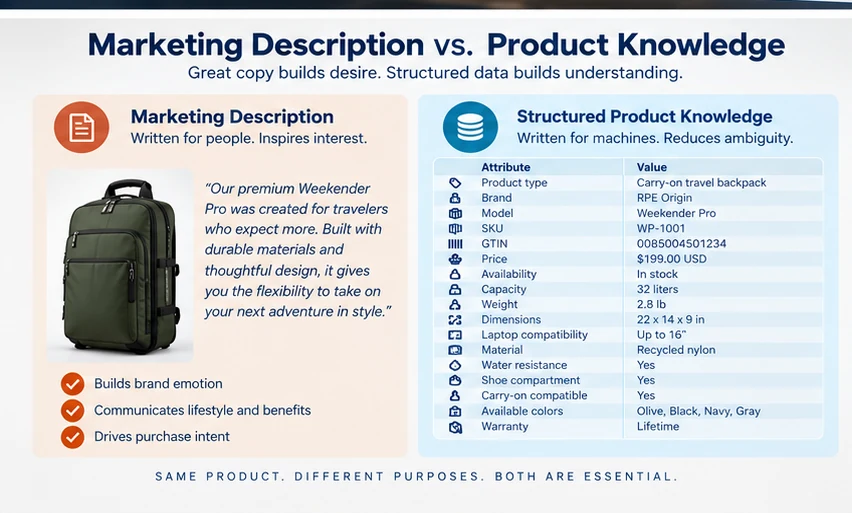
Consider this fictional product description: “Our premium Weekender Pro was created for travelers who expect more. Built with durable materials and thoughtful design, it gives you the flexibility to take on your next adventure in style.”
That copy may support the brand. It may communicate positioning. It may even convert well.
But now consider the questions an AI system may need to answer: What are its exact dimensions? How much does it weigh? What material is it made from? Does it fit a 15-inch laptop? Is it waterproof or water-resistant? Does it qualify as a carry-on? Does it contain a separate shoe compartment? What colors are available? What is the warranty? Which variants are currently in stock? Can it arrive before Friday?
If the answers exist only inside photography, PDFs, lifestyle copy or disconnected systems, the product may be much harder for machines to interpret reliably.
Good marketing copy and structured product knowledge serve different purposes. Strong AI Commerce preparation requires both.
Think in Attributes, Not Just Descriptions
One of the most useful changes a commerce team can make is to begin thinking about products as collections of explicit attributes.
Instead of relying on “Our lightweight commuter backpack is perfect for busy professionals,” the product knowledge layer might include product type, intended use, capacity, weight, laptop compatibility, material, water resistance, exterior bottle pockets, carry-on compatibility, warranty and available colors.
The marketing description can still exist. But the machine no longer needs to infer every important characteristic from prose. This is one reason structured attributes are so valuable: they reduce ambiguity.
The Attributes That Matter Depend on the Product
There is no universal AI Commerce attribute list. The meaningful properties of a television are different from those of a mattress, pair of running shoes or skincare product.
For televisions, shoppers may care about screen size, panel technology, refresh rate, resolution, brightness, HDMI inputs and gaming features. For furniture, dimensions, materials, assembly requirements, weight capacity, style, room suitability, fabric and color may matter. Apparel may depend on size, fit, material, pattern, intended audience, care requirements and weather suitability. Beauty products may depend on ingredients, skin type, formulation, fragrance, application, benefits and sensitivities.
The important question becomes: What characteristics actually determine whether this product is appropriate for a particular customer’s need? Those characteristics deserve to become first-class product data.
Variants Need Clear Relationships
Product variants are another area where ambiguity can undermine machine understanding.
A merchant may sell one shoe in eight sizes, four colors and two widths. Humans intuitively understand these as variations of the same product. Machines need that relationship to be represented correctly.
The answer to “Do you carry this shoe in women’s size 9, wide, in black?” requires more than knowing the shoe exists. The system must understand the relationship between the parent product and the specific purchasable variation.
Identity Matters More Than It Appears
Product identity is another foundational issue. Important identifiers may include SKU, GTIN, UPC, EAN, ISBN, MPN, brand and manufacturer.
These identifiers help platforms determine whether two pieces of information refer to the same product. That becomes particularly important when information is being reconciled across the ecommerce platform, product feeds, marketplaces, structured data, advertising platforms, manufacturer information, reviews and inventory systems.
A product whose identity changes from system to system creates ambiguity. AI Commerce readiness therefore includes a surprisingly traditional discipline: data governance.
Your Website and Product Feed Should Agree
Many ecommerce teams think about their product page and product feed as separate assets. From a machine’s perspective, discrepancies between them can become a trust and quality problem.
Imagine a website price of $149.00 while the feed says $129.00; a website that says out of stock while the feed says in stock; or a product page showing blue and black variants while the feed includes black only.
When the same product is described differently across multiple authoritative sources, an AI system may have to decide which source to trust. The cleaner solution is consistency.
Structured Data Creates a Machine-Readable Layer
Structured data gives commerce organizations a mechanism for describing products in a standardized format.
On an ecommerce product page, Product and Offer schema can communicate properties such as product name, description, SKU, GTIN, brand, price, currency, availability, shipping and return information.
Structured data should not be considered a replacement for strong visible content. It is a complementary layer. The customer sees the product experience. Machines receive a more explicit representation of the product underneath it.
AI Commerce Requires Context, Not Just Specifications
Technical specifications are necessary, but specifications alone do not completely describe why someone should buy something.
Consider a sleeping bag. The catalog may accurately represent weight, dimensions, insulation material, temperature rating and packed size. But a shopper may ask: “Is this a good sleeping bag for a beginner camping in Georgia in October?”
The answer requires context. Product knowledge may need to represent concepts such as seasonality, environment, experience level, intended use, suitability and tradeoffs.
This is where AI Commerce begins moving beyond traditional product-information management. A mature product knowledge model connects what the product is with what the product is good for.
Images Contain Product Information Too
Commerce organizations should also consider how much important product information lives only inside imagery.
Examples include dimensions shown in diagrams, ingredient lists shown on packaging, installation diagrams, comparison charts, size charts, compatibility matrices, material labels and feature callouts.
The goal should not be to eliminate visual communication. The goal should be to avoid making an image the only authoritative source for an important product fact. If a specification affects purchase suitability, it should generally exist as accessible text or structured data as well.
Completeness Is Not the Same as Quality
A catalog can technically have every required field populated and still contain weak product information.
Values such as “premium material,” “modern” or “everyday” may satisfy a field requirement without providing meaningful differentiation.
High-quality product data should be specific, factual, consistent, current, relevant, normalized where appropriate and understandable outside internal company terminology.
This is why catalog completeness should not be evaluated purely as a percentage. The more important question is: Does the data contain enough reliable meaning to support a purchase decision?
Begin With the Questions Customers Ask
A practical AI Commerce product-data exercise begins with customer intent.
Take a representative product category. Then create ten or twenty realistic questions customers might ask an AI system.
For a running shoe retailer, those might include: Which shoes are best for runners with wide feet? What shoes under $150 work well for daily training? Which models are waterproof? Which shoes are appropriate for trail running? Which options are lightweight but still offer substantial cushioning?
Then map each question to the product attributes required to answer it accurately. That exercise often reveals the difference between the product information an organization already stores and the product knowledge shoppers actually need.
Assess the Product Knowledge Gap
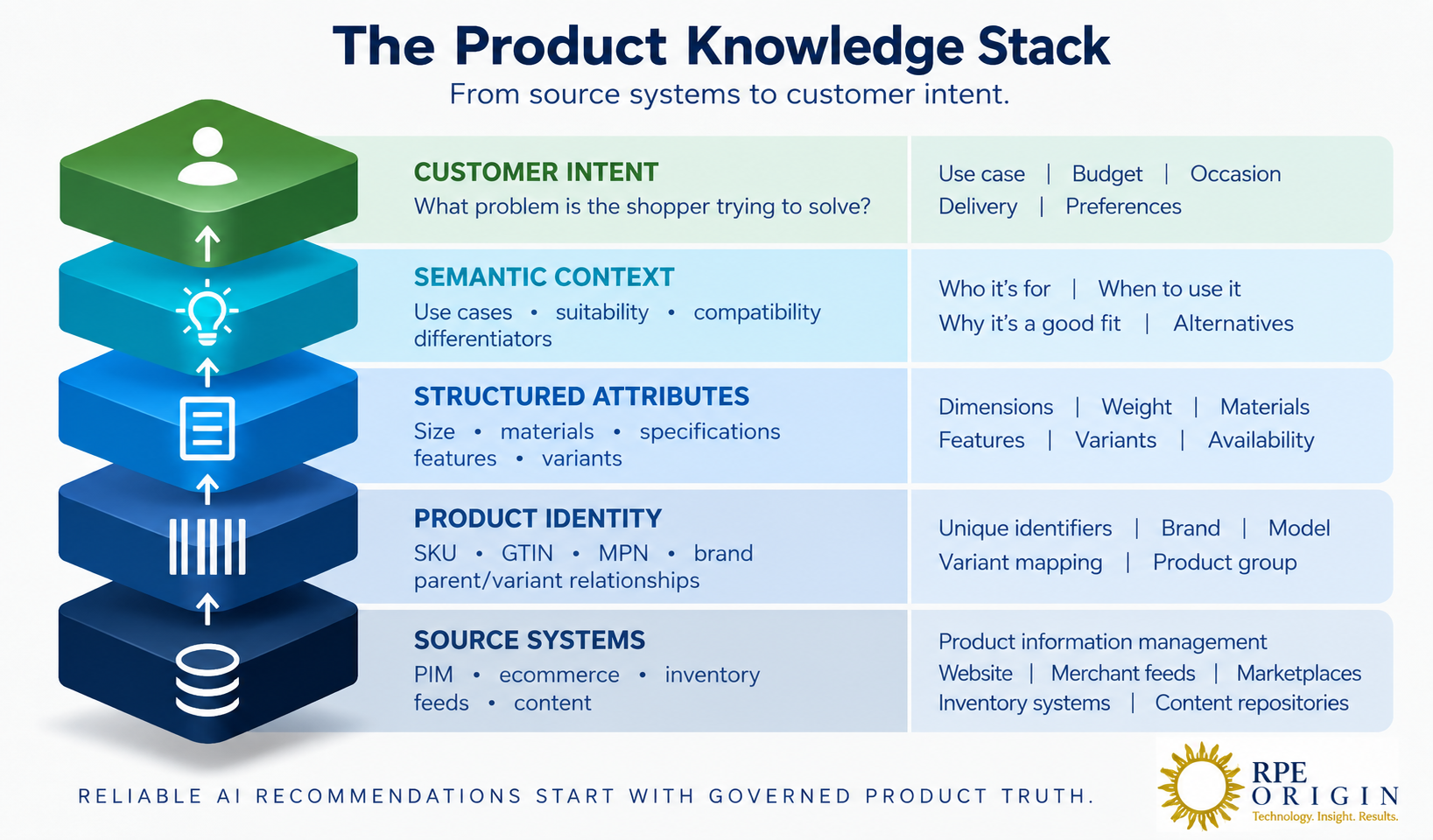
An effective AI Commerce readiness assessment should examine product information across multiple layers:
- Product Identity – Are products and variants consistently identifiable?
- Attribute Completeness – Are important category-specific characteristics represented?
- Attribute Quality – Are values useful, specific and normalized?
- Content Coverage – Can important customer questions be answered?
- Structured Data – Are important product facts represented in machine-readable form?
- Feed Quality – Are commerce feeds complete, current and consistent?
- Cross-System Consistency – Do the website, feed, inventory and commerce platforms agree?
- Semantic Context – Can the system understand intended use, suitability and differentiators?
These are not simply SEO checks. They form the foundation of machine-understandable commerce.
Better Product Knowledge Has Value Beyond AI
One of the strongest reasons to improve product data is that the benefits extend well beyond AI shopping.
Better structured product knowledge can improve onsite search, filters and facets, merchandising, product recommendations, marketplace syndication, paid media, personalization, customer service, product comparison, analytics and catalog operations.
AI Commerce is creating a new reason to address problems that many commerce organizations already know exist. The difference is that machines are becoming an increasingly important consumer of the same data.
Can AI Actually Understand What You Sell?
In the first article in this series, we introduced a simple AI Commerce readiness model: Available -> Understandable -> Recommendable.
Product data is the bridge between the first two stages.
Your products may already be available online. The next question is whether machines can accurately understand what they are, how they differ, which variants exist, what they cost, whether they’re available, what they’re compatible with, who they’re intended for and which customer needs they satisfy.
Only then can an AI system begin to determine when those products should be recommended.
Find the Gaps Before Your Customers Do
An AI Commerce Readiness Assessment examines how effectively your existing product data, feeds, content and technical infrastructure communicate what you sell to emerging AI-driven commerce systems.
The objective is not simply to populate more fields. It is to identify the information AI systems need to understand your products accurately, determine where that knowledge is incomplete or inconsistent, and establish a prioritized path toward becoming more discoverable and recommendable.
Schedule an AI Commerce Readiness Assessment with RPE Origin to establish your product-knowledge baseline and identify the gaps that could limit AI-assisted discovery.
Can AI Actually Understand What You Sell?
An AI Commerce Readiness Assessment examines how effectively your existing product data, feeds, content, and technical infrastructure communicate what you sell to emerging AI-driven commerce systems. The goal is to identify the information AI systems need to understand your products accurately, determine where that knowledge is incomplete or inconsistent, and establish a prioritized path toward becoming more discoverable and recommendable.
Recent Comments