

AI Commerce Is Here: Is Your Brand Ready for the 2026 Holiday Shopping Season?
Holiday commerce has always rewarded preparation.
Retailers spend months preparing inventory, promotions, media plans, email programs, paid search campaigns, landing pages and fulfillment operations for the seasonal surge in demand.
But the 2026 holiday season introduces another consideration that many commerce teams have not yet incorporated into their planning:
Can artificial intelligence understand your products well enough to recommend them?
That question matters because the way consumers discover and evaluate products is changing.
A shopper who once searched Google for “best carry-on luggage” can now ask an AI assistant: “I need a lightweight carry-on under $200 that will fit most domestic overhead bins, has a padded laptop compartment and is durable enough for frequent business travel. What should I buy?”
Those two interactions may appear similar, but they create very different requirements for a retailer.
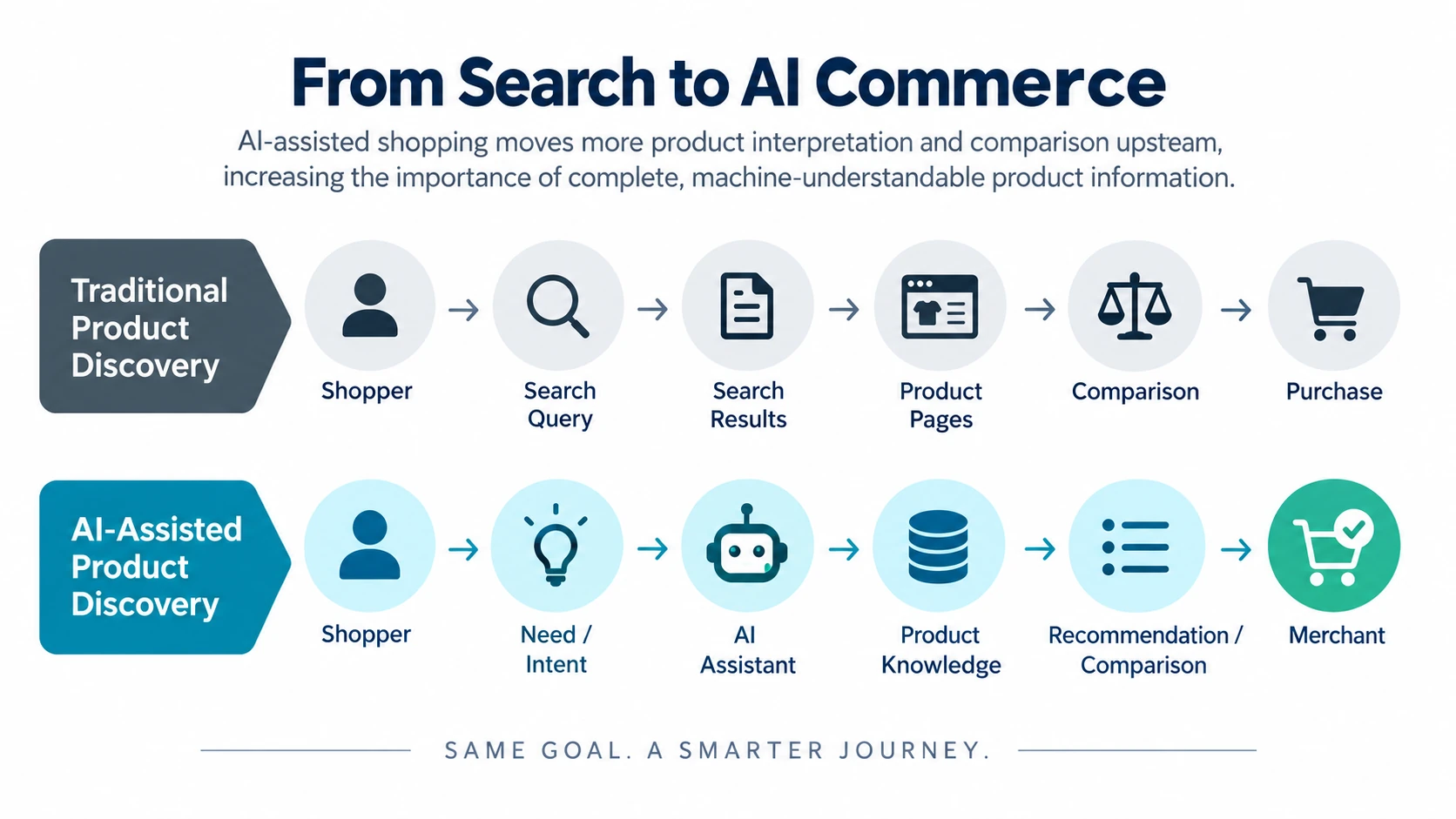
Traditional search primarily helped consumers find pages. AI-assisted shopping is increasingly helping consumers evaluate choices, compare products and narrow a purchase decision.
For retailers preparing for the holiday rush, that creates an important new question:
When an AI system is asked to find a product like yours, does it have enough accurate, structured and accessible information to understand why your product belongs in the answer?
That is the foundation of AI Commerce readiness.
AI-Assisted Shopping Is Moving Into the Mainstream
AI-powered commerce is no longer limited to experimental chatbots or future-looking demonstrations.
OpenAI has expanded shopping inside ChatGPT to support richer product discovery, conversational refinement and side-by-side comparison. Its commerce infrastructure also gives merchants and commerce providers ways to supply product information into AI-assisted shopping experiences.
Google is moving in the same direction. Merchant Center has introduced AI-oriented reporting and product-data guidance designed to help merchants understand how products are represented across emerging AI discovery surfaces.
The implications are significant.
AI is beginning to occupy a position between the shopper and the merchant that was previously dominated by search engines, marketplaces, comparison sites and retailer websites.
That does not mean those channels disappear. It means retailers now have another discovery layer to prepare for.
Search Is Becoming a Conversation
Traditional ecommerce acquisition has largely been organized around queries.
A customer enters a few keywords: waterproof hiking boots, laptop backpack, gifts for golfers, winter jacket women, 65-inch television.
The search engine returns options. The shopper then does much of the interpretation. They open several pages, read descriptions, compare specifications, check reviews and decide which products appear to meet their needs.
AI-assisted shopping can change that interaction. Instead of forcing the consumer to translate a need into a series of keywords, an AI system can accept the need itself.
“I need a holiday gift for my father. He plays golf every weekend, already has clubs, travels frequently and I want to spend less than $150.”
That request contains several signals: recipient, activity, existing product ownership, lifestyle, budget and gifting intent. The AI system can use those constraints to identify possible solutions and refine them conversationally.
“Nothing personalized because I need it delivered next week.”
Now fulfillment and customization become part of the decision. The shopper has not simply searched for a product. They have described a problem. Increasingly, AI systems are being designed to help solve it.
Your Product Page Was Written for People. AI Needs More.
Most ecommerce content was created with two audiences in mind: humans and traditional search engines. AI Commerce adds a third audience: machines trying to understand the product itself.
Imagine a product page for a piece of luggage. The page may say: “Built for your next adventure. Our newest premium travel companion combines sleek design with rugged performance for wherever the journey takes you.”
That may be acceptable marketing copy. But a shopper might ask an AI: “Which bags under $250 fit a 15-inch laptop, weigh less than seven pounds and have a separate shoe compartment?”
Can the AI confidently determine whether that product qualifies? Only if those facts are available and understandable.
It may need to identify dimensions, weight, price, laptop capacity, compartment configuration, material, warranty, available colors, inventory, shipping availability, customer ratings, intended use and product variants.
The more ambiguous or fragmented that information is, the harder it can be for an AI system to confidently include the product in an answer.
This is why AI Commerce readiness starts well before implementing an AI chatbot. It starts with the information architecture of commerce.
Being Online Does Not Automatically Mean Being AI Ready
A retailer may have an excellent ecommerce website, strong SEO, a complete merchant feed, sophisticated paid media, a healthy CRM database, robust lifecycle marketing and years of product content—and still have substantial AI Commerce readiness gaps.
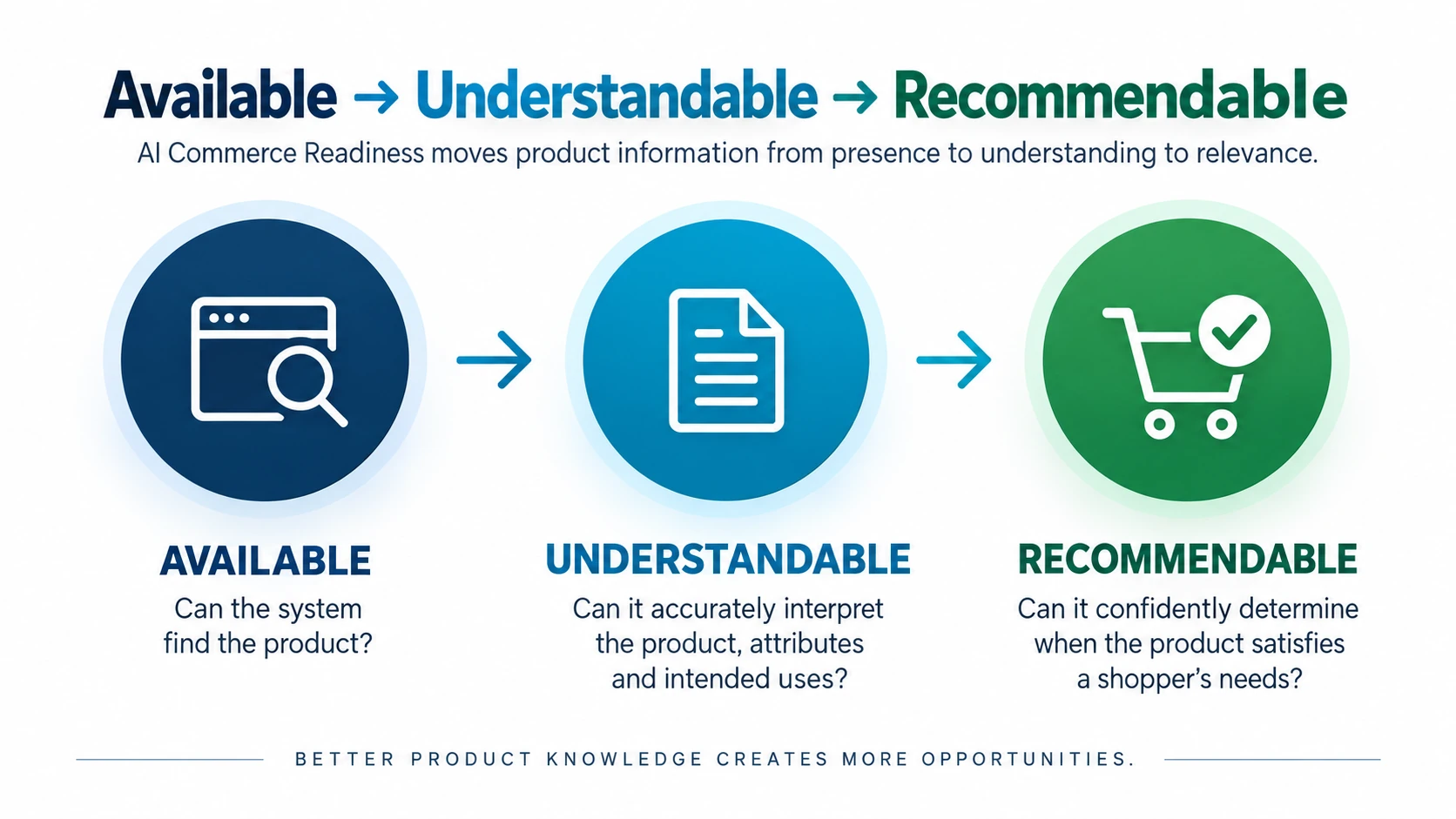
Why? Because being available on the web is different from being completely understandable by an AI system.
1. Available
The product exists online and can be discovered.
2. Understandable
The system can accurately determine what the product is, its attributes, its availability and the needs it satisfies.
3. Recommendable
The system has enough reliable information to determine that the product is an appropriate answer to a particular consumer need.
That distinction will become increasingly important. A product may rank well for a traditional keyword and still be poorly represented when a consumer gives an AI assistant a complex set of constraints.
Availability does not guarantee understanding. And understanding does not automatically guarantee recommendation.
AI Commerce Is a Data Problem Before It Is an AI Problem
There is a tendency to assume that preparing for AI Commerce requires an AI implementation project. For many organizations, the first problems are much more fundamental.
They involve questions such as:
- Are product attributes complete?
- Are important specifications structured or buried inside marketing copy?
- Do product feeds agree with the website?
- Can variants be clearly distinguished?
- Are pricing and inventory signals current?
- Can machines determine product compatibility?
- Are important differentiators represented as data?
- Does the product content answer the types of questions consumers actually ask?
- Are product relationships explicit?
- Can the organization measure traffic and activity originating from emerging AI discovery channels?
These are commerce architecture, data quality, content and measurement questions. AI simply makes them more visible.
Holiday Shopping Raises the Stakes
Seasonal commerce compresses consumer decision-making into a relatively short window.
During that period, shoppers are particularly interested in price, promotions, availability, delivery dates, gift suitability, product comparisons, alternatives, reviews, sizing, compatibility and returns.
Those happen to be exactly the kinds of multi-factor questions conversational AI is well positioned to help answer.
“What are the best educational gifts under $75 for an eight-year-old that can arrive before December 20?”
“Find me a television similar to this one, but under $900, with better performance in a bright room.”
“Which of these three coffee makers would be best for someone who makes one cup every morning and does not want to use pods?”
For a merchant, the question becomes: Does our commerce data provide enough context for an AI system to participate accurately in those conversations?
Discovering the answer in late November is not an ideal strategy.
AI Commerce Readiness Goes Beyond Product Feeds
Product data is central, but it is only one part of the equation. A meaningful AI Commerce readiness review should consider several connected areas.
Product and Catalog Data: Can machines accurately understand your catalog, variants, specifications, inventory and pricing?
Semantic Product Knowledge: Can your product data explain not only what something is, but also when, why and for whom it is appropriate?
Technical Discoverability: Can AI and search systems reliably access and interpret your commerce content, structured data and feeds?
Content and Merchandising: Does product content answer real purchase questions, communicate differentiation and provide enough information for comparison?
AI and Agent Accessibility: How is your organization positioned for emerging commerce protocols, merchant feeds, AI discovery systems and agent-mediated transactions?
Measurement and Attribution: Can you determine when AI-driven experiences are influencing discovery, traffic or revenue?
Governance: Who is responsible when product descriptions, feeds, structured data, pricing systems and AI-facing information disagree?
These areas form the foundation of an AI Commerce Readiness Assessment.
Start by Asking AI the Questions Your Customers Will Ask
One useful exercise requires no major implementation. Start testing your own catalog through the lens of a customer.
Do not ask, “Does AI know our brand?” Ask, “What would a shopper actually ask when deciding whether to buy one of our products?”
Build realistic prompts around budget, product use, compatibility, occasion, dimensions, materials, performance, customer type, alternatives and delivery requirements.
Then examine the results.
- Does your brand appear?
- Are the right products identified?
- Are important specifications correct?
- Are competitors represented more clearly?
- Are your strongest differentiators visible?
- Is outdated information being used?
- Are there questions the AI cannot confidently answer about your products?
Those gaps are useful signals. They begin to show the difference between having product information and having AI-ready product knowledge.
The Goal Is Not to Chase an Algorithm
Retailers have spent years adapting to changes in search, social media, marketplaces and advertising platforms. AI Commerce should not become another exercise in chasing an opaque ranking algorithm.
The better objective is much more durable: Make your commerce information complete, accurate, structured, accessible and useful enough that both people and machines can understand what you sell.
That work has value regardless of which AI platform ultimately mediates the transaction.
Better product knowledge can improve search visibility, onsite search, merchandising, customer service, personalization, feed quality, marketplace syndication, recommendation systems, paid media and analytics.
AI Commerce readiness therefore should not be treated as an isolated AI initiative. It is an extension of good digital-commerce architecture.
Do Not Wait for Peak Season to Find the Gaps
The holiday season puts pressure on every part of the commerce ecosystem. Traffic increases. Inventory changes rapidly. Promotions become more complex. Shipping deadlines matter. Consumers compare more options. And increasingly, some of those consumers will rely on AI to help make sense of those choices.
Retailers do not need to predict exactly how large AI-assisted commerce will become this holiday season to justify preparing for it. They need to answer a much simpler question:
If an AI system tried to understand and recommend our products today, what would it find?
That answer establishes the baseline.
An AI Commerce Readiness Assessment examines the product data, content, technical architecture, discoverability, measurement and operational processes that influence how well a commerce business is positioned for AI-assisted discovery.
The objective is not to bolt AI onto the storefront. It is to understand where the business stands today, identify material gaps and create a prioritized roadmap for becoming more machine-understandable before AI-mediated shopping becomes another critical commerce channel.
Recent Comments