
A broken promotion. An incorrect price. An out-of-stock product still being advertised. A checkout defect. A missing shipping deadline. A product page that leaves an important question unanswered.
In traditional ecommerce, those problems can cost conversions. In AI-assisted commerce, they can also affect whether a product is understood, considered or recommended at all.
That is why seasonal preparation now needs to include a new question: Is our commerce ecosystem ready to represent our products accurately when shoppers use AI to discover, compare and decide what to buy?
You do not need to rebuild your technology stack before the holiday season. You do need to know where the most important gaps are.
This checklist is designed to help.

Start With the Products That Matter Most
Do not begin with the entire catalog. Start with the products most likely to influence seasonal performance:
- holiday best sellers
- promotional products
- high-margin products
- giftable products
- new products
- products with significant paid-media support
- products with historically strong seasonal demand
The objective is simple: if an AI system tries to evaluate these products during peak season, can it find accurate enough information to understand and recommend them?
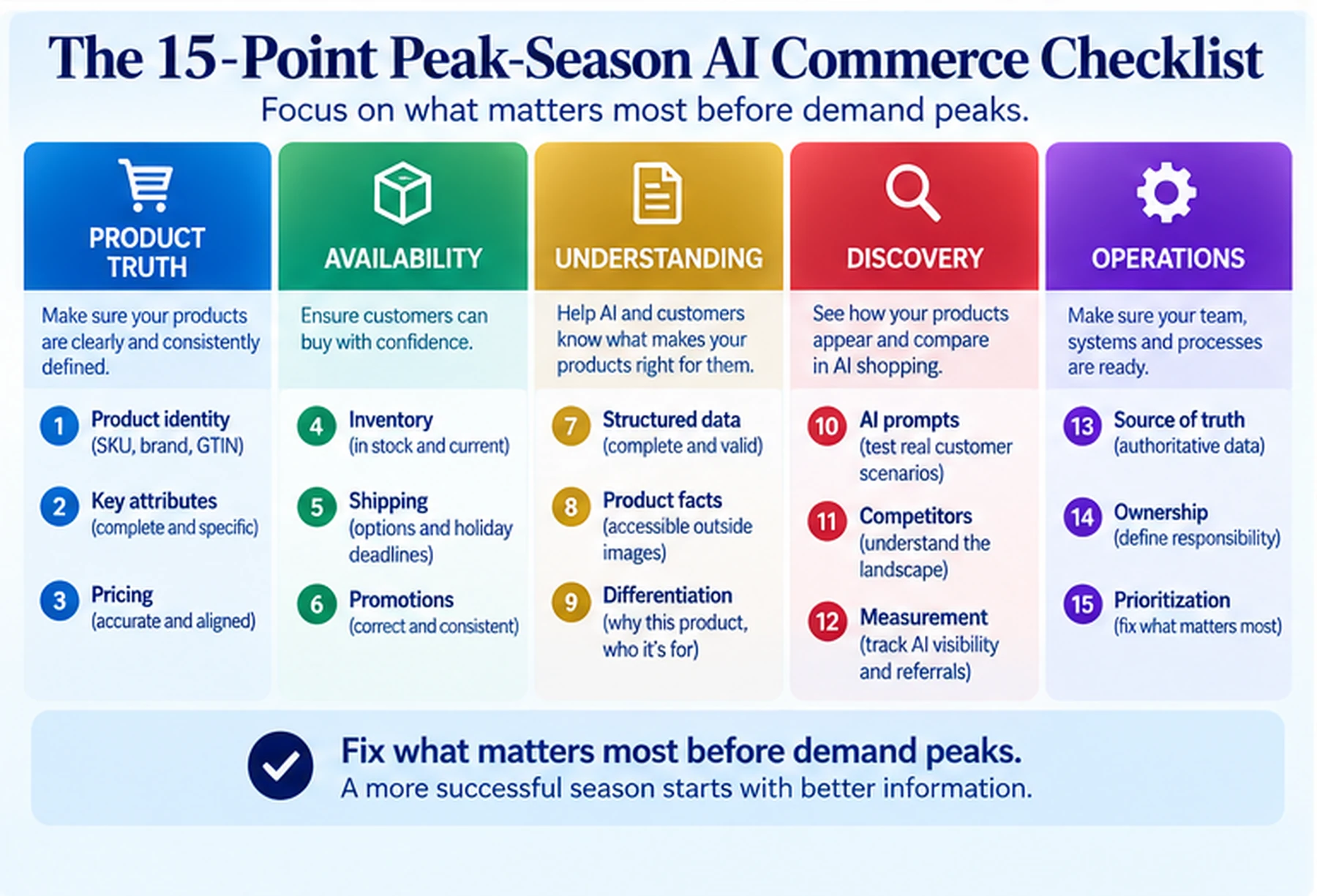
1. Validate Product Identity
Every product needs a clear identity across the commerce ecosystem.
Review SKU, brand, GTIN/UPC/EAN where applicable, manufacturer part number, parent product, variants and product group relationships.
Ask: Does the same product look like the same product everywhere?
Trace 20–50 priority products across the website, commerce platform, product feed, PIM, marketplace listings and structured data. Correct mismatched identifiers before peak traffic arrives.
2. Check the Attributes Customers Actually Use
Required feed fields are not necessarily the same as useful product knowledge.
For each priority category, identify the 10–20 attributes most likely to affect purchase decisions, measure coverage, and correct missing, generic or inconsistent values.
Specificity creates understanding: “Material: Recycled nylon” is more useful than “Material: Premium.”
3. Reconcile Price and Availability
Holiday inventory and promotions change quickly. Compare product-page price, promotional price, merchant-feed price, structured-data price, inventory state and availability.
Create automated or scheduled checks for priority products covering Price → Promotion → Inventory → Availability. Increase monitoring during major promotional events.
4. Verify Shipping and Fulfillment Information
Holiday shoppers care about whether a product will arrive in time.
Confirm shipping options, estimated delivery dates, pickup availability, local inventory, free-shipping thresholds, expedited eligibility and holiday cutoff dates.
Represent important cutoff dates clearly in visible text and keep customer-facing and machine-facing channels consistent.
5. Review Structured Data
Review Product and Offer structured data for name, description, SKU, brand, identifiers, price, currency, availability, ratings, shipping, returns and variants.
Run representative priority-product URLs through the appropriate validators. Fix missing required fields, invalid markup, stale values, duplicate properties and variant problems.
Treat schema as a product-data interface, not a one-time SEO implementation.
6. Make Important Product Facts Accessible Outside Images
Holiday creative often introduces promotional graphics, comparison charts, gift guides, size charts, feature callouts and shipping notices.
If a fact materially influences suitability, represent it in accessible page text, structured product attributes or both. The image should reinforce the information, not be its only source.
7. Review Product Copy for Actual Purchase Questions
Holiday shoppers ask practical questions: Will this fit? Is this appropriate for a beginner? Is this compatible? What is the difference? Is this good for a gift? How quickly can I get it?
For each priority product category, identify the ten most common purchase questions and verify that your content can answer them. Add FAQs, comparisons, specifications, use cases or buying guidance where needed.
8. Clarify Product Differentiation
If five products appear almost identical in your product data, an AI system has little basis for deciding which one fits the shopper best.
For major product families, answer: Why would a shopper choose Product A instead of Product B?
Move meaningful differentiation out of internal merchandising knowledge and into commerce content and data.
9. Test Real Customer Prompts
Test realistic shopping questions rather than branded prompts.
Record whether your brand appears, which products and competitors appear, whether facts are correct, which attributes are cited and what seems to be missing.
Create a repeatable prompt set and rerun the same scenarios periodically to establish a discovery baseline.
10. Look at Competitors Through the Same Lens
AI readiness cannot be evaluated only internally because recommendation sets are competitive.
Select three to five competitors per priority category. Compare which brands appear, which products are selected, what attributes are highlighted and whether competitor product information is richer or clearer.
The objective is not imitation. It is identifying information gaps that may affect recommendation confidence.
11. Confirm AI Referral Measurement
Review source/medium handling, referral-domain rules, channel grouping, landing-page performance, product-level conversion and assisted conversion behavior.
Create an AI/referral reporting view before peak traffic. Do not wait until after the season to discover that useful history was grouped into Referral or Other.
12. Establish a Baseline for AI Visibility
Referral traffic alone does not measure discovery.
Track representative prompts and record brand inclusion, product inclusion, factual accuracy, competitor inclusion, recommendation language and recurring gaps.
Capture the baseline before major holiday promotions begin, then repeat the tests throughout the season.
13. Identify the Authoritative Source for Product Truth
When information conflicts, define which system is authoritative for product identity, description, specifications, price, inventory, promotions, shipping and images.
Document how those values propagate downstream. The answer to a discrepancy should never be “it depends who you ask.”
14. Assign Ownership Before Problems Occur
Define responsibility for catalog corrections, feed problems, schema defects, inventory discrepancies, pricing issues, content changes, analytics and AI visibility monitoring.
Use a simple escalation path: Issue → Owner → Source of truth → Correction → Verification.
15. Prioritize the Gaps
You will probably identify more issues than can be corrected before peak season. Prioritize by Impact, Exposure, Urgency and Effort.
Fix Now: incorrect prices, broken availability, invalid schema, missing major attributes.
Improve Before Peak: missing comparisons, incomplete category attributes, weak variant relationships.
Plan Next: PIM modernization, product knowledge layers, commerce APIs and agentic checkout preparation.
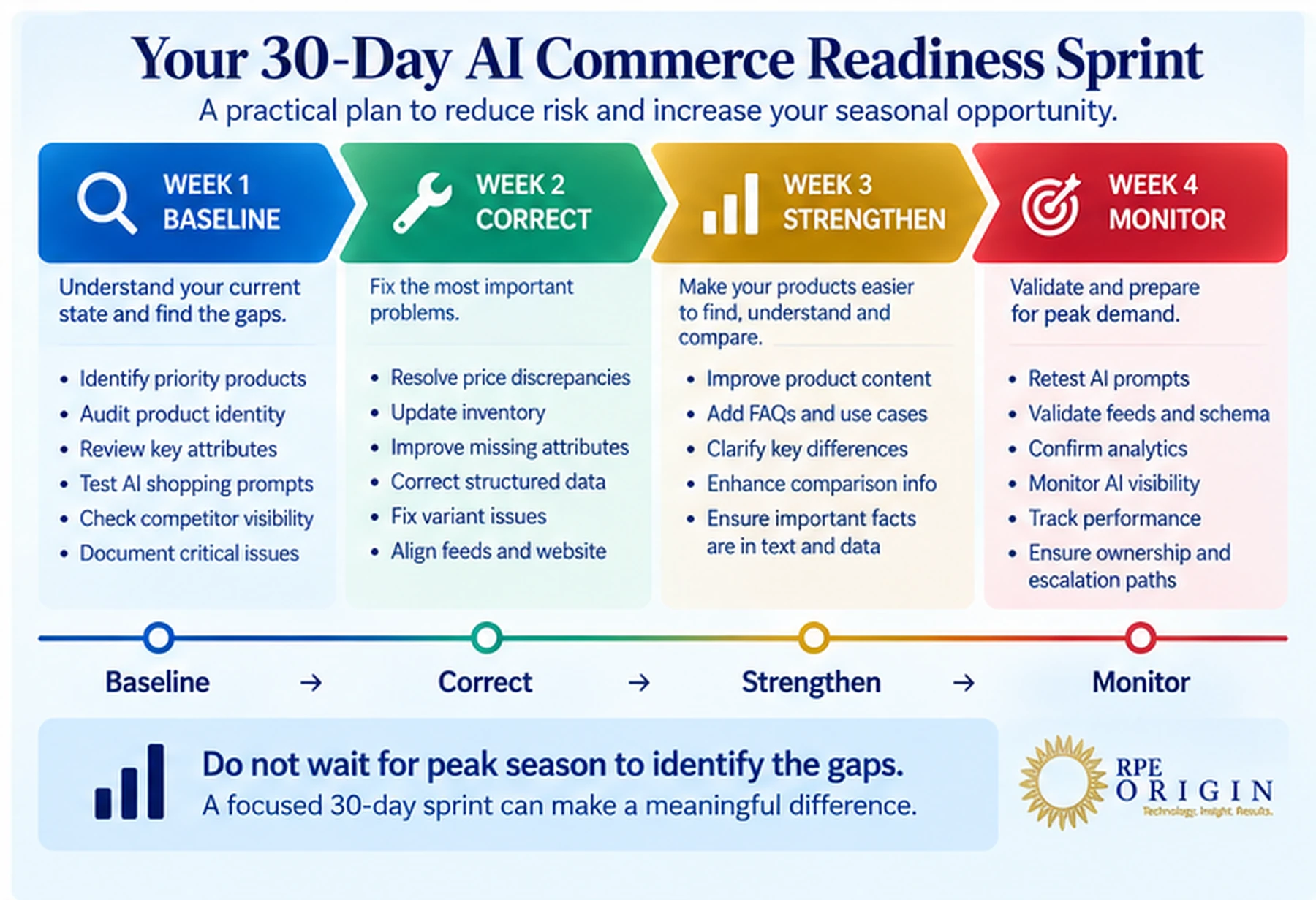
A 30-Day AI Commerce Readiness Sprint
Week 1 — Baseline
- identify priority products
- audit product identity
- test product attributes
- capture representative AI prompts
- document competitor visibility
- identify critical inconsistencies
Week 2 — Correct
- repair price and inventory discrepancies
- improve important attributes
- correct structured data
- resolve variant issues
- add missing product facts
Week 3 — Strengthen
- improve FAQs
- add comparison content
- clarify product differentiation
- expose use cases
- improve machine-readable product information
Week 4 — Monitor
- retest AI prompts
- validate feeds
- validate structured data
- confirm analytics
- confirm ownership
- establish peak-season monitoring
The goal is not perfection. The goal is to reduce preventable gaps before demand peaks.
Your Holiday Readiness Checklist
- ☐ Are priority products consistently identified across systems?
- ☐ Are important product attributes complete?
- ☐ Do the website, feeds and structured data agree?
- ☐ Are price and inventory current?
- ☐ Are shipping deadlines represented accurately?
- ☐ Are important product facts available as text or structured data?
- ☐ Can product content answer real shopping questions?
- ☐ Are meaningful product differences explicit?
- ☐ Have representative AI-shopping prompts been tested?
- ☐ Have key competitors been reviewed?
- ☐ Can AI referral traffic be identified?
- ☐ Has an AI-discovery baseline been established?
- ☐ Is the source of product truth documented?
- ☐ Does every major issue have an owner?
- ☐ Are the most important gaps prioritized?
If several of those questions are difficult to answer, that is useful information. It means the organization has identifiable readiness work to do.
Do Not Wait for the Holiday Rush to Become the Assessment
Peak season will reveal weaknesses. The question is whether they are discovered by your team first—or by customers.
AI Commerce adds another layer to seasonal preparation, but the objective is straightforward: make your products easier to find, easier to understand, easier to compare and easier to recommend.
That work strengthens not only AI Commerce. It strengthens commerce itself.
Establish Your Baseline Before Peak Demand
An AI Commerce Readiness Assessment from RPE Origin evaluates the product data, product knowledge, technical discoverability, content, agent accessibility, measurement and governance that influence AI-assisted commerce.
You receive a current-state baseline, documented gaps and a prioritized roadmap focused on practical improvements.
Recent Comments