
A commerce organization can improve product data, enrich product knowledge, remove technical barriers, strengthen merchandising, expose feeds and APIs to approved AI systems and build better measurement.
And still lose ground six months later.
The reason is straightforward: readiness degrades when no one owns it.
Products change. Prices change. Inventory changes. Feeds change. Platforms change. Teams change. Vendors change. APIs change. Content changes. AI discovery systems change.
Without defined ownership and operating discipline, yesterday’s accurate product representation can become tomorrow’s conflicting product truth.
That is the purpose of the seventh dimension in RPE Origin’s AI Commerce Readiness Assessment: Governance & Operational Readiness.
This dimension evaluates whether ownership, source-of-truth rules, change control, escalation and ongoing monitoring are defined.
It asks a question that is less technical than the previous dimensions but just as important: Who is responsible for keeping AI-facing commerce information accurate after the assessment is complete?
Readiness Is a State That Has to Be Maintained
AI Commerce readiness should not be treated as a one-time implementation milestone.
There is no practical point at which a retailer can declare that the catalog is now AI-ready forever and move on.
Commerce systems are dynamic. A product may be introduced today, repriced tomorrow and discontinued next quarter. A product-description template may change. A marketplace feed may be remapped. A PIM field may be renamed. A new category may introduce attributes the existing model does not support. A security rule may block a crawler. An API version may be deprecated.
Any of those changes can affect readiness even when the teams making the change have no intention of changing AI Commerce behavior.
That is why operational readiness is about preserving alignment over time. The organization needs an operating model capable of detecting when machine-facing product information begins to drift and a process for deciding who corrects it.
Governance provides that continuity.
Governance Starts With Ownership
One of the most common readiness problems is not missing technology. It is unclear responsibility.
Consider a product-price mismatch between a feed and the product page. Ecommerce may believe pricing owns the issue. Pricing may believe the feed-management vendor owns it. The vendor may believe the website team is publishing an old value. Everyone can be partially involved while no one is clearly accountable.
That ambiguity increases resolution time and encourages local fixes that may not address the underlying cause.
Governance begins by identifying clear ownership. That does not mean one team has to manage everything. It means each important capability has an accountable owner with the authority to make or coordinate a decision.
Product identity may belong to product-data operations. Pricing may belong to commerce operations or an ERP owner. Product content may belong to merchandising. Structured data may belong to ecommerce engineering. Product feeds may belong to channel operations. AI-facing integrations may belong to technology. Measurement may belong to analytics.
The assignments will vary by organization. The requirement is that they are explicit.
Ownership Is Different From Participation
Many AI Commerce issues are cross-functional, and that can make governance confusing.
A product-data issue may require merchandising, IT and ecommerce. A crawler-access problem may require SEO, engineering and security. An AI-referral classification issue may involve analytics and marketing.
That does not mean every participant should share equal accountability.
A useful operating model distinguishes among accountable owner, technical owner, content owner, approver, contributor and informed stakeholder.
Without that distinction, organizations can create committees that discuss problems extensively while leaving the actual decision unresolved.
AI Commerce governance should make it clear who decides, who implements and who must be consulted.
Source-of-Truth Rules Have to Be Explicit
The phrase source of truth is used frequently in commerce organizations. It is often much less precise than it sounds.
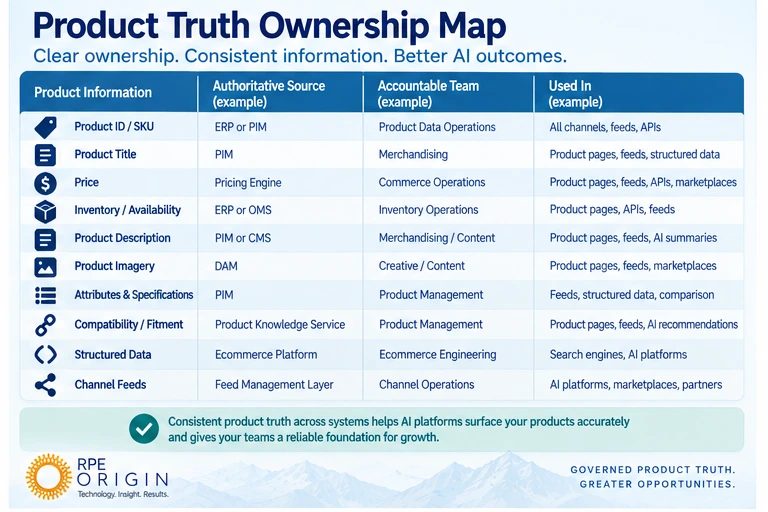
An organization may say the PIM is the source of truth, but that statement rarely applies to every field. The ERP may own price. An order-management system may own availability. The PIM may own product copy. A DAM may own imagery. A separate service may own compatibility. A feed-management layer may transform values for particular channels.
The more useful governance question is not “What is the source of truth?” It is “What is the authoritative source for each important class of product information?”
That creates field-level or domain-level ownership and prevents different systems from redefining the same fact independently.
A governance model should document both the authoritative source and the accountable team for information such as product ID, product title, price, inventory, description, imagery, attributes, compatibility, structured data and channel feeds.
Once that map exists, conflict resolution becomes much clearer. When two systems disagree, the organization knows which source wins and which downstream representation needs correction.
AI Makes Product-Truth Conflicts More Visible
Product-data conflicts existed long before AI Commerce. AI-assisted discovery simply makes them more consequential because external systems can combine evidence from several surfaces.
A human shopper who sees two different prices may recognize the inconsistency and investigate. An AI system may encounter a product page, a merchant feed, structured data and a marketplace record that do not agree and still need to decide what information to present.
That raises the value of coherent product truth across product pages, feeds, structured data, APIs, marketplaces, content and documentation.
Governance provides the mechanism for deciding which source is authoritative and how corrections propagate when conflicts appear.
Without that mechanism, teams can fix the same issue differently in several places and create another round of contradictions.
Change Control Is Part of AI Commerce Readiness
Most readiness defects are introduced by change rather than by intentional neglect.
A new product template removes a structured-data field. A feed transformation changes. A security rule begins blocking a crawler. A taxonomy update breaks a mapping. A content editor adds an unsupported product claim. An API change alters a response contract. A new merchandising tool starts writing values back to the catalog.
None of those changes may be described internally as an AI Commerce change. They can still affect how products are discovered, interpreted or transacted.
That is why readiness requires practical change control.
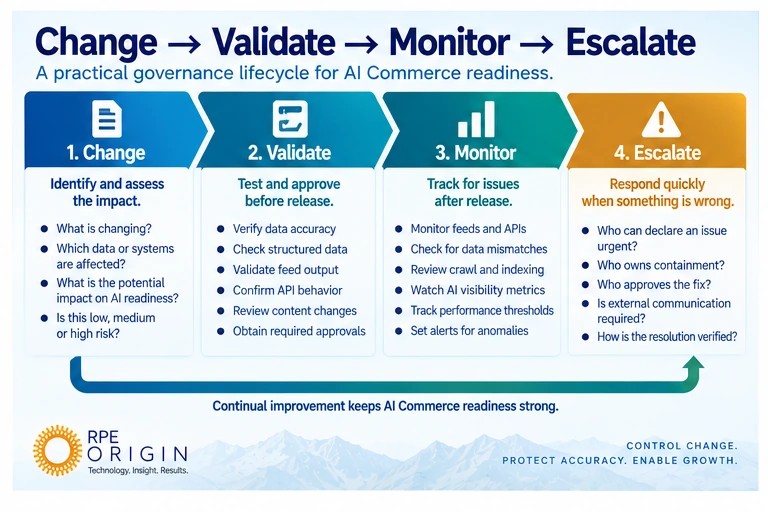
For significant changes, the operating model should ask what is changing, which data or systems are affected, whether the change can alter machine-facing product information, what must be validated before release and what should be monitored afterward.
This does not require heavyweight bureaucracy. The purpose is to introduce enough control that important downstream effects are considered before they become production problems.
Governance Should Be Proportional to Risk
Not every change needs the same review path.
Correcting punctuation in a product description does not carry the same risk as changing pricing logic. Replacing an image does not carry the same operational consequence as changing checkout APIs or product identity rules.
A practical governance model should classify changes by potential impact.
Low-impact changes may include editorial cleanup, non-material copy updates or straightforward asset replacements.
Medium-impact changes may include attribute-model changes, taxonomy updates, feed mappings, merchandising rules or comparison logic.
High-impact changes may include pricing logic, inventory integration, product identity, structured-data templates, crawler-access rules, AI-facing APIs and checkout services.
The control should match the consequence. The objective is to protect product truth without creating unnecessary friction.
Escalation Paths Matter When Product Truth Is Wrong
Not every readiness issue can wait for the next sprint or backlog review.
A discontinued product may still be represented as available. A price may be materially wrong. A compatibility claim may create customer risk. An AI-facing endpoint may expose information outside its intended scope. A crawler may suddenly be blocked across the catalog. A feed may begin publishing corrupted data.
Those situations need defined escalation paths.
A mature operating model should identify who can declare an issue urgent, who owns containment, who can disable a feed or integration, who approves the corrective change and who verifies that the fix actually restored the intended state.
External communication may also matter in some cases. A vendor, marketplace, platform or customer-service team may need to be notified.
Without pre-defined escalation, organizations tend to negotiate responsibility while the incident is already happening.
Monitoring Turns Governance Into an Operating Discipline
Governance without monitoring is largely reactive.
The organization learns about problems only after a customer, partner, platform or employee happens to notice them.
A stronger operating model continuously observes the areas most likely to drift.
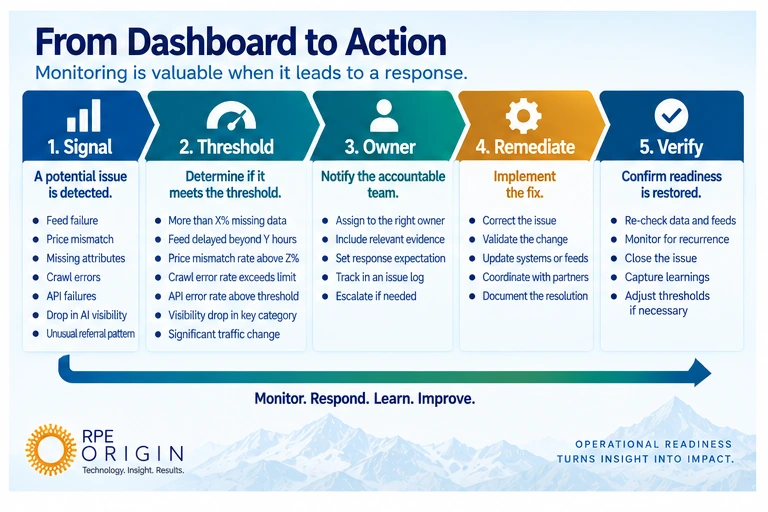
That may include feed failures, price mismatches, availability mismatches, crawl failures, structured-data errors, missing attributes, stale product records, API failures, changes in AI visibility or unusual referral patterns.
Not every organization needs sophisticated automation immediately. But every organization should know which signals indicate that readiness is deteriorating.
That question connects Governance directly to Measurement & Attribution. Measurement shows what is happening. Governance determines what happens next.
Monitoring Needs Thresholds, Not Just Dashboards
A dashboard can display a problem without causing anyone to act.
Operational readiness requires thresholds, ownership and response rules.
For example, the organization may decide that a feed delayed beyond a defined window requires investigation, that a price-mismatch rate above a threshold triggers escalation, or that a sharp drop in visibility for a priority category requires a review of recent data or technical changes.
The exact thresholds depend on the business, risk profile and normal operating baseline.
The important point is that monitoring should have an operational consequence. A signal should be tied to an accountable owner, a response expectation and a verification step.
Otherwise the organization can accumulate analytics without building a reliable response mechanism.
Governance Should Include Vendors and Partners
Modern commerce environments frequently depend on external providers: ecommerce platforms, agencies, PIM vendors, marketplace providers, feed-management tools, analytics vendors, development partners and AI platforms.
Governance has to account for those relationships.
If an agency controls a feed transformation, who approves changes? If a vendor changes an API, who evaluates the impact? If an external development team changes structured data, who validates it? If a platform introduces a new requirement, who monitors the announcement and decides whether action is necessary?
Responsibility for execution can be delegated. Accountability for the business outcome should not disappear.
Vendor governance is therefore part of AI Commerce governance, particularly where external partners control machine-facing product information or integration behavior.
Documentation Matters More Than It Appears
Many commerce systems work because a small number of experienced people know how they work.
That can create operational fragility.
If the person who understands a product-feed transformation leaves, does anyone else know which fields are mapped, which rules are custom, which systems are authoritative, which exceptions exist and which downstream channels depend on the transformation?
The same problem appears with structured data, API permissions, analytics classifications and merchandising logic.
Important readiness decisions should be documented. That can include source-of-truth rules, integration ownership, field mappings, access rules, monitoring thresholds, escalation paths, remediation decisions and known exceptions.
Documentation is not administrative overhead when it preserves operational continuity. It is part of readiness.
Governance Should Prevent Knowledge From Becoming Tribal
Semantic Product Knowledge introduces another governance challenge.
Important product knowledge may begin as expertise held by merchandising, product managers, customer service or sales. Those people know which product is appropriate for a particular use case, which accessories are compatible or why a premium model exists.
If that knowledge is never formalized, AI Commerce readiness remains dependent on individual people rather than durable systems.
The organization needs a mechanism for turning useful operational knowledge into governed product knowledge through product-attribute enrichment, compatibility models, FAQs, buyer guides, product relationships or comparison rules.
Governance determines who can create that knowledge, who validates it, which evidence supports it and how it is maintained when products change.
Without that process, product knowledge becomes tribal again.
Generative AI Needs Its Own Content Controls
As organizations use generative AI to draft product descriptions, summaries, FAQs, comparison content or merchandising copy, governance becomes even more important.
Generative AI can accelerate content production. It can also accelerate the publication of unsupported or inconsistent claims.
A generated statement may sound plausible while not being grounded in approved product evidence. If that statement is then reused across a product page, feed, marketplace listing or support answer, the error can spread quickly.
AI-generated commerce content should therefore operate within defined controls around approved source data, factual validation, review, publication authority and versioning.
The governing principle remains the same as the rest of the RPE Origin framework: Reliable AI recommendations start with governed product truth.
The same standard should apply to the content created with AI.
Governance Has to Cross Organizational Boundaries
AI Commerce does not sit neatly inside one department.
It touches ecommerce, merchandising, product management, marketing, IT, engineering, analytics, SEO, security and customer service.
That creates an operating-model challenge, but it does not necessarily require creating a separate AI Commerce department.
Many organizations can govern readiness through an existing cross-functional structure as long as the model has real accountability.
A practical structure may include an executive sponsor who provides direction and resolves organizational blockers, an AI Commerce program owner who maintains the readiness baseline and coordinates priorities, dimension owners who own remediation within functional areas, technical owners who manage systems and integrations, and an analytics owner who governs measurement definitions.
The structure can scale to the size of the organization. The essential requirement is that ownership survives beyond the assessment itself.
A RACI Can Be Useful—If It Reflects Reality
A RACI matrix can be useful for clarifying who is Responsible, Accountable, Consulted and Informed.
But the document itself is not the outcome.
If the organization creates a polished RACI that does not reflect how decisions actually happen, the governance problem remains.
The useful test is operational: when something breaks on a Monday morning, does everyone know who has authority to contain the issue, who fixes it and who verifies the result?
If the answer is no, the governance model still needs work.
What Governance & Operational Readiness Gaps Look Like in Practice
A readiness assessment may identify findings such as no single owner for AI Commerce readiness, conflicting source-of-truth assumptions, undocumented field ownership, feed changes occurring without downstream validation, no process for reviewing platform requirement changes, AI-generated content lacking factual review, monitoring without thresholds or unclear incident escalation.
Other findings may include ambiguous vendor responsibilities, product knowledge that depends on individual employees, AI visibility reporting that is reviewed inconsistently or remediation work that is not tracked after the assessment.
These findings are not glamorous, but they often determine whether improvements last.
Without operational ownership, the organization can repeatedly solve the same problems. With clear governance, the fixes become part of the operating model.
What Evidence Does the Assessment Examine?
For Governance & Operational Readiness, the evidence can include organizational ownership, system ownership, data stewardship, source-of-truth documentation, change-management procedures, release controls, escalation paths, monitoring processes, incident-response procedures, vendor responsibilities, content-approval workflows, AI-generated content policies, analytics governance, remediation tracking and documentation quality.
Interviews are especially important in this dimension because operational conflicts are not always visible in technical artifacts.
Two teams may both believe they own the same field. Or each may believe the other team owns it. A vendor may be performing a critical transformation that internal teams do not fully understand. A dashboard may exist but have no assigned responder.
Those gaps emerge through evidence about how the organization actually works, not just how the architecture diagram says it works.
The assessment should therefore compare documented responsibility with observed responsibility.
Governance Is What Keeps the Other Six Dimensions Working
The seventh dimension is different from the first six.
It does not introduce another product-data field, technical integration or measurement technique. It provides the operating system for everything else.
Without governance, product data drifts. Product knowledge becomes inconsistent. Technical access breaks. Content becomes outdated. APIs accumulate risk. Measurement loses definition.
With governance, those capabilities become maintainable.
That is why Governance & Operational Readiness is not the final administrative step in the framework. It is what makes the framework sustainable.
From Seven Dimensions to the Assessment Process
The seven readiness dimensions answer one core question: What does RPE Origin evaluate?
- Product & Catalog Data
2. Semantic Product Knowledge
3. Technical Discoverability
4. Content & Merchandising
5. AI & Agent Accessibility
6. Measurement & Attribution
7. Governance & Operational Readiness
That completes the first half of the deeper AI Commerce Readiness in Practice series.
The next five articles answer a different question: How does the assessment actually work?
The process is: Discover → Assess → Baseline → Prioritize → Roadmap.
Article 8 therefore transitions from the dimensions themselves to the first assessment phase: Discover – What an AI Commerce Readiness Assessment Needs to Understand First.
Who Owns AI Commerce Readiness After the Initial Improvements Are Made?
Product data, content, technical access and measurement all change over time. Without clear ownership, source-of-truth rules, change controls and monitoring, readiness can deteriorate quickly. An AI Commerce Readiness Assessment can help identify where operational accountability is strong, where governance gaps exist and what needs to be established to sustain progress.
Recent Comments