
The first four dimensions of AI Commerce readiness focus primarily on whether a product can be represented well enough to be found, understood and evaluated. Product data establishes factual truth. Semantic product knowledge adds context. Technical discoverability makes that information reachable. Content and merchandising help translate those facts into a useful decision experience.
That is foundational.
But emerging AI Commerce experiences introduce another question: What happens when an AI system needs to interact with the commerce environment rather than simply read from it?
An AI assistant may need current product information. It may need to retrieve availability, understand shipping options, compare promotions, create or update a cart, initiate checkout or participate in post-purchase workflows.
Those interactions require something more than well-structured product pages. They require controlled access to commerce data and capabilities.
That is the purpose of the fifth dimension in RPE Origin’s AI Commerce Readiness Assessment: AI & Agent Accessibility.
This dimension evaluates whether commerce information and capabilities can be exposed safely through feeds, APIs and emerging agentic-commerce integration patterns.
The central question is: Can an AI system access what it needs without being given access to more than it should have?
Discovery Access and Transaction Access Are Different Problems
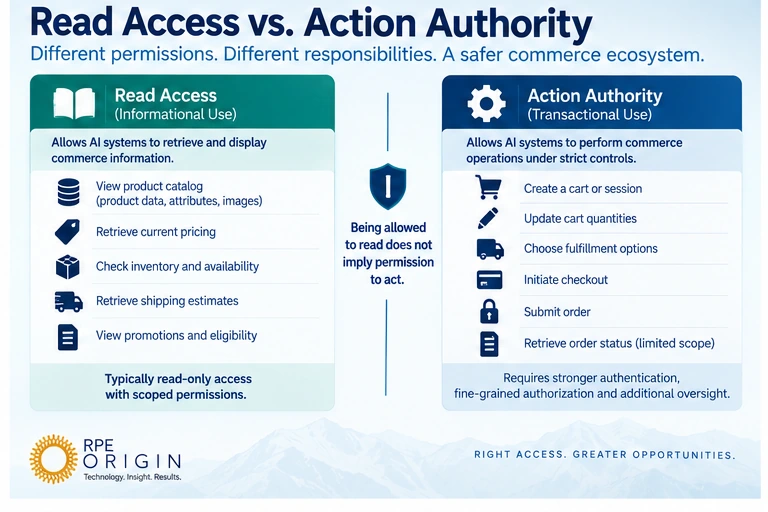
One of the most important distinctions in agentic commerce is the difference between reading commerce information and taking commerce actions.
A product feed is primarily informational. It can provide product identity, descriptions, pricing, availability, imagery, variants and fulfillment information. That helps an AI system understand the catalog and present products accurately.
A transactional integration is different. It may allow an agent to create a cart or checkout session, update quantities, choose fulfillment options, calculate tax, submit buyer information, initiate payment or place an order.
Those actions carry substantially different security, operational and governance implications.
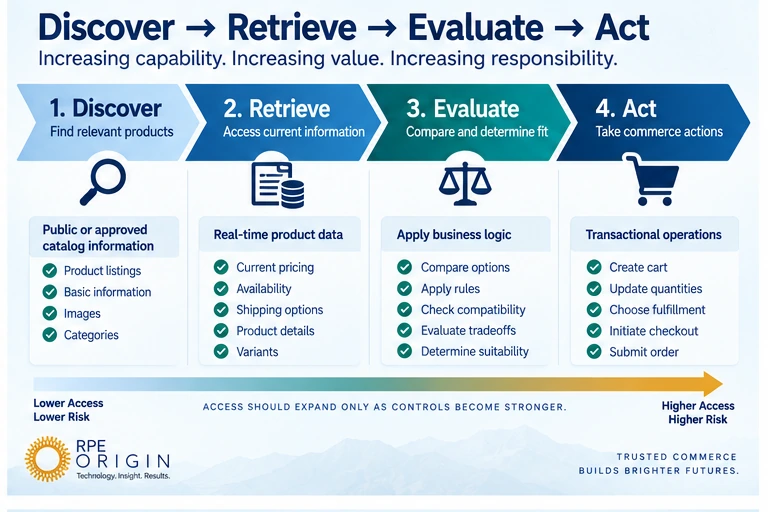
An AI Commerce readiness assessment should therefore avoid treating “AI access” as a single capability. A more useful model is a progression: Discover → Retrieve → Evaluate → Act.
At Discover, a system may only need public or approved catalog information. At Retrieve, it may need current price, inventory, shipping or promotion data. At Evaluate, business logic may be applied to compatibility, eligibility, availability or tradeoffs. At Act, the integration can begin changing commerce state.
Each stage can create more value, but each stage also introduces more responsibility. Access should expand only as the underlying controls become strong enough to support it.
Product Feeds Are Often the First Integration Layer
For many commerce organizations, the most practical entry point into AI Commerce is not an autonomous purchasing agent. It is a structured product feed.
OpenAI’s current Agentic Commerce documentation recommends starting an ACP integration by sharing a structured product feed. OpenAI states that feeds give ChatGPT catalog information needed to index products, understand core attributes and present accurate product information in shopping experiences.
That makes the product feed an important accessibility mechanism. The merchant is no longer relying only on a crawler to infer product meaning from web pages. It can provide an explicit representation of product identity, descriptions, images, price, availability and other relevant commerce facts.
But accessibility through a feed creates operational responsibilities. The feed needs to be complete enough to be useful, current enough to reflect the business, stable enough to support consistent identity and monitored closely enough to detect failures.
OpenAI currently recommends a full feed snapshot on a regular cadence and supports API-based updates for products and promotions. Its guidance specifically emphasizes keeping price and inventory fresh.
That means feed accessibility is not merely a one-time connectivity milestone. A feed that can be delivered but cannot be maintained is not a mature commerce capability.
APIs Add Flexibility—and More Responsibility
File-based feeds are efficient when the main requirement is distributing a current catalog snapshot. APIs become more useful when product state changes frequently or when interactive commerce capabilities need to be exposed.
OpenAI’s current Agentic Commerce API supports feed creation, product retrieval, partial product upserts and promotion updates. That model lets merchants change only the affected records instead of rebuilding a complete catalog every time a product or promotion changes.
The architectural benefit is obvious. Availability, pricing and promotional information can be propagated more quickly.
But API access introduces a broader readiness surface.
How is the caller authenticated? Can permissions be scoped? Where are credentials stored? Is each request traceable? Are rate limits appropriate? Are operations idempotent? What happens if the API is unavailable? How are retries handled? Can an erroneous integration be disabled quickly? Is production isolated from testing?
These are not new AI-specific engineering concepts. They are mature integration and platform-governance disciplines.
AI Commerce creates another consumer of those services, and therefore another reason to determine whether those disciplines are actually in place.
Agentic Commerce Extends Beyond Product Discovery
The more consequential change occurs when an AI system moves beyond discovery and starts participating in a transaction.
OpenAI’s current Agentic Commerce documentation includes product-discovery infrastructure and separately enabled checkout capabilities for approved partners. In its checkout model, the AI experience may gather buyer and fulfillment information while the merchant remains responsible for validating commerce state, determining fulfillment, calculating tax, managing risk, processing payment and accepting or declining the order.
That division of responsibility is important.
The AI interface can mediate part of the shopping journey without replacing the merchant’s commerce platform or business logic.
From a readiness perspective, this changes the role of the backend. Instead of serving only a storefront, mobile application or marketplace connector, the commerce platform may need to serve an additional machine-mediated interaction channel.
The stronger the existing service boundaries are, the easier it becomes to support that new channel without creating a parallel transaction stack.
Google Is Moving Toward the Same Interaction Model
Google’s Universal Commerce Protocol, or UCP, illustrates the same broader direction.
Google describes UCP as an open standard for agentic commerce that allows agents and systems to work together across the shopping journey from discovery and purchase through post-purchase support. Its Merchant Center guidance says the protocol can support programmatic exchanges through APIs and compatible agent protocols and can enable capabilities such as checkout on eligible experiences in AI Mode and Gemini for participating merchants.
Google also states that participating merchants remain the seller of record and can preserve merchant-specific checkout requirements.
The terminology and implementation model differ from OpenAI’s Agentic Commerce Protocol, but the architectural direction is similar.
Commerce platforms are increasingly exposing standardized interfaces through which AI-driven systems can interact with merchant capabilities.
For retailers, that changes the readiness conversation. The question is no longer only “Can an AI system find our products?” It becomes “Which commerce capabilities are we prepared to expose programmatically, under what conditions and with what controls?”
Accessibility Does Not Mean Open Access
The phrase AI & Agent Accessibility can easily be misunderstood.
Accessibility does not mean opening commerce systems indiscriminately. It means exposing the right capability to the right system with the right permissions.
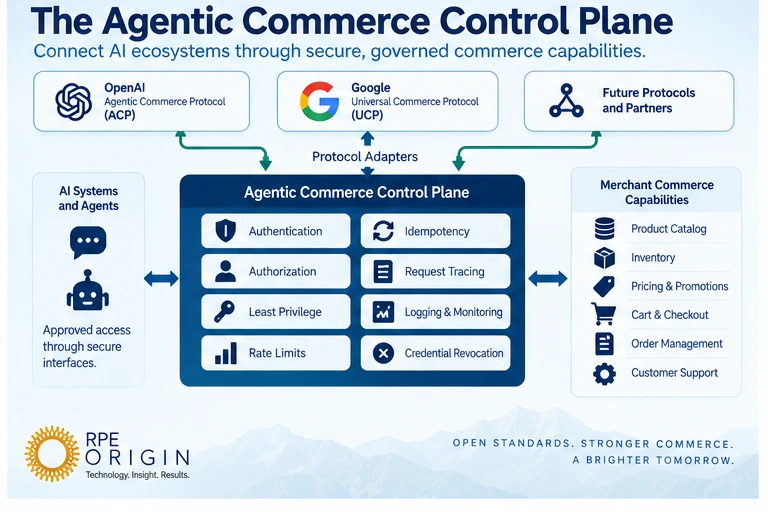
A mature integration should use familiar enterprise controls: authentication, authorization, least privilege, credential management, rate limiting, logging, monitoring, tracing, environment separation and clean revocation.
A product-feed consumer may only require read access to approved catalog fields. A pricing consumer may need current commercial values but no customer data. A checkout integration may need the ability to create a short-lived commerce session without receiving broader administrative authority.
Those boundaries matter because a technically capable API is not automatically an appropriate agent-facing API.
The readiness question is not simply: Can the API do it?
It is: Should this actor be allowed to do it, under what scope, and how will the organization know what happened?
Read Access Should Be Separated From Action Authority
This distinction becomes especially important as commerce systems become more agent-accessible.
An AI system that can read inventory does not automatically need permission to reserve inventory. A system that can retrieve shipping estimates does not necessarily need permission to create a shipment. A system that can display a cart does not automatically need permission to submit an order.
Those functions should be treated as separate capabilities with separate authorization boundaries.
That separation limits the impact of compromised credentials, makes auditing easier and allows an organization to introduce agentic capabilities incrementally instead of granting broad access all at once.
It also gives business, security and governance teams a clearer approval model. Read access can often be approved earlier than transactional authority. Cart creation may be appropriate before order submission. Order status may be exposed without exposing payment data.
A readiness assessment should therefore examine capability boundaries, not merely whether an endpoint exists.
Being allowed to read does not imply permission to act.
Freshness Becomes More Important as Agents Move Closer to Transaction
A stale product description may be inconvenient. A stale availability signal at checkout can cause a failed transaction or create a poor customer experience.
As AI systems move from discovery toward action, tolerance for stale information decreases.
Different commerce facts also have different freshness requirements. A title or material description may change rarely. Price can change daily. Inventory may change continuously. Shipping availability can depend on location, time and fulfillment capacity. Promotions can begin or expire at precise moments.
An effective accessibility model needs to distinguish among those cadences.
This is one reason real-time service calls become more important as agentic interactions move closer to a transaction. Static catalog snapshots remain useful for discovery. They become less appropriate when the system has to make a decision based on the current operational state of the business.
The readiness question is therefore not simply whether an endpoint returns data. It is whether the endpoint returns data that is current enough for the decision being made.
Agentic Integration Requires Failure Handling
Traditional ecommerce already requires strong failure handling. Agent-mediated commerce makes that requirement more visible because the interface initiating the action may be outside the merchant’s direct control.
What happens if inventory changes during checkout? What if a requested shipping option becomes unavailable? What if tax calculation fails? What if a payment is declined? What if the agent retries the same request after a timeout? What if the original request actually succeeded?
These are ordinary commerce conditions, not edge cases.
OpenAI’s current Agentic Commerce API documentation includes idempotency keys and request IDs in the request model. Idempotency helps prevent duplicate operations when a request is retried, while request identifiers improve tracing and diagnostics.
Those mechanisms illustrate a broader readiness principle: connectivity is only the beginning.
An agent-facing integration needs predictable error semantics, safe retry behavior, traceable requests, timeouts, monitoring and a clear understanding of which operations can be repeated safely.
Agent accessibility must include operational resilience.
Merchant Control Still Matters
One misconception about agentic commerce is that the agent replaces the merchant’s business logic.
Current implementations point in the opposite direction.
OpenAI’s documented checkout model keeps validation, fulfillment, tax, risk analysis, payment processing and order acceptance in the merchant’s environment. Google’s UCP guidance similarly states that the merchant remains the seller of record and can retain merchant-specific checkout requirements.
That means the agent is another interface to commerce capabilities. It should not become a bypass around them.
A prepared merchant should be able to expose agent-facing functionality while preserving inventory controls, pricing rules, fraud protections, tax logic, fulfillment constraints, order validation and customer-service processes.
That is a safer and more durable architecture than creating a separate AI-specific transaction path with different rules.
Existing Commerce Services May Be More Valuable Than New AI Services
Many organizations already have APIs supporting product search, pricing, inventory, cart creation, checkout, customer accounts, order status or returns.
Those services may have been built for the ecommerce site, a mobile app, a marketplace integration, a call-center application or a partner portal.
That existing capability can become a significant advantage.
The organization may not need to rebuild commerce for AI. It may need to determine whether the services it already owns are stable, documented and appropriately governed for controlled external access.
That assessment includes practical questions: Is the contract stable? Can it support additional consumers? Are permissions granular enough? Does it expose internal implementation details unnecessarily? Can the service scale? Is observability sufficient? Are versioning and deprecation processes defined?
AI & Agent Accessibility therefore often becomes an API-maturity assessment as much as an AI assessment.
Protocol Support Should Not Become the Strategy
OpenAI has ACP. Google has UCP. Other protocols and integration patterns will continue to appear.
Organizations should understand those standards, but they should avoid designing their entire commerce architecture around whichever protocol is newest.
The more durable objective is to build clean internal commerce capabilities that can be exposed through appropriate adapters.
That means governed catalog data, reliable pricing services, accurate inventory interfaces, stable cart operations, controlled checkout services and well-defined order-management capabilities.
If those foundations exist, supporting a new external protocol becomes a translation problem rather than a reinvention of core commerce logic.
If they do not exist, protocol adoption can become a brittle point-to-point exercise where business rules and integration-specific exceptions accumulate at the edge.
AI Commerce readiness should therefore distinguish between protocol compliance and commerce capability maturity. The second is more important.
Not Every Merchant Needs Transactional Agent Access Yet
Another important readiness principle is proportionality.
A company does not need to implement agentic checkout simply because agentic commerce exists.
OpenAI currently limits some onboarding and checkout capabilities to approved partners, while Google’s UCP-powered checkout is also available to selected participating merchants and markets rather than universally.
That makes premature implementation a real risk. A retailer may get more near-term value from improving product feeds, API documentation, identifier consistency, access controls and observability than from attempting a full transaction integration immediately.
A readiness assessment should therefore separate what is necessary now from what should be prepared next and what can remain on the roadmap.
That keeps the work aligned to actual business opportunity rather than to technology novelty.
What AI & Agent Accessibility Gaps Look Like in Practice
A useful readiness assessment might identify findings such as product feeds that are technically available but updated too slowly, APIs that exist but are undocumented, catalog endpoints that expose more data than an external consumer needs or authentication models that are difficult to scope.
Other findings may include combined read and write permissions, weak separation between production and test environments, inventory APIs that cannot provide sufficiently current values, cart operations that are tightly coupled to the storefront UI, retry behavior that can create duplicate operations, requests that cannot be traced end to end or partner credentials that cannot be revoked cleanly.
Identity mismatches can also become significant. If the catalog feed, inventory service and checkout service use different product identifiers without a stable mapping, an agent-facing workflow can break even though each individual service appears healthy.
These findings are more actionable than simply concluding that the organization is “not ready for agents.”
Each gap points toward a specific architectural, security, data or governance improvement.
What Evidence Does the Assessment Examine?
For AI & Agent Accessibility, the evidence can span both informational and transactional layers.
That may include product-feed architecture, feed-update cadence, product APIs, pricing services, inventory services, cart endpoints, checkout services, authentication mechanisms, authorization models, API documentation, environment separation, rate limits, logging, tracing, idempotency controls, retry behavior, error models, partner-access policies, credential management and integration ownership.
The assessment does not need to exercise every production capability. Representative scenarios can reveal a great deal.
Can an approved external system retrieve current product availability without gaining unnecessary access to internal data? Can a price change propagate quickly enough to support a live commerce interaction? Can a cart be created through a documented service rather than UI automation? Can an agent-facing credential be revoked without affecting unrelated integrations? Can duplicate requests be recognized and handled safely?
These are capability tests.
They show whether the commerce platform is prepared to support machine-to-machine interaction under controlled conditions.
Accessibility Is a Capability, Not a Checkbox
An organization should not define success as “We implemented ACP” or “We connected to UCP.”
Those can be meaningful implementation milestones. They do not prove broader readiness.
The more durable capability is an architecture where product and commerce services can be exposed deliberately, securely and reliably to approved external systems.
That capability remains useful as protocols, platforms and distribution channels change.
The assessment therefore looks beyond individual integrations and asks whether the organization has built an operating model that can support the next integration without creating a new exception every time.
From Accessible Products to Observable Outcomes
At this point, the readiness model has moved substantially closer to actual AI-mediated commerce.
Product & Catalog Data establishes product truth.
Semantic Product Knowledge adds meaning.
Technical Discoverability makes the information reachable.
Content & Merchandising helps translate information into choice.
AI & Agent Accessibility determines whether systems can interact with commerce data and capabilities under appropriate controls.
But once those interactions begin, the organization needs to answer another question: Can we tell what is happening?
Can we observe AI-driven discovery? Can we distinguish AI referrals? Can we understand which products are being surfaced? Can we measure how those interactions contribute to engagement or revenue?
That leads to the sixth readiness dimension: Measurement & Attribution.
Is Your Commerce Architecture Ready for Controlled AI and Agent Access?
AI Commerce increasingly depends on structured feeds, reliable APIs and clearly defined capability boundaries. If product, pricing, inventory or checkout services cannot be exposed safely and predictably, emerging agentic experiences may be difficult to support without creating unnecessary operational risk. An AI Commerce Readiness Assessment can help determine which capabilities are ready today, which controls need strengthening and which agentic integrations belong on the roadmap.
Recent Comments